Jamaledin Rezvan, Di Natale Concetta, Onesto Valentina, Taraghdari Zahra Baghban, Zare Ehsan Nazarzadeh, Makvandi Pooyan, Vecchione Raffaele, Netti Paolo Antonio
Center for Advanced Biomaterials for Health Care, Istituto Italiano di Tecnologia (IIT@CRIB), 80125 Naples, Italy.
Department of Chemical, Materials and Industrial Production Engineering, University of Naples Federico II, 80125 Naples, Italy.
J Clin Med. 2020 Feb 17;9(2):542. doi: 10.3390/jcm9020542.
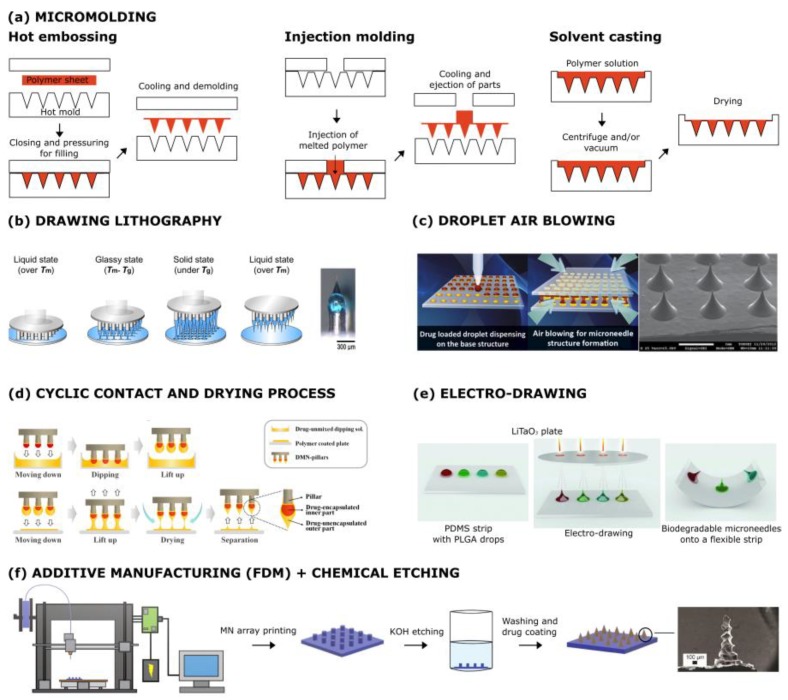
The growing demand for patient-compliance therapies in recent years has led to the development of transdermal drug delivery, which possesses several advantages compared with conventional methods. Delivering protein through the skin by transdermal patches is extremely difficult due to the presence of the stratum corneum which restricts the application to lipophilic drugs with relatively low molecular weight. To overcome these limitations, microneedle (MN) patches, consisting of micro/miniature-sized needles, are a promising tool to perforate the stratum corneum and to release drugs and proteins into the dermis following a non-invasive route. This review investigates the fabrication methods, protein delivery, and translational considerations for the industrial scaling-up of polymeric MNs for dermal protein delivery
近年来,对患者依从性疗法的需求不断增长,推动了透皮给药技术的发展,与传统方法相比,透皮给药具有诸多优势。由于角质层的存在,通过透皮贴剂经皮递送蛋白质极为困难,这限制了其应用于相对低分子量的亲脂性药物。为克服这些限制,由微/小型针组成的微针(MN)贴片是一种很有前景的工具,可穿透角质层并以非侵入性途径将药物和蛋白质释放到真皮中。本文综述了用于皮肤蛋白质递送的聚合物微针的制备方法、蛋白质递送以及工业放大生产的转化考量因素。