Babaie Soraya, Bakhshayesh Azizeh Rahmani Del, Ha Ji Won, Hamishehkar Hamed, Kim Ki Hyun
Biotechnology Research Center, Student Research Committee, and Faculty of Advanced Medical Science, Tabriz University of Medical Sciences, Tabriz 51368, Iran.
Stem Cell and Regenerative Medicine Institute, and Department of Tissue Engineering, Faculty of Advanced Medical Sciences, Tabriz University of Medical Sciences, Tabriz 51368, Iran.
Nanomaterials (Basel). 2020 Feb 17;10(2):341. doi: 10.3390/nano10020341.
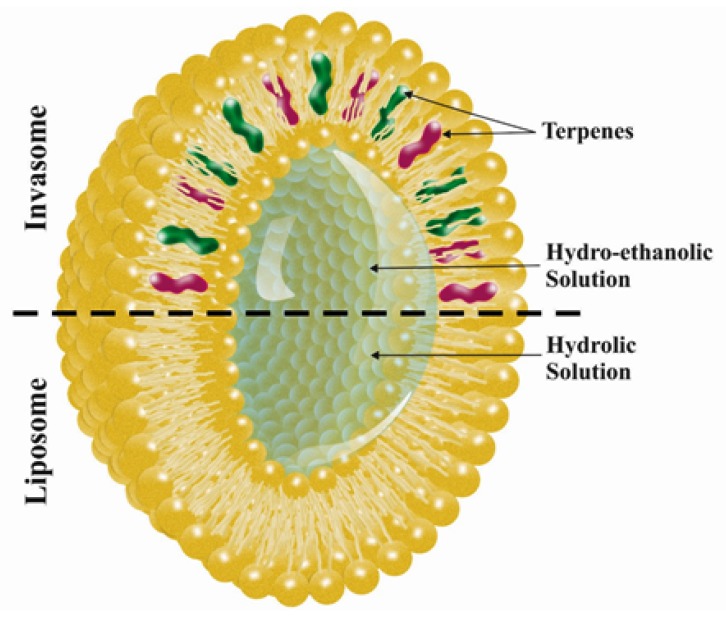
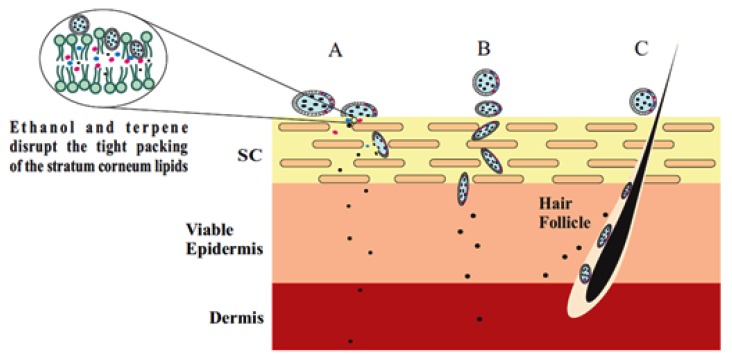
Invasomes are novel vesicular systems that exhibit improved transdermal penetration compared to conventional liposomes. These vesicles contain phospholipids, ethanol, and terpene in their structures; these components confer suitable transdermal penetration properties to the soft vesicles. The main advantages of these nanovesicles lie in their ability to increase the permeability of the drug into the skin and decrease absorption into the systemic circulation, thus, limiting the activity of various drugs within the skin layer. In this paper, several features of invasomes, including their structure, mechanism of penetration, applications, characterization, and potential advantages in dermal drug delivery, are highlighted. Overall, this review suggests that enhanced transdermal penetration of drugs using invasomes provides an appropriate opportunity for the development of lipid vesicular carriers.
侵入体是一种新型囊泡系统,与传统脂质体相比,其经皮渗透性能有所提高。这些囊泡在结构上含有磷脂、乙醇和萜烯;这些成分赋予了这些柔软囊泡合适的经皮渗透特性。这些纳米囊泡的主要优点在于它们能够增加药物进入皮肤的渗透性,并减少进入体循环的吸收,从而限制各种药物在皮肤层内的活性。本文重点介绍了侵入体的几个特征,包括其结构、渗透机制、应用、表征以及在皮肤给药中的潜在优势。总体而言,这篇综述表明,使用侵入体增强药物的经皮渗透为脂质囊泡载体的开发提供了一个合适的机会。