Departamento de Química Analítica, Química Física e Ingeniería Química, Universidad de Alcalá, Ctra. Madrid-Barcelona Km. 33.600, 28871 Alcalá de Henares (Madrid), Spain.
Instituto de Investigación Química Andrés M. del Río (IQAR), Universidad de Alcalá, Ctra. Madrid-Barcelona Km. 33.600, 28871 Alcalá de Henares (Madrid), Spain.
Molecules. 2020 Feb 17;25(4):887. doi: 10.3390/molecules25040887.
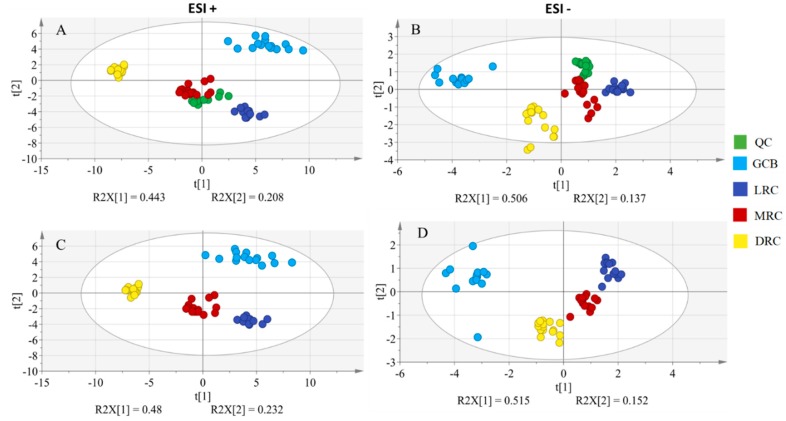
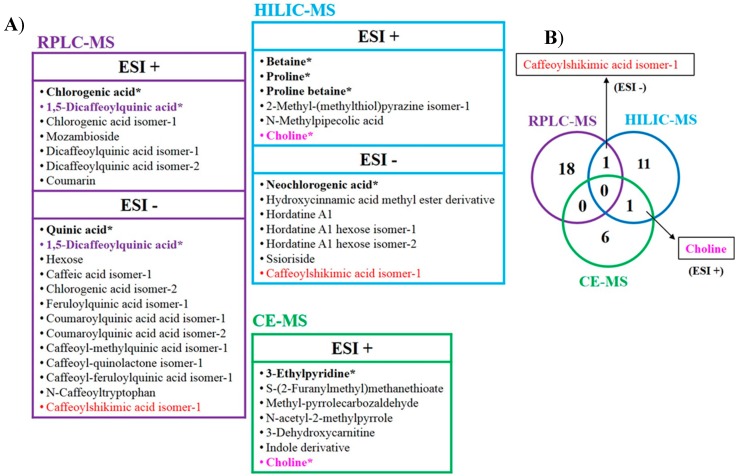
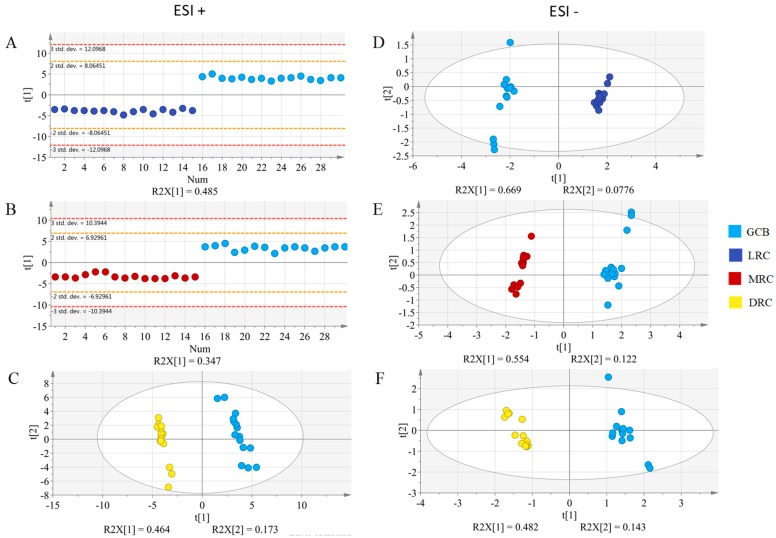
An untargeted metabolomics strategy using hydrophilic interaction chromatography-mass spectrometry (HILIC-MS) was developed in this work enabling the study of the coffee roasting process. Green coffee beans and coffee beans submitted to three different roasting degrees (light, medium, and strong) were analyzed. Chromatographic separation was carried out using water containing 10 mM ammonium formate with 0.2 % formic acid (mobile phase A) and acetonitrile containing 10 mM ammonium formate with 0.2 % formic acid (mobile phase B). A total of 93 molecular features were considered from which 31 were chosen as the most statistically significant using variable in the projection values. 13 metabolites were tentatively identified as potential biomarkers of the coffee roasting process using this metabolomic platform. Results obtained in this work were complementary to those achieved using orthogonal techniques such as reversed-phase liquid chromatography-mass spectrometry (RPLC-MS) and capillary electrophoresis-mass spectrometry (CE-MS) since only one metabolite was found to be common between HILIC-MS and RPLC-MS platforms (caffeoylshikimic acid isomer) and other between HILIC-MS and CE-MS platforms (choline). On the basis of these results, an untargeted metabolomics multiplatform is proposed in this work based on the integration of the three orthogonal techniques as a powerful tool to expand the coverage of the roasted coffee metabolome.
本工作建立了一种基于亲水作用色谱-质谱联用(HILIC-MS)的非靶向代谢组学策略,用于研究咖啡烘焙过程。对绿咖啡豆和经过三种不同烘焙程度(浅度、中度和深度)烘焙的咖啡豆进行了分析。采用含 10 mM 甲酸铵和 0.2 %甲酸的水(流动相 A)和含 10 mM 甲酸铵和 0.2 %甲酸的乙腈(流动相 B)进行色谱分离。从 93 个分子特征中选择了 31 个具有统计学意义的特征作为最显著的变量进行投影分析。使用该代谢组学平台,共鉴定出 13 种可能作为咖啡烘焙过程生物标志物的代谢物。本工作的结果与反相液相色谱-质谱联用(RPLC-MS)和毛细管电泳-质谱联用(CE-MS)等正交技术的结果互补,因为仅在 HILIC-MS 和 RPLC-MS 平台之间发现一种共同的代谢物(咖啡酰奎尼酸异构体),在 HILIC-MS 和 CE-MS 平台之间发现另一种共同的代谢物(胆碱)。基于这些结果,本工作提出了一种基于三种正交技术整合的非靶向代谢组学多平台方法,作为扩展烘焙咖啡代谢组学覆盖范围的有力工具。