Liu Kai, Xu Ying, Gong Shenzhen, Li Jiangbo, Li Xinran, Ye Runyu, Liao Hang, Chen Xiaoping
Department of Cardiology, West China Hospital, Sichuan University, Chengdu, Sichuan, China.
Medicine (Baltimore). 2020 Feb;99(8):e19278. doi: 10.1097/MD.0000000000019278.
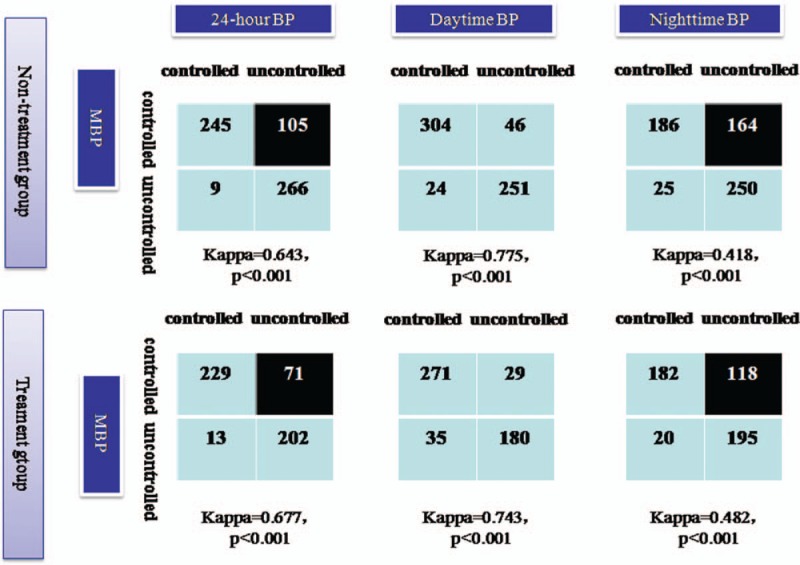
To investigate whether the control of morning blood pressure (MBP) reflects the control of blood pressure (BP) in other periods (daytime, nighttime and 24-hour) and to assess whether morning BP displays a closer association with subclinical target organ damage (TOD) than the BP measured in other periods.One thousand one hundred forty patients with primary hypertension who completed subclinical TOD detection and 24-hour ambulatory BP monitoring were included in the analysis. Pearson correlation analysis, Kappa consistency test, multiple linear regression analysis, and area under the receiver operating curve were used to analyze the data.Morning BP and daytime BP displayed good agreement, but not 24-hour BP , particularly the nighttime BP (all P < .001). Approximately 39.4% of the hypertensive patients receiving drug treatment who had achieved control of the morning BP presented masked nocturnal hypertension, which was associated with worse subclinical TOD. The BP measured in all periods correlated with subclinical TOD, and the correlation was more obvious in the treatment subgroup. However, morning BP did not independently affect subclinical TOD. Morning BP appeared to exhibit less discriminatory power than nighttime BP, particularly with respect to the urinary albumin to creatinine ratio.The use of morning BP for monitoring during hypertension management may not be enough. Masked uncontrolled nocturnal hypertension should be screened when morning BP is controlled.
探讨清晨血压(MBP)的控制是否反映其他时段(日间、夜间及24小时)的血压控制情况,并评估清晨血压与亚临床靶器官损害(TOD)的关联是否比其他时段测量的血压更为密切。纳入1140例完成亚临床TOD检测及24小时动态血压监测的原发性高血压患者进行分析。采用Pearson相关分析、Kappa一致性检验、多元线性回归分析及受试者工作特征曲线下面积分析数据。清晨血压与日间血压一致性良好,但与24小时血压不一致,尤其是夜间血压(均P<0.001)。在接受药物治疗且清晨血压已得到控制的高血压患者中,约39.4%存在隐蔽性夜间高血压,这与更严重的亚临床TOD相关。所有时段测量的血压均与亚临床TOD相关,且在治疗亚组中相关性更明显。然而,清晨血压并不能独立影响亚临床TOD。清晨血压的鉴别能力似乎低于夜间血压,尤其是在尿白蛋白与肌酐比值方面。在高血压管理中仅用清晨血压进行监测可能不够。当清晨血压得到控制时,应筛查隐蔽性未控制的夜间高血压。