Nirenberg Valerie Abigail, Yifrach Ofer
Department of Life Sciences and the Zlotowski Center for Neurosciences, Ben-Gurion University of the Negev, Be'er Sheva, Israel.
Front Pharmacol. 2020 Jan 29;10:1644. doi: 10.3389/fphar.2019.01644. eCollection 2019.
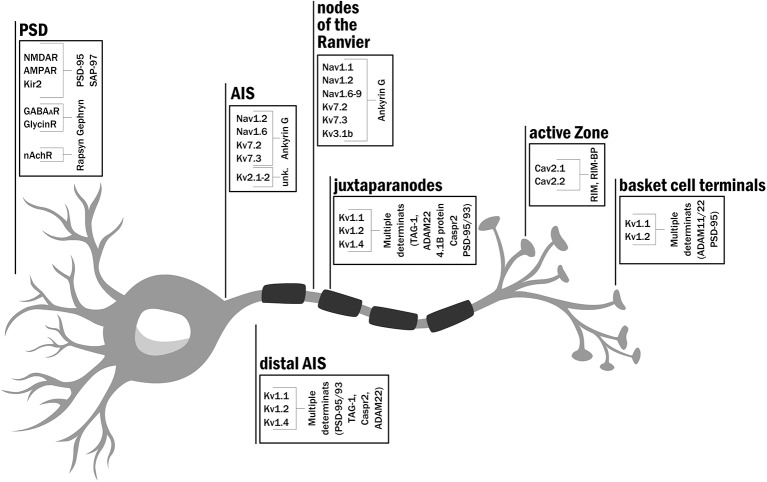
The clustering of many voltage-dependent ion channel molecules at unique neuronal membrane sites such as axon initial segments, nodes of Ranvier, or the post-synaptic density, is an active process mediated by the interaction of ion channels with scaffold proteins and is of immense importance for electrical signaling. Growing evidence indicates that the density of ion channels at such membrane sites may affect action potential conduction properties and synaptic transmission. However, despite the emerging importance of ion channel density for electrical signaling, how ion channel-scaffold protein molecular interactions lead to cellular ion channel clustering, and how this process is regulated are largely unknown. In this review, we emphasize that voltage-dependent ion channel density at native clustering sites not only affects the density of ionic current fluxes but may also affect the conduction properties of the channel and/or the physical properties of the membrane at such locations, all changes that are expected to affect action potential conduction properties. Using the concrete example of the prototypical voltage-activated potassium channel (Kv) protein, we demonstrate how insight into the regulation of cellular ion channel clustering can be obtained when the molecular mechanism of ion channel-scaffold protein interaction is known. Our review emphasizes that such mechanistic knowledge is essential, and when combined with super-resolution imaging microscopy, can serve to bridge the molecular-cellular gap in understanding the regulation of ion channel clustering. Pressing questions, challenges and future directions in addressing ion channel clustering and its regulation are discussed.
许多电压依赖性离子通道分子聚集在独特的神经元膜位点,如轴突起始段、郎飞结或突触后致密区,这是一个由离子通道与支架蛋白相互作用介导的活跃过程,对电信号传导极为重要。越来越多的证据表明,这些膜位点处离子通道的密度可能会影响动作电位的传导特性和突触传递。然而,尽管离子通道密度对电信号传导的重要性日益凸显,但离子通道与支架蛋白的分子相互作用如何导致细胞内离子通道聚集,以及这一过程是如何被调控的,目前仍 largely未知。在本综述中,我们强调天然聚集位点处电压依赖性离子通道的密度不仅会影响离子电流通量的密度,还可能会影响通道的传导特性和/或该位置处膜的物理特性,所有这些变化预计都会影响动作电位的传导特性。以典型的电压激活钾通道(Kv)蛋白为例,我们展示了在已知离子通道与支架蛋白相互作用的分子机制时,如何深入了解细胞内离子通道聚集的调控。我们的综述强调,这种机制性知识至关重要,并且与超分辨率成像显微镜相结合时,有助于弥合在理解离子通道聚集调控方面的分子与细胞层面的差距。文中还讨论了在解决离子通道聚集及其调控方面的紧迫问题、挑战和未来方向。