Cell Biology, Department of Biology, Faculty of Science, Utrecht University, 3584 CH Utrecht, The Netherlands.
Cell Biology, Department of Biology, Faculty of Science, Utrecht University, 3584 CH Utrecht, The Netherlands.
Mol Cell Neurosci. 2018 Sep;91:82-94. doi: 10.1016/j.mcn.2018.05.002. Epub 2018 May 16.
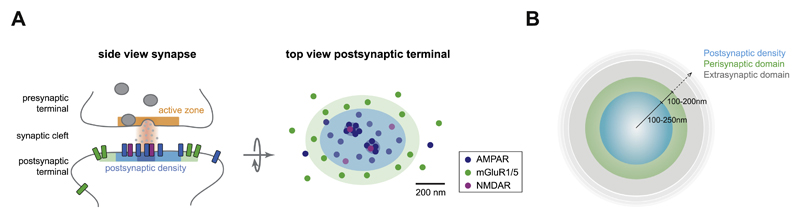
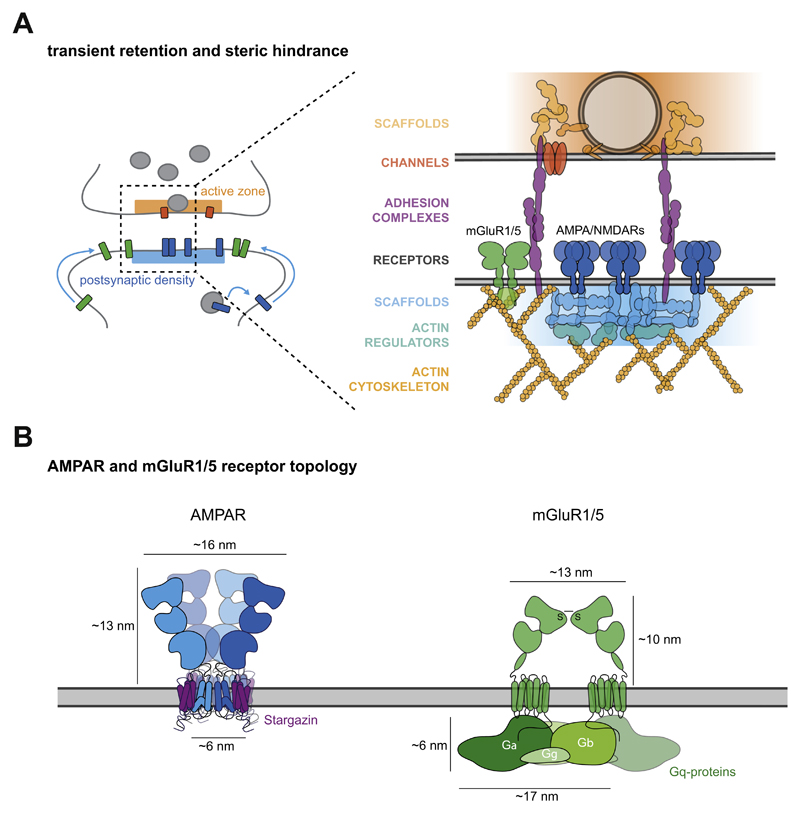
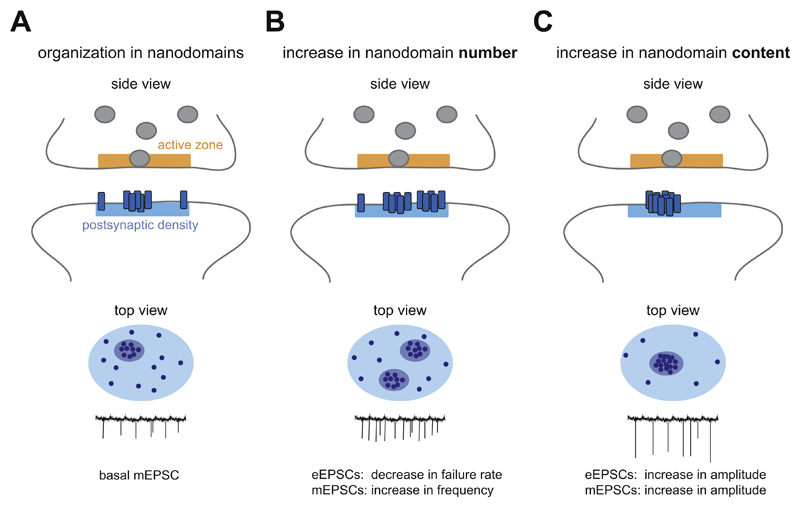
Glutamate receptors are the most abundant excitatory neurotransmitter receptors in the brain, responsible for mediating the vast majority of excitatory transmission in neuronal networks. The AMPA- and NMDA-type ionotropic glutamate receptors (iGluRs) are ligand-gated ion channels that mediate the fast synaptic responses, while metabotropic glutamate receptors (mGluRs) are coupled to downstream signaling cascades that act on much slower timescales. These functionally distinct receptor sub-types are co-expressed at individual synapses, allowing for the precise temporal modulation of postsynaptic excitability and plasticity. Intriguingly, these receptors are differentially distributed with respect to the presynaptic release site. While iGluRs are enriched in the core of the synapse directly opposing the release site, mGluRs reside preferentially at the border of the synapse. As such, to understand the differential contribution of these receptors to synaptic transmission, it is important to not only consider their signaling properties, but also the mechanisms that control the spatial segregation of these receptor types within synapses. In this review, we will focus on the mechanisms that control the organization of glutamate receptors at the postsynaptic membrane with respect to the release site, and discuss how this organization could regulate synapse physiology.
谷氨酸受体是大脑中最丰富的兴奋性神经递质受体,负责介导神经元网络中绝大多数的兴奋性传递。AMPA 和 NMDA 型离子型谷氨酸受体(iGluRs)是配体门控离子通道,介导快速的突触反应,而代谢型谷氨酸受体(mGluRs)与下游信号级联耦联,作用于较慢的时间尺度。这些功能不同的受体亚型在单个突触中共表达,允许对突触后兴奋性和可塑性进行精确的时间调节。有趣的是,这些受体相对于突触前释放位点具有不同的分布。虽然 iGluRs 在与释放位点直接相对的突触核心中富集,但 mGluRs 优先存在于突触的边界处。因此,要了解这些受体对突触传递的差异贡献,不仅要考虑它们的信号特性,还要考虑控制这些受体类型在突触内空间分离的机制。在这篇综述中,我们将重点讨论控制谷氨酸受体在突触后膜上相对于释放位点的组织的机制,并讨论这种组织如何调节突触生理学。