From the Institute of Biophysics, Medical University of Graz, 8010 Graz, Austria.
the Department of Pharmacology, University of California, Davis, California 95616.
J Biol Chem. 2018 Jan 19;293(3):1040-1053. doi: 10.1074/jbc.M117.799585. Epub 2017 Nov 27.
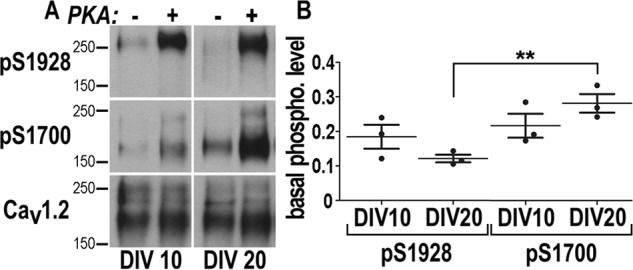
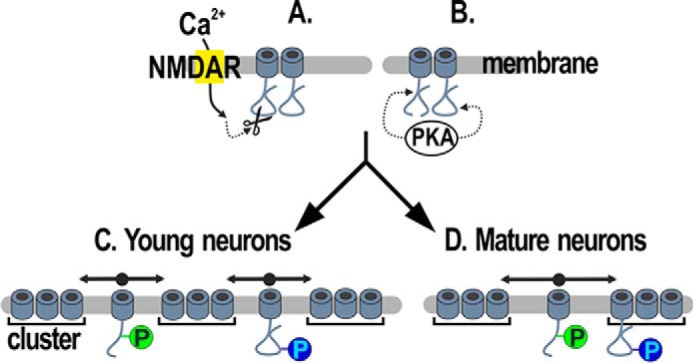
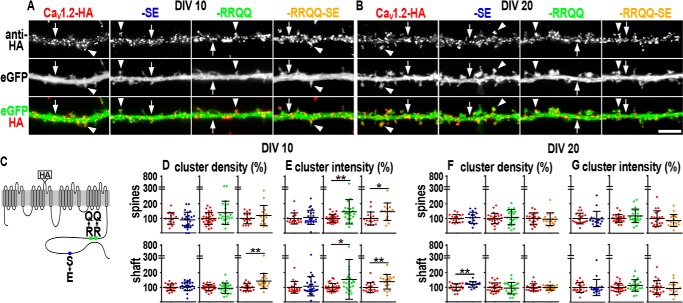
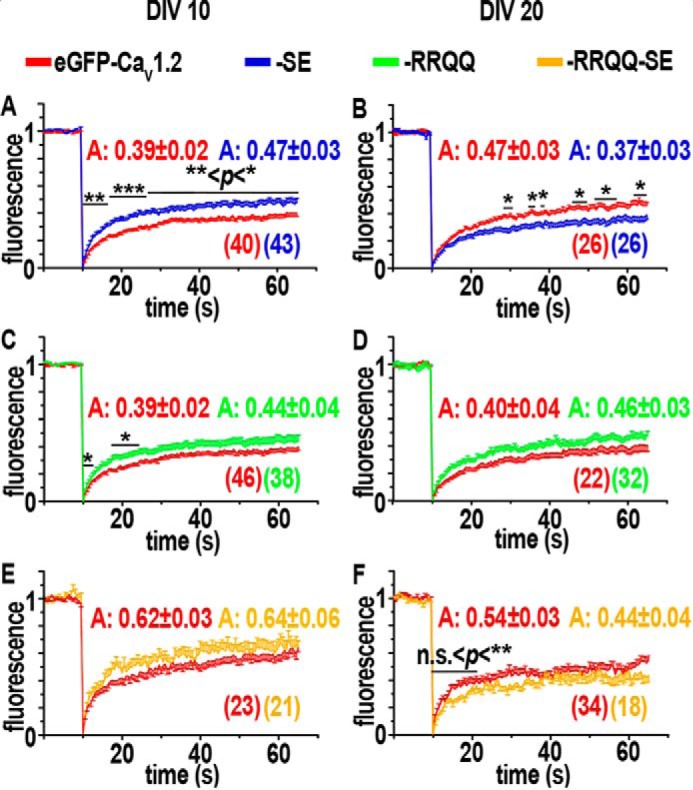
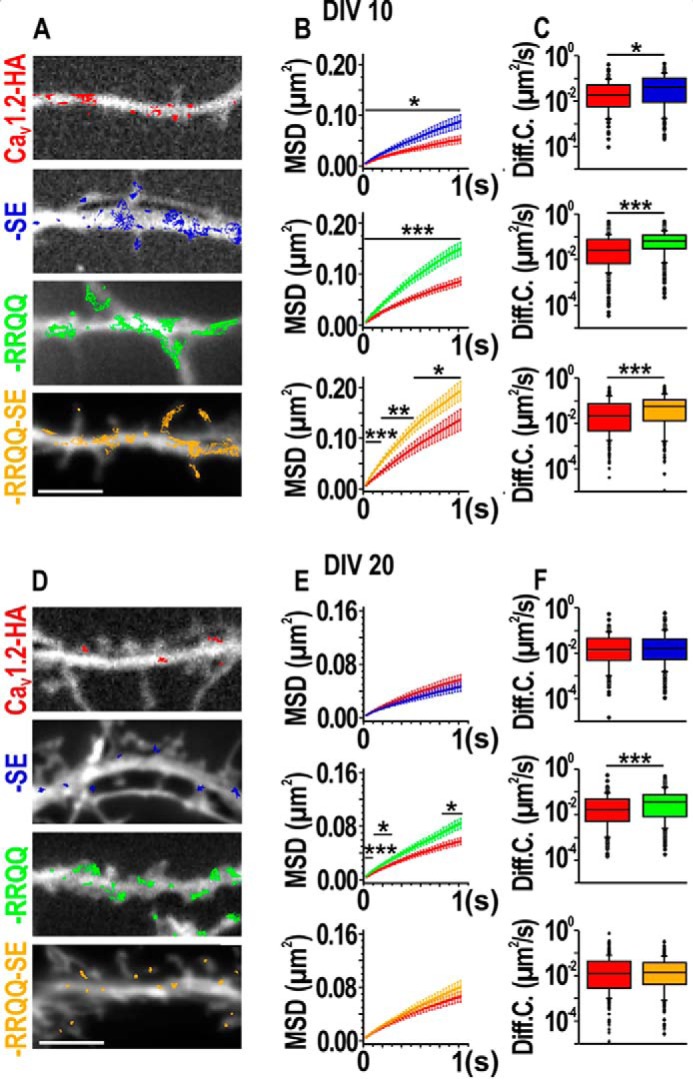
L-type voltage-gated Ca1.2 calcium channels (Ca1.2) are key regulators of neuronal excitability, synaptic plasticity, and excitation-transcription coupling. Surface-exposed Ca1.2 distributes in clusters along the dendrites of hippocampal neurons. A permanent exchange between stably clustered and laterally diffusive extra-clustered channels maintains steady-state levels of Ca1.2 at dendritic signaling domains. A dynamic equilibrium between anchored and diffusive receptors is a common feature among ion channels and is crucial to modulate signaling transduction. Despite the importance of this fine regulatory system, the molecular mechanisms underlying the surface dynamics of Ca1.2 are completely unexplored. Here, we examined the dynamic states of Ca1.2 depending on phosphorylation on Ser-1700 and Ser-1928 at the channel C terminus. Phosphorylation at these sites is strongly involved in Ca1.2-mediated nuclear factor of activated T cells (NFAT) signaling, long-term potentiation, and responsiveness to adrenergic stimulation. We engineered Ca1.2 constructs mimicking phosphorylation at Ser-1700 and Ser-1928 and analyzed their behavior at the membrane by immunolabeling protocols, fluorescence recovery after photobleaching, and single particle tracking. We found that the phosphomimetic S1928E variant increases the mobility of Ca1.2 without altering the steady-state maintenance of cluster in young neurons and favors channel stabilization later in differentiation. Instead, mimicking phosphorylation at Ser-1700 promoted the diffusive state of Ca1.2 irrespective of the differentiation stage. Together, these results reveal that phosphorylation could contribute to the establishment of channel anchoring mechanisms depending on the neuronal differentiation state. Finally, our findings suggest a novel mechanism by which phosphorylation at the C terminus regulates calcium signaling by tuning the content of Ca1.2 at signaling complexes.
L 型电压门控 Ca1.2 钙通道(Ca1.2)是神经元兴奋性、突触可塑性和兴奋-转录偶联的关键调节因子。表面暴露的 Ca1.2 沿海马神经元的树突呈簇状分布。稳定聚集的和侧向扩散的额外聚集通道之间的永久交换维持树突信号域中 Ca1.2 的稳态水平。锚定和扩散受体之间的动态平衡是离子通道的共同特征,对于调节信号转导至关重要。尽管这个精细的调节系统很重要,但 Ca1.2 表面动力学的分子机制仍完全未知。在这里,我们检查了 Ca1.2 取决于通道 C 末端丝氨酸 1700 和丝氨酸 1928 磷酸化的动态状态。这些位点的磷酸化强烈参与 Ca1.2 介导的核因子活化 T 细胞(NFAT)信号转导、长时程增强和对肾上腺素能刺激的反应。我们构建了模拟丝氨酸 1700 和丝氨酸 1928 磷酸化的 Ca1.2 构建体,并通过免疫标记协议、光漂白后荧光恢复和单粒子跟踪分析了它们在膜上的行为。我们发现,磷酸化模拟物 S1928E 变体增加了 Ca1.2 的流动性,而不会改变年轻神经元中簇的稳态维持,并在分化后期有利于通道稳定。相反,模拟丝氨酸 1700 的磷酸化促进了 Ca1.2 的扩散状态,而与分化阶段无关。总之,这些结果表明,磷酸化可能有助于根据神经元分化状态建立通道锚定机制。最后,我们的研究结果表明,C 端磷酸化通过调节信号复合物中 Ca1.2 的含量来调节钙信号的新机制。