Liu Jianjian, Li Chao, Muhae-Ud-Din Ghulam, Liu Taiguo, Chen Wanquan, Zhang Jianmin, Gao Li
State Key Laboratory for Biology of Plant Diseases and Insect Pests, Institute of Plant Protection, Chinese Academy of Agricultural Sciences, Beijing, China.
School of Agriculture, Yangtze University, Jingzhou, China.
Front Microbiol. 2020 Jan 30;11:4. doi: 10.3389/fmicb.2020.00004. eCollection 2020.
The dwarf bunt disease of wheat is caused by Kühn. This pathogen is primarily involved in the stunted growth of wheat and affects seed quality. Many countries in the world have therefore imposed quarantine bans to prevent the spread of . Morphological observations are the main method of detecting teliospores in soil. However, this is a lengthy and laborious process; this method is thus unable to quickly meet the demand for detection of teliospores in the soil.
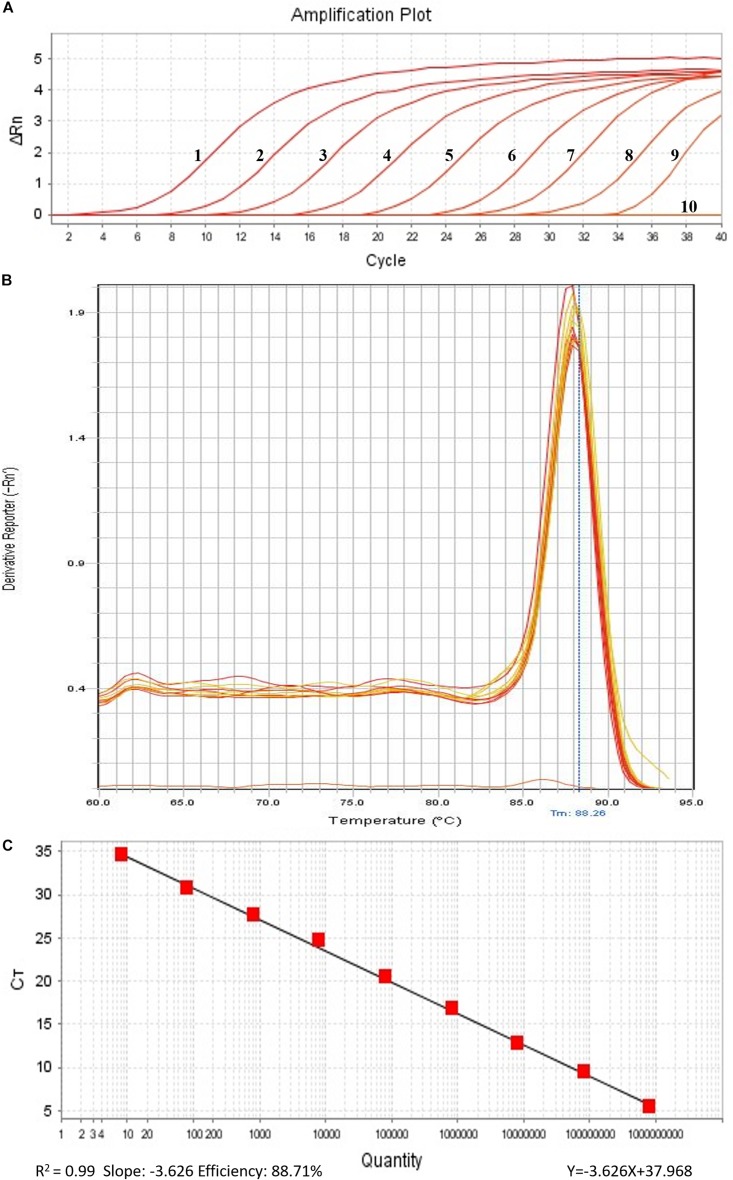
We compared PCR, real-time PCR and droplet digital PCR (ddPCR) for the qualitative and quantitative measurement of the teliospores of in soil.
We suggest the use of ddPCR for detection of the soil samples, which was demonstrated to have the most sensitive detection at 2.1 copies/μL. In contract, SYBR Green I real-time PCR could detect 7.97 copies/μL of in soil, and this sensitivity was 100 times more sensitive than that of simple PCR.
This study was the first report using ddPCR techniques to detect teliospores in soil with greatly enhanced sensitivity.
小麦矮腥黑穗病由 Kühn 引起。这种病原菌主要导致小麦生长发育不良并影响种子质量。因此,世界上许多国家已实施检疫禁令以防止其传播。形态学观察是检测土壤中冬孢子的主要方法。然而,这是一个漫长且费力的过程;因此这种方法无法快速满足对土壤中冬孢子检测的需求。
我们比较了聚合酶链式反应(PCR)、实时荧光定量聚合酶链式反应(real-time PCR)和液滴数字聚合酶链式反应(ddPCR)对土壤中冬孢子进行定性和定量测定的效果。
我们建议使用 ddPCR 检测土壤样本,结果表明其在检测土壤中冬孢子时灵敏度最高,检测限为 2.1 拷贝/微升。相比之下,SYBR Green I 实时荧光定量聚合酶链式反应可检测到土壤中 7.97 拷贝/微升的冬孢子,其灵敏度比普通 PCR 高 100 倍。
本研究是首次报道使用 ddPCR 技术检测土壤中的冬孢子,灵敏度大大提高。