Wu Vivian, Helder Marco N, Bravenboer Nathalie, Ten Bruggenkate Christiaan M, Jin Jianfeng, Klein-Nulend Jenneke, Schulten Engelbert A J M
Department of Oral Cell Biology, Academic Centre for Dentistry Amsterdam (ACTA), University of Amsterdam and Vrije Universiteit Amsterdam, Amsterdam Movement Sciences, Amsterdam, Netherlands.
Department of Oral and Maxillofacial Surgery/Oral Pathology, Amsterdam University Medical Centers and Academic Centre for Dentistry Amsterdam (ACTA), Vrije Universiteit Amsterdam, Amsterdam Movement Sciences, Amsterdam, Netherlands.
Stem Cells Int. 2019 Dec 30;2019:6279721. doi: 10.1155/2019/6279721. eCollection 2019.
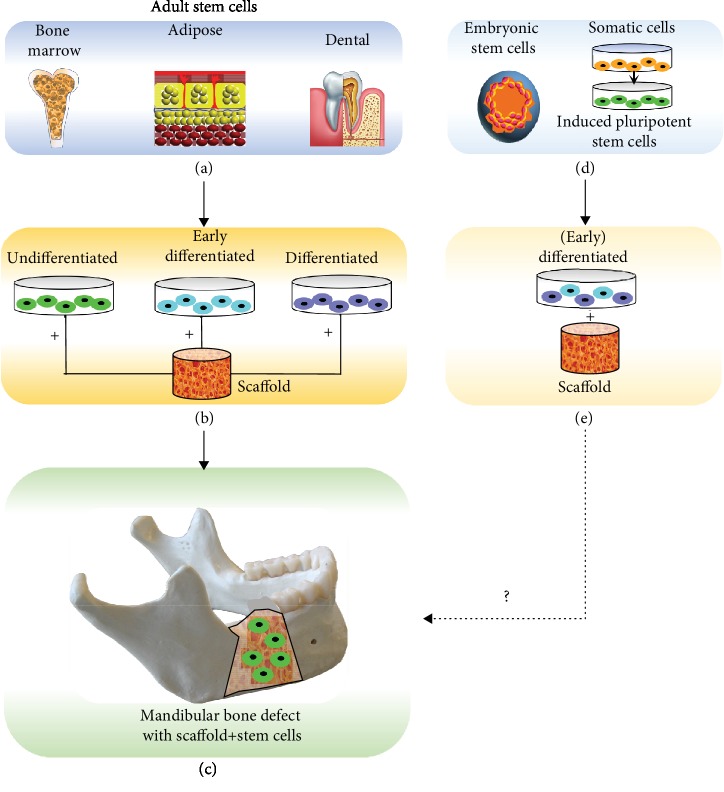
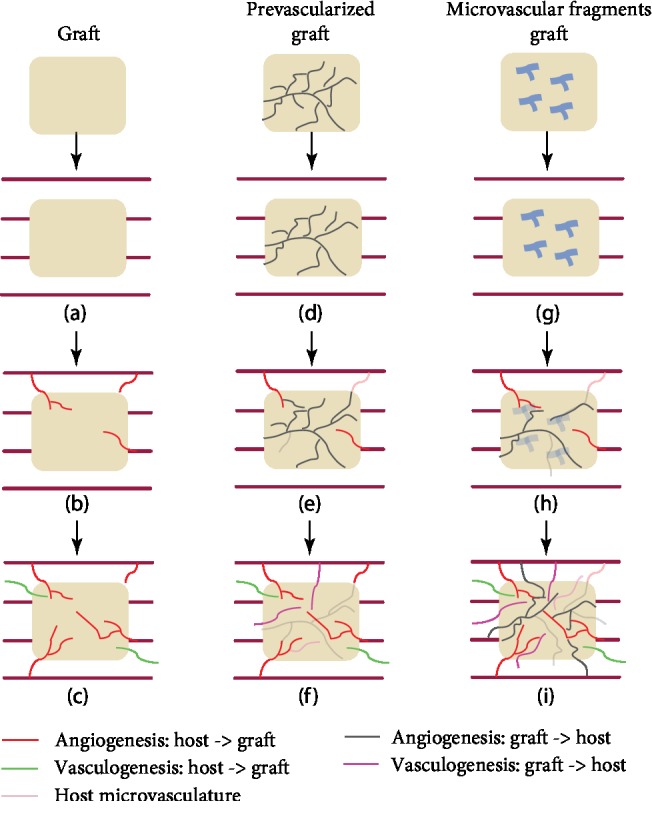
Bone tissue engineering techniques are a promising alternative for the use of autologous bone grafts to reconstruct bone defects in the oral and maxillofacial region. However, for successful bone regeneration, adequate vascularization is a prerequisite. This review presents and discusses the application of stem cells and new strategies to improve vascularization, which may lead to feasible clinical applications. Multiple sources of stem cells have been investigated for bone tissue engineering. The stromal vascular fraction (SVF) of human adipose tissue is considered a promising single source for a heterogeneous population of essential cells with, amongst others, osteogenic and angiogenic potential. Enhanced vascularization of tissue-engineered grafts can be achieved by different mechanisms: vascular ingrowth directed from the surrounding host tissue to the implanted graft, vice versa, or concomitantly. Vascular ingrowth into the implanted graft can be enhanced by (i) optimizing the material properties of scaffolds and (ii) their bioactivation by incorporation of growth factors or cell seeding. Vascular ingrowth directed from the implanted graft towards the host tissue can be achieved by incorporating the graft with either (i) preformed microvascular networks or (ii) microvascular fragments (MF). The latter may have stimulating actions on both vascular ingrowth and outgrowth, since they contain angiogenic stem cells like SVF, as well as vascularized matrix fragments. Both adipose tissue-derived SVF and MF are cell sources with clinical feasibility due to their large quantities that can be harvested and applied in a one-step surgical procedure. During the past years, important advancements of stem cell application and vascularization in bone tissue regeneration have been made. The development of engineered 3D models mimicking the bone defect environment would facilitate new strategies in bone tissue engineering. Successful clinical application requires innovative future investigations enhancing vascularization.
骨组织工程技术是使用自体骨移植来修复口腔颌面区域骨缺损的一种有前景的替代方法。然而,要实现成功的骨再生,充足的血管化是一个先决条件。本综述介绍并讨论了干细胞的应用以及改善血管化的新策略,这可能会带来可行的临床应用。已经对多种干细胞来源进行了骨组织工程研究。人脂肪组织的基质血管成分(SVF)被认为是一种有前景的单一来源,可提供具有成骨和血管生成潜力等多种重要细胞的异质群体。组织工程移植物的血管化增强可通过不同机制实现:血管从周围宿主组织向内生长至植入的移植物,反之亦然,或同时进行。通过以下方式可增强血管向内生长至植入的移植物:(i)优化支架的材料特性,以及(ii)通过掺入生长因子或接种细胞对其进行生物活化。通过将移植物与(i)预制微血管网络或(ii)微血管片段(MF)结合,可实现从植入的移植物向宿主组织的血管向内生长。后者可能对血管向内生长和向外生长均有刺激作用,因为它们含有像SVF这样的血管生成干细胞以及血管化的基质片段。脂肪组织来源的SVF和MF都是具有临床可行性的细胞来源,因为它们可以大量获取并通过一步外科手术应用。在过去几年中,干细胞应用和血管化在骨组织再生方面取得了重要进展。模仿骨缺损环境的工程化3D模型的开发将有助于骨组织工程的新策略。成功的临床应用需要未来进行创新研究以增强血管化。