Institute of Molecular Biomedicine, Faculty of Medicine in Bratislava, Comenius University, Bratislava, Slovakia.
Institute of Medical Physics, Biophysics, Informatics and Telemedicine, Faculty of Medicine in Bratislava, Comenius University, Bratislava, Slovakia.
Oxid Med Cell Longev. 2020 Jan 23;2020:5478708. doi: 10.1155/2020/5478708. eCollection 2020.
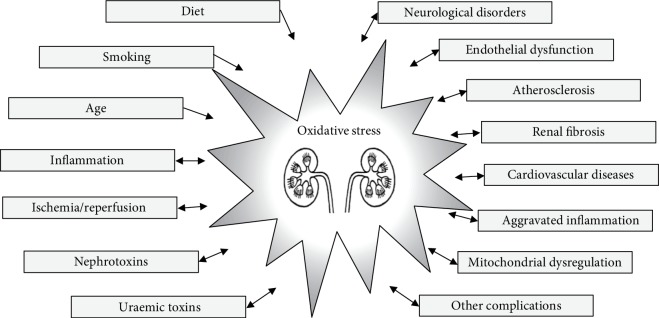
Kidney disease represents a serious global health problem. One of the main concerns is its late diagnosis, only feasible in a progressed disease state. The lack of a clinical manifestation in the early stages and the fact that the commonly measured parameters of renal function are markedly reduced only during advanced stages of the disease are the main cause. Changes at the molecular level of the kidney tissue occur even before nitrogenous substances, such as creatinine and urea, start to accumulate in the blood. Renal proximal tubules contain a large number of mitochondria and are critical for the energy-demanding process of reabsorption of water and solutes. Mitochondria are the largest producers of oxygen radicals, which, in turn, increase the susceptibility of kidneys to oxidative stress-induced damage. Free radicals and prooxidants produced during acute or chronic kidney injury may further aggravate the course of the disease and play a role in the pathogenesis of subsequent complications. Prevention might be the solution in CKD, but patients are often reluctant to undergo preventive examinations. Noninvasive markers and the possibility to obtain samples at home might help to increase compliance. This review will provide an overview of the possible uses of markers of oxidative status in noninvasive biofluids in patients with renal disease.
肾脏疾病是一个严重的全球性健康问题。其中一个主要关注点是其晚期诊断,只有在疾病进展阶段才可行。这主要是因为早期没有临床表现,而且肾功能的常用测量参数只有在疾病晚期才会明显降低。即使在血液中开始积累肌酐和尿素等含氮物质之前,肾脏组织的分子水平就已经发生了变化。肾脏近端小管含有大量的线粒体,对于水和溶质的能量需求重吸收过程至关重要。线粒体是氧自由基的最大产生者,而氧自由基又会增加肾脏对氧化应激诱导损伤的易感性。急性或慢性肾损伤期间产生的自由基和促氧化剂可能会进一步加重疾病的进程,并在随后的并发症发病机制中发挥作用。预防可能是慢性肾脏病的解决方案,但患者通常不愿意接受预防性检查。非侵入性标志物以及在家中获取样本的可能性可能有助于提高依从性。这篇综述将概述氧化状态标志物在肾病患者非侵入性生物流体中的可能用途。