Werner Brian C, Cancienne Jourdan M, Browning Robert, Verma Nikhil N, Cole Brian J
Department of Orthopaedic Surgery, University of Virginia Health System, Charlottesville, Virginia, USA.
Midwest Orthopaedics at Rush, Chicago, Illinois, USA.
Orthop J Sports Med. 2020 Feb 6;8(2):2325967119900811. doi: 10.1177/2325967119900811. eCollection 2020 Feb.
The use of platelet-rich plasma (PRP) in the Medicare population is not well described.
To investigate the national use of PRP among Medicare beneficiaries, including the incidence and conditions for which it was used in both operative and nonoperative settings, and determine charges to Medicare.
Descriptive epidemiology study.
The Medicare Standard Analytical Files within the PearlDiver database were queried for PRP injections by use of Current Procedural Terminology (CPT) code 0232T from 2010 to 2014. A search of every associated International Classification of Diseases, 9th Revision, code and CPT code on the day of the injection was performed, and codes were broadly categorized as shoulder, knee, elbow, hip, and foot/ankle. These categories were then subdivided into 2 groups based on whether the injection was performed at the time of surgery or for a nonoperative condition. The patient data were analyzed by demographics and geographic region. In further analysis, the charges sent to Medicare for PRP injections were stratified by year and musculoskeletal site.
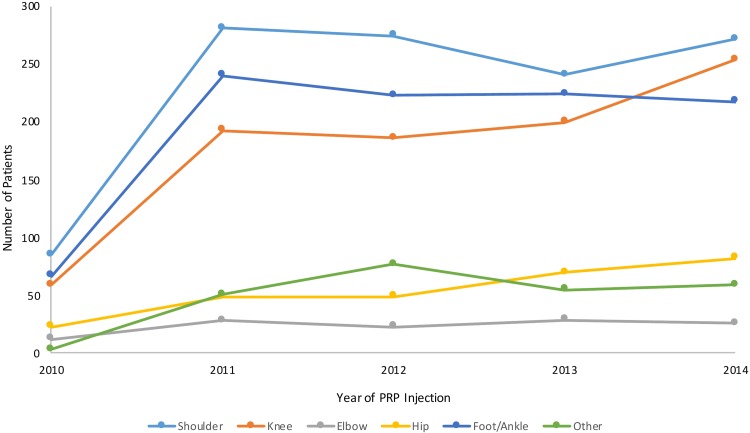
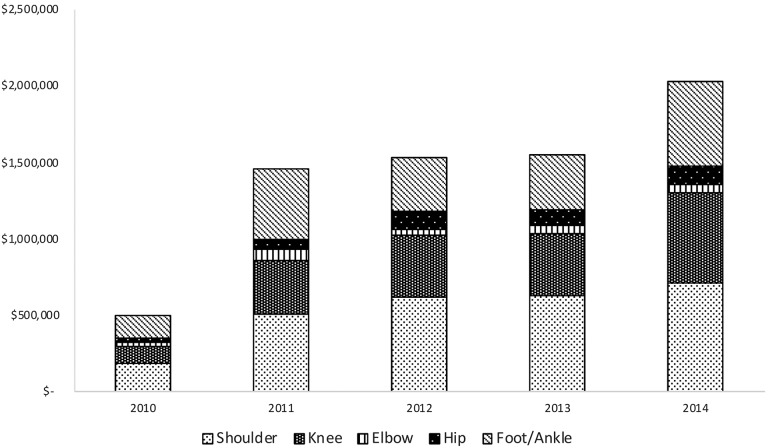
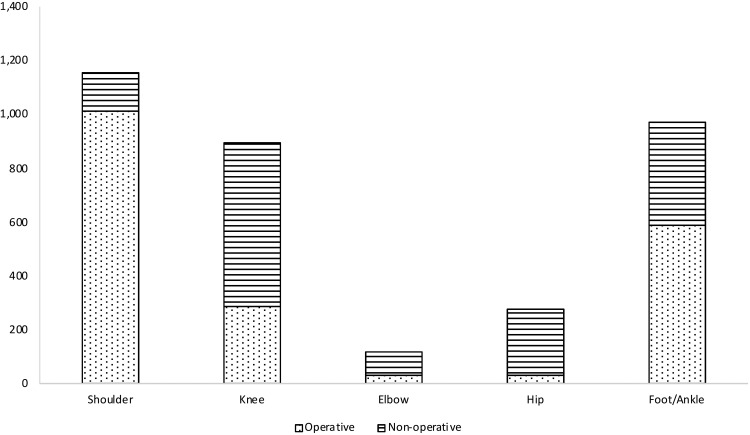
A total of 3654 PRP injections were coded for and administered during the study period; 57% of recipients were men and 33% were 65 to 69 years of age. We found that 42% of all PRP injections were administered in the southern geographic region. PRP injections were most commonly associated with shoulder diagnoses, followed closely by the foot and ankle and by the knee. The majority of injections given for shoulder conditions were performed at the time of surgery, whereas the majority of knee conditions treated with PRP were associated with nonoperative treatments. Annual charges to Medicare for PRP injections increased 400%, from $500,000 in 2010 to more than $2 million in 2014.
The use and breadth of PRP therapy have increased substantially in Medicare beneficiaries. Further research is required to obtain a consensus on treatment recommendations for PRP use in this population in addition to strategies to obtain insurance reimbursement.
医疗保险人群中富血小板血浆(PRP)的使用情况尚无详尽描述。
调查医疗保险受益人群中PRP的全国使用情况,包括其在手术和非手术环境下的使用发生率及适用病症,并确定医疗保险的费用支出。
描述性流行病学研究。
利用PearlDiver数据库中的医疗保险标准分析文件,通过使用当前程序术语(CPT)代码0232T查询2010年至2014年期间的PRP注射情况。对注射当天的每一个相关国际疾病分类第九版代码和CPT代码进行检索,并将代码大致分为肩部、膝部、肘部、髋部和足部/踝部。然后根据注射是在手术时进行还是用于非手术病症,将这些类别再细分为两组。患者数据按人口统计学和地理区域进行分析。在进一步分析中,向医疗保险机构收取的PRP注射费用按年份和肌肉骨骼部位进行分层。
在研究期间,共编码并实施了3654次PRP注射;57%的接受者为男性,33%的接受者年龄在65至69岁之间。我们发现,所有PRP注射中有42%是在南部地理区域进行的。PRP注射最常与肩部诊断相关,其次是足部和踝部以及膝部。针对肩部病症进行的注射大多数是在手术时进行的,而用PRP治疗的大多数膝部病症与非手术治疗相关。向医疗保险机构收取的PRP注射年度费用增长了400%,从2010年的50万美元增至2014年的200多万美元。
医疗保险受益人群中PRP疗法的使用和范围已大幅增加。除了获得保险报销的策略外,还需要进一步研究以就该人群使用PRP的治疗建议达成共识。