Nanizawa Eri, Tamaki Yuki, Sono Reika, Miyashita Rintaro, Hayashi Yumi, Kanbe Ayumu, Ito Hiroyasu, Ishikawa Tetsuya
Department of Radiological & Medical Laboratory Sciences, Nagoya University Graduate School of Medicine, 1-1-20 Daikominami, Higashi-ku, Nagoya, 461-8673, Japan.
Department of Informative Clinical Medicine, Gifu University Graduate School of Medicine, 1-1 Yanagido, Gifu City, 501-1194, Japan.
Biochem Biophys Rep. 2020 Feb 12;22:100736. doi: 10.1016/j.bbrep.2020.100736. eCollection 2020 Jul.
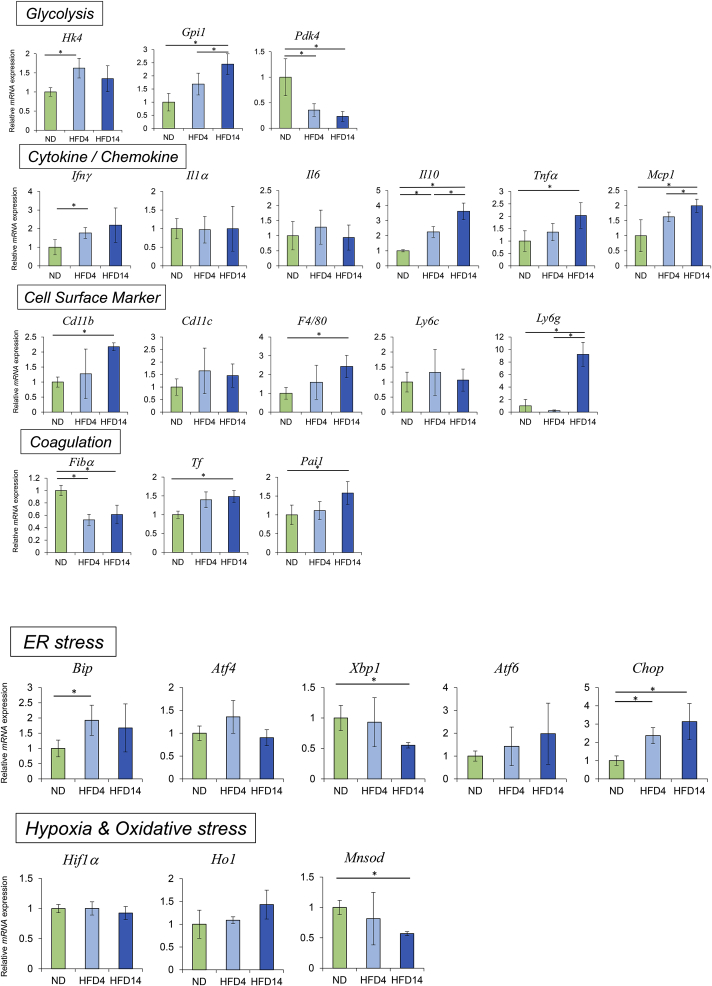
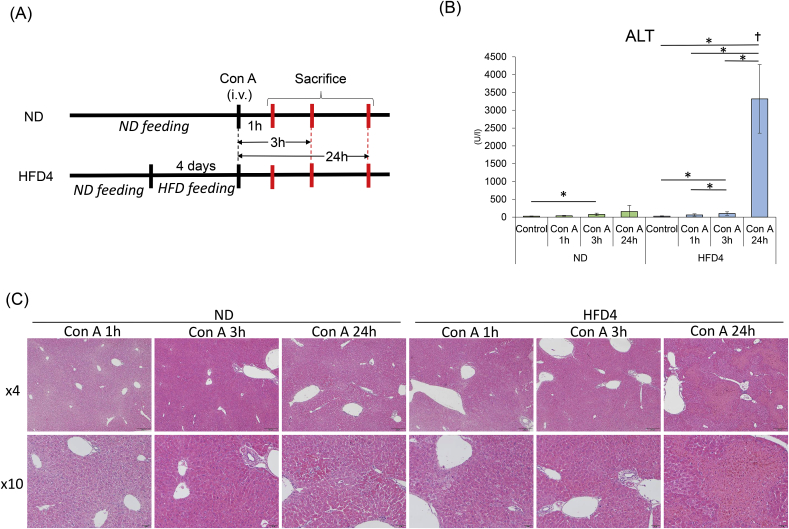
Obesity and high-fat diet (HFD) are known to cause proinflammatory and procoagulation states and suggested to become a risk of developing thromboembolic diseases. Non-alcoholic fatty liver disease (NAFLD) is usually associated with obesity and HFD, and a part of NAFLD is known to progress to nonalcoholic steatohepatitis (NASH), the pathogenesis of which has not been fully elucidated. In the current study, we examined the influence of short-term HFD on hepatic expression of the molecules related to inflammation, coagulation, metabolism, and cellular stresses from the perspective that HFD itself can be a risk for the development to NASH. In the analysis in short-term (4 days to 14 days) HFD-fed mice, we found out that HFD increased hepatic expression of IFN-γ, TNF-α, IL-10, monocyte chemotactic protein-1 (MCP-1), tissue factor (TF), plasminogen activator inhibitor-1 (PAI-1) mRNAs, and fibrin/fibrinogen deposition in the liver tissues. And it was suggested that metabolic alterations and endoplasmic reticulum (ER) stresses induced by the HFD intake were associated with this proinflammatory and procoagulation states. When we administered concanavalin A (Con A) to these HFD-fed mice, the extent of liver injury was dramatically exacerbated in HFD-fed mice. Heparin treatment to Con A-administered, HFD-fed mice (for 4 days) profoundly ameliorated the extent of liver injury. These suggest that even short-term of HFD intake induces proinflammatory and procoagulation states in the liver and thereby increases the susceptibility of the liver to circulating inflammatory stimuli. We think that it may explain a part of NASH pathogenesis.
众所周知,肥胖和高脂饮食(HFD)会导致促炎和促凝状态,并被认为会增加发生血栓栓塞性疾病的风险。非酒精性脂肪性肝病(NAFLD)通常与肥胖和HFD相关,并且已知一部分NAFLD会进展为非酒精性脂肪性肝炎(NASH),其发病机制尚未完全阐明。在本研究中,我们从HFD本身可能是NASH发生风险的角度,研究了短期HFD对肝脏中与炎症、凝血、代谢和细胞应激相关分子表达的影响。在对短期(4天至14天)喂食HFD的小鼠的分析中,我们发现HFD增加了肝脏中IFN-γ、TNF-α、IL-10、单核细胞趋化蛋白-1(MCP-1)、组织因子(TF)、纤溶酶原激活物抑制剂-1(PAI-1)mRNA的表达,以及肝脏组织中纤维蛋白/纤维蛋白原的沉积。并且提示,HFD摄入引起的代谢改变和内质网(ER)应激与这种促炎和促凝状态有关。当我们给这些喂食HFD的小鼠注射刀豆蛋白A(Con A)时,喂食HFD的小鼠肝脏损伤程度显著加重。对注射Con A的喂食HFD的小鼠(持续4天)进行肝素治疗,可显著改善肝脏损伤程度。这些结果表明,即使短期摄入HFD也会在肝脏中诱导促炎和促凝状态,从而增加肝脏对循环炎症刺激的易感性。我们认为这可能解释了NASH发病机制的一部分。