Kumar Suresh, Raj V Samuel, Ahmad Ayaan, Saini Vikram
National Institute of Biologicals, Ministry of Health & Family Welfare, Govt. of India, Noida, 201309, India.
Center for Drug, Design, Discovery and Development (C4D), SRM University, Delhi-NCR, 131029, Sonepat, Haryana, India.
Gut Pathog. 2022 Oct 13;14(1):40. doi: 10.1186/s13099-022-00513-0.
A high-fat diet (HFD) induced perturbation of gut microbiota is a major contributory factor to promote the pathophysiology of HFD-associated metabolic syndrome. The HFD could also increase the susceptibility to the microbial infections warranting the use of antibiotics which are independently capable of impacting both gut microbiota and metabolic syndrome. Further, the usage of antibiotics in individuals consuming HFD can impact mitochondrial function that can be associated with an elevated risk of chronic conditions like inflammatory bowel disease (IBD). Despite this high propensity to infections in individuals on HFD, the link between duration of HFD and antibiotic treatment, and its impact on diversity of the gut microbiome and features of metabolic syndrome is not well established. In this study, we have addressed these knowledge gaps by examining how the gut microbiota profile changes in HFD-fed mice receiving antibiotic intervention in the form of amoxicillin. We also determine whether antibiotic treatment in HFD-fed mice may adversely impact the ability of immune cells to clear microbial infections.
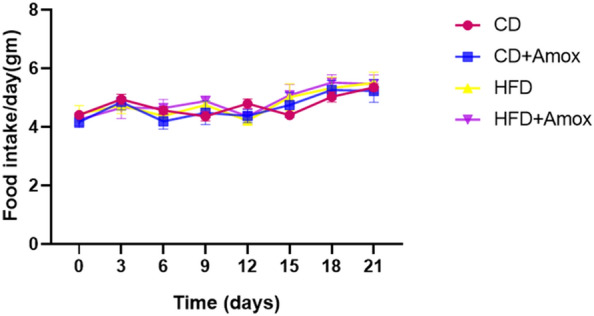
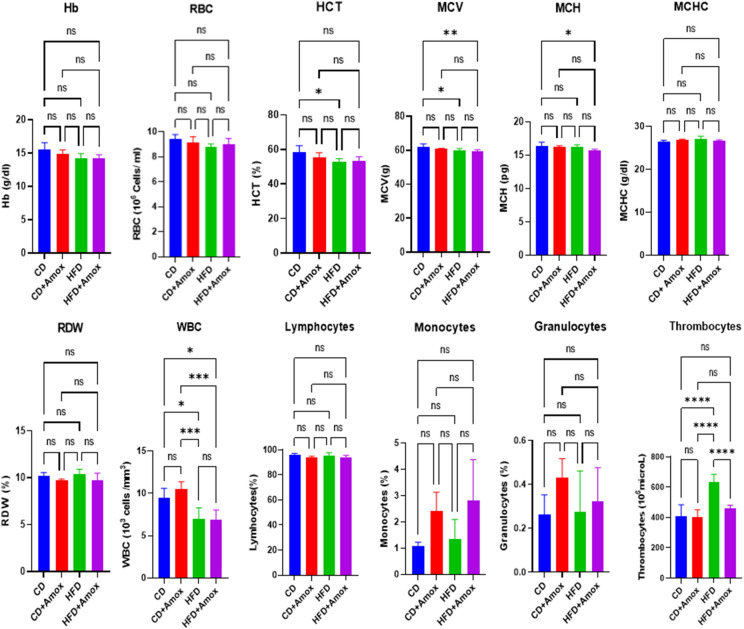
We have subjected mice to HFD and chow diet (CD) for 3 weeks, and a subset of these mice on both diets received antibiotic intervention in the form of amoxicillin in the 3rd week. Body weight and food intake were recorded for 3 weeks. After 21 days, all animals were weighted and sacrificed. Subsequently, these animals were evaluated for basic haemato-biochemical and histopathological attributes. We used 16S rRNA sequencing followed by bioinformatics analysis to determine changes in gut microbiota in these mice. We observed that a HFD, even for a short-duration, could successfully induce the partial pathophysiology typical of a metabolic syndrome, and substantially modulated the gut microbiota in mice. The short course of amoxicillin treatment to HFD-fed mice resulted in beneficial effects by significantly reducing fasting blood glucose and skewing the number of thrombocytes towards a normal range. Remarkably, we observed a significant remodelling of gut microbiota in amoxicillin-treated HFD-fed mice. Importantly, some gut microbes associated with improved insulin sensitivity and recovery from metabolic syndrome only appeared in amoxicillin-treated HFD-fed mice reinforcing the beneficial effects of antibiotic treatment in the HFD-associated metabolic syndrome. Moreover, we also observed the presence of gut-microbiota unique to amoxicillin-treated HFD-fed mice that are also known to improve the pathophysiology associated with metabolic syndrome. However, both CD-fed as well as HFD-fed mice receiving antibiotics showed an increase in intestinal pathogens as is typically observed for antibiotic treatment. Importantly though, infection studies with S. aureus and A. baumannii, revealed that macrophages isolated from amoxicillin-treated HFD-fed mice are comparable to those isolated from mice receiving only HFD or CD in terms of susceptibility, and progression of microbial infection. This finding clearly indicated that amoxicillin treatment does not introduce any additional deficits in the ability of macrophages to combat microbial infections.
Our results showed that amoxicillin treatment in HFD-fed mice exert a beneficial influence on the pathophysiological attributes of metabolic syndrome which correlates with a significant remodelling of gut microbiota. A novel observation was the increase in microbes known to improve insulin sensitivity following amoxicillin treatment during short-term intake of HFD. Even though there is a minor increase in gut-resistant intestinal pathogens in amoxicillin-treated groups, there is no adverse impact on macrophages with respect to their susceptibility and ability to control infections. Taken together, this study provides a proof of principle for the exploration of amoxicillin treatment as a potential therapy in the people affected with metabolic syndrome.
高脂饮食(HFD)引起的肠道微生物群紊乱是促进HFD相关代谢综合征病理生理过程的主要因素。HFD还会增加对微生物感染的易感性,这就需要使用抗生素,而抗生素本身就能够影响肠道微生物群和代谢综合征。此外,在食用HFD的个体中使用抗生素会影响线粒体功能,这可能与炎症性肠病(IBD)等慢性病风险升高有关。尽管食用HFD的个体极易感染,但HFD持续时间与抗生素治疗之间的联系及其对肠道微生物群多样性和代谢综合征特征的影响尚未明确。在本研究中,我们通过研究以阿莫西林形式接受抗生素干预的HFD喂养小鼠的肠道微生物群谱如何变化,填补了这些知识空白。我们还确定了HFD喂养小鼠中的抗生素治疗是否会对免疫细胞清除微生物感染的能力产生不利影响。
我们让小鼠分别食用HFD和普通饮食(CD)3周,两种饮食中的一部分小鼠在第3周接受了阿莫西林形式的抗生素干预。记录3周内的体重和食物摄入量。21天后,对所有动物进行称重并处死。随后,对这些动物的基本血液生化和组织病理学特征进行评估。我们使用16S rRNA测序并进行生物信息学分析,以确定这些小鼠肠道微生物群的变化。我们观察到,即使是短期的HFD也能成功诱导代谢综合征典型的部分病理生理过程,并显著调节小鼠的肠道微生物群。对HFD喂养小鼠进行的短期阿莫西林治疗通过显著降低空腹血糖并使血小板数量偏向正常范围而产生有益效果。值得注意的是,我们观察到阿莫西林治疗的HFD喂养小鼠的肠道微生物群有显著重塑。重要的是,一些与改善胰岛素敏感性和从代谢综合征中恢复相关的肠道微生物仅出现在阿莫西林治疗的HFD喂养小鼠中,这加强了抗生素治疗对HFD相关代谢综合征的有益作用。此外,我们还观察到阿莫西林治疗的HFD喂养小鼠中存在独特的肠道微生物群,已知这些微生物群也能改善与代谢综合征相关的病理生理过程。然而,接受抗生素治疗的CD喂养小鼠和HFD喂养小鼠的肠道病原体均有所增加,这是抗生素治疗通常会出现的情况。但重要的是,对金黄色葡萄球菌和鲍曼不动杆菌的感染研究表明,从阿莫西林治疗的HFD喂养小鼠中分离出的巨噬细胞在易感性和微生物感染进展方面与仅接受HFD或CD的小鼠分离出的巨噬细胞相当。这一发现清楚地表明,阿莫西林治疗不会在巨噬细胞对抗微生物感染的能力上引入任何额外缺陷。
我们的结果表明,对HFD喂养小鼠进行阿莫西林治疗对代谢综合征的病理生理特征产生有益影响,这与肠道微生物群的显著重塑相关。一个新的观察结果是,在短期摄入HFD期间,阿莫西林治疗后已知能改善胰岛素敏感性的微生物有所增加。尽管阿莫西林治疗组中肠道耐药性肠道病原体略有增加,但对巨噬细胞的易感性和控制感染的能力没有不利影响。综上所述,本研究为探索阿莫西林治疗作为代谢综合征患者的潜在疗法提供了原理证明。