Amsterdam University Medical Centre, location VUmc, Amsterdam, The Netherlands.
Institute of Psychiatry, Psychology and Neuroscience (IoPPN), King's College London, London, UK.
Autism Res. 2020 Jul;13(7):1029-1050. doi: 10.1002/aur.2276. Epub 2020 Feb 21.
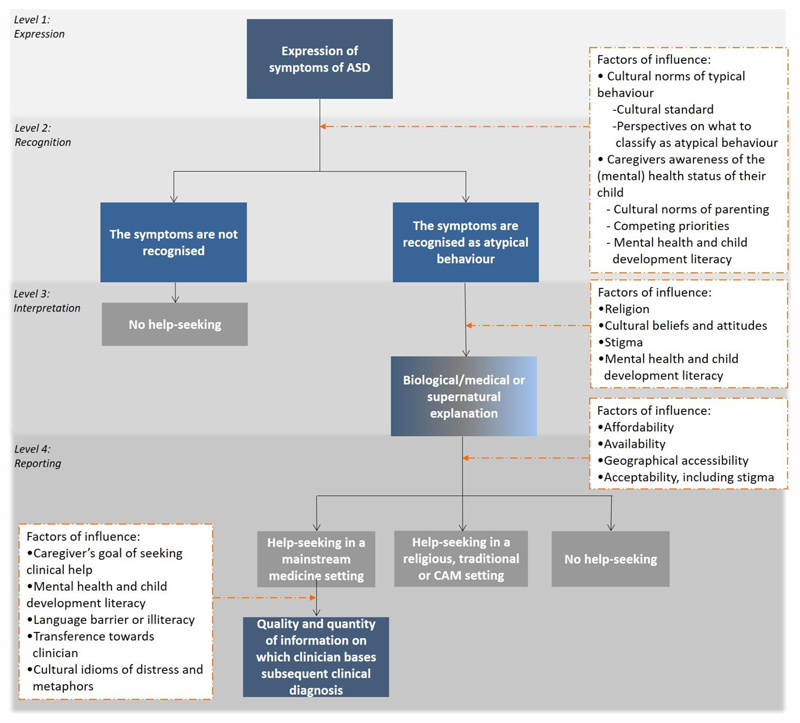
Autism research is heavily skewed toward western high-income countries. Culturally appropriate screening and diagnostic instruments for autism are lacking in most low- and middle-income settings where the majority of the global autism population lives. To date, a clear overview of the possible cultural and contextual factors that may affect the process of identifying and diagnosing individuals with autism spectrum disorders (ASD) is missing. This study aims to outline these factors by proposing a conceptual framework. A multidisciplinary review approach was applied to inform the development of the conceptual framework, combining a systematic review of the relevant autism research literature with a wider literature search spanning key texts in global mental health, cultural psychiatry, cross-cultural psychology, and intellectual disability research. The resulting conceptual framework considers the identification, help-seeking, and diagnostic process at four interrelated levels: (a) the expression; (b) recognition; (c) interpretation; and (d) reporting of autism symptoms, and describes the cultural and contextual factors associated with each of these levels, including cultural norms of typical and atypical behavior, culture-specific approaches to parenting, mental health literacy, cultural beliefs, attitudes and stigma, as well as the affordability, availability, accessibility, and acceptability of services. This framework, mapping out the cultural and contextual factors that can affect the identification, help-seeking, and diagnosis of ASD may function as a springboard for the development of culturally appropriate autism screening and diagnostic instruments, and inform future cross-cultural autism research directions. The framework also has relevance for clinicians and policy makers aiming to improve support for underserved autism populations worldwide. Autism Res 2020, 13: 1029-1050. © 2020 International Society for Autism Research, Wiley Periodicals, Inc. LAY SUMMARY: The vast majority of autism research is conducted in western high-income settings. We therefore know relatively little of how culture and context can affect the identification, help-seeking, and diagnosis of autism across the globe. This study synthesizes what is known from the autism research literature and a broader literature and maps out how culture and context may affect (a) the expression, (b) recognition, (c) interpretation, and (d) reporting of autism symptoms.
自闭症研究严重偏向于西方高收入国家。在大多数中低收入环境中,缺乏适合文化的自闭症筛查和诊断工具,而这些环境中生活着全球大多数自闭症患者。迄今为止,对于可能影响识别和诊断自闭症谱系障碍(ASD)个体的文化和背景因素,我们缺乏清晰的概述。本研究旨在通过提出一个概念框架来概述这些因素。采用多学科综述方法为概念框架的制定提供信息,将自闭症相关研究文献的系统综述与更广泛的文献检索相结合,涵盖全球心理健康、文化精神病学、跨文化心理学和智力残疾研究的关键文本。由此产生的概念框架考虑了在四个相互关联的层面上自闭症的识别、寻求帮助和诊断过程:(a)表现;(b)识别;(c)解释;(d)自闭症症状的报告,并描述了与这些层面相关的文化和背景因素,包括典型和非典型行为的文化规范、特定于文化的育儿方法、心理健康素养、文化信仰、态度和耻辱感,以及服务的可负担性、可及性、可及性和可接受性。该框架详细说明了可能影响自闭症识别、寻求帮助和诊断的文化和背景因素,可以作为开发适合文化的自闭症筛查和诊断工具的基础,并为未来的跨文化自闭症研究方向提供信息。该框架对于旨在为全球服务不足的自闭症人群提供支持的临床医生和政策制定者也具有相关性。自闭症研究 2020 年,13:1029-1050。 © 2020 自闭症国际研究协会,威利期刊,公司。 摘要:绝大多数自闭症研究都是在西方高收入环境中进行的。因此,我们对文化和背景如何在全球范围内影响自闭症的识别、寻求帮助和诊断知之甚少。本研究综合了自闭症研究文献和更广泛文献中的知识,并绘制了文化和背景如何影响(a)自闭症症状的表达、(b)识别、(c)解释和(d)报告。