Division of Cardiovascular Medicine, Radcliffe Department of Medicine, University of Oxford, Oxford, United Kingdom.
British Heart Foundation Centre of Research Excellence, University of Oxford, Oxford, United Kingdom.
Am J Physiol Heart Circ Physiol. 2020 Mar 1;318(3):H715-H722. doi: 10.1152/ajpheart.00023.2020. Epub 2020 Feb 21.
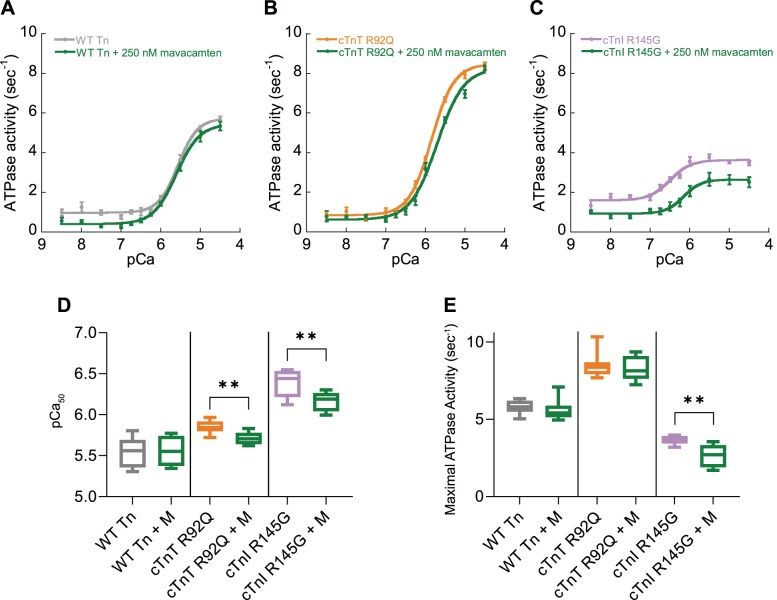
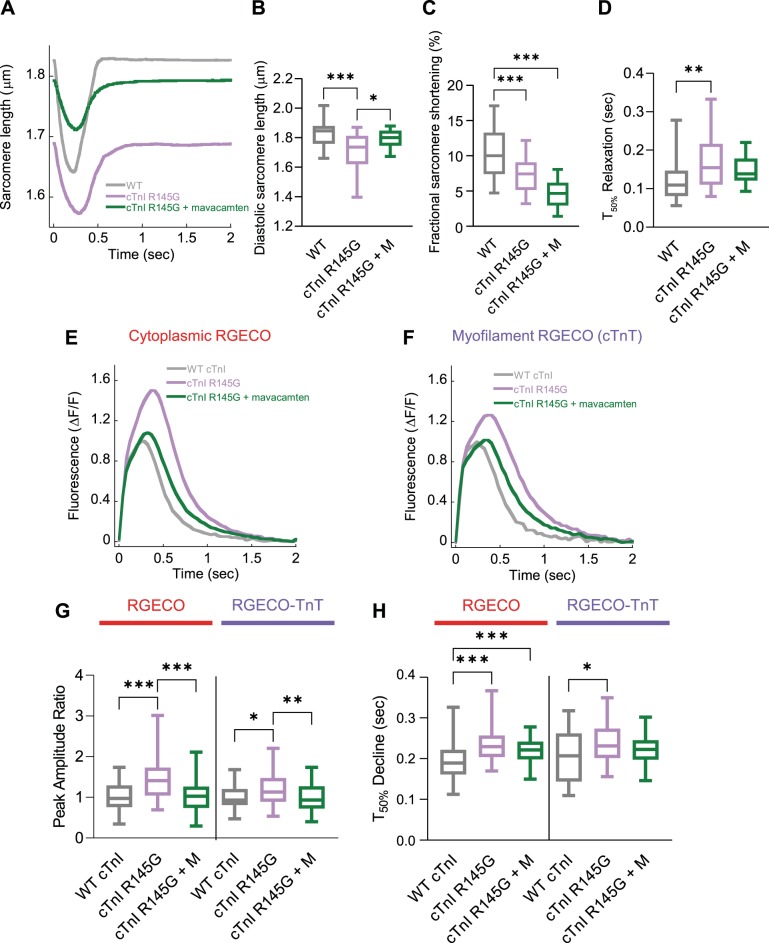
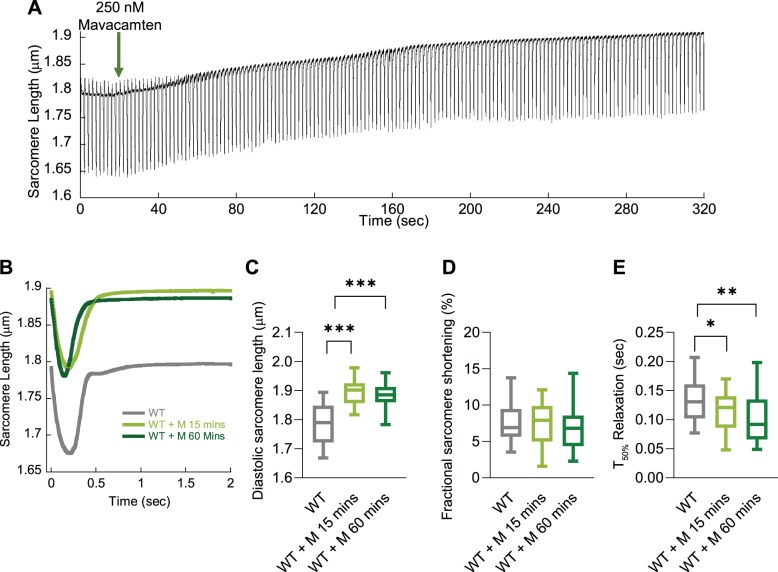
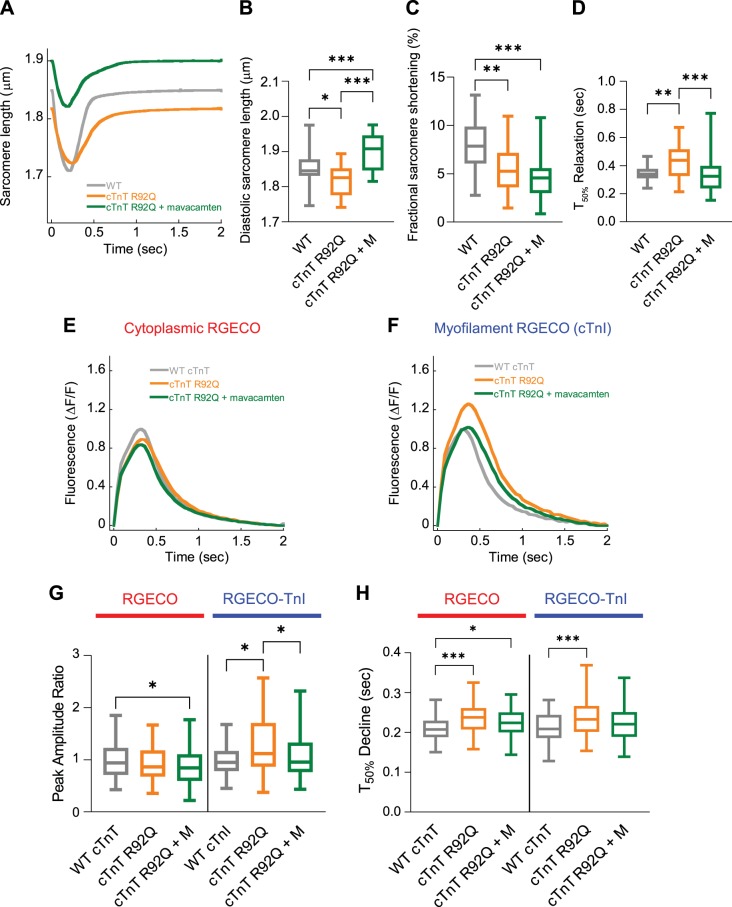
Thin filament hypertrophic cardiomyopathy (HCM) mutations increase myofilament Ca sensitivity and alter Ca handling and buffering. The myosin inhibitor mavacamten reverses the increased contractility caused by HCM thick filament mutations, and we here test its effect on HCM thin filament mutations where the mode of action is not known. Mavacamten (250 nM) partially reversed the increased Ca sensitivity caused by HCM mutations Cardiac troponin T (cTnT) R92Q, and cardiac troponin I (cTnI) R145G in in vitro ATPase assays. The effect of mavacamten was also analyzed in cardiomyocyte models of cTnT R92Q and cTnI R145G containing cytoplasmic and myofilament specific Ca sensors. While mavacamten rescued the hypercontracted basal sarcomere length, the reduced fractional shortening did not improve with mavacamten. Both mutations caused an increase in peak systolic Ca detected at the myofilament, and this was completely rescued by 250 nM mavacamten. Systolic Ca detected by the cytoplasmic sensor was also reduced by mavacamten treatment, although only R145G increased cytoplasmic Ca. There was also a reversal of Ca decay time prolongation caused by both mutations at the myofilament but not in the cytoplasm. We thus show that mavacamten reverses some of the Ca-sensitive molecular and cellular changes caused by the HCM mutations, particularly altered Ca flux at the myofilament. The reduction of peak systolic Ca as a consequence of mavacamten treatment represents a novel mechanism by which the compound is able to reduce contractility, working synergistically with its direct effect on the myosin motor. Mavacamten, a myosin inhibitor, is currently in phase-3 clinical trials as a pharmacotherapy for hypertrophic cardiomyopathy (HCM). Its efficacy in HCM caused by mutations in thin filament proteins is not known. We show in reductionist and cellular models that mavacamten can rescue the effects of thin filament mutations on calcium sensitivity and calcium handling although it only partially rescues the contractile cellular phenotype and, in some cases, exacerbates the effect of the mutation.
薄肌丝肥厚型心肌病(HCM)突变增加肌球蛋白细丝 Ca 敏感性,并改变 Ca 处理和缓冲。肌球蛋白抑制剂 mavacamten 可逆转由 HCM 厚肌丝突变引起的收缩力增加,我们在此测试其对 HCM 薄肌丝突变的影响,其作用机制尚不清楚。Mavacamten(250 nM)部分逆转了由 HCM 突变肌钙蛋白 T(cTnT)R92Q 和肌钙蛋白 I(cTnI)R145G 在体外 ATP 酶测定中引起的 Ca 敏感性增加。还分析了 mavacamten 在含有细胞质和肌丝特异性 Ca 传感器的 cTnT R92Q 和 cTnI R145G 心肌细胞模型中的作用。虽然 mavacamten 挽救了超收缩的基础肌节长度,但减少的分数缩短并未随 mavacamten 而改善。两种突变均导致肌丝上检测到的收缩期峰值 Ca 增加,这完全被 250 nM mavacamten 挽救。细胞质传感器检测到的收缩期 Ca 也因 mavacamten 处理而降低,尽管只有 R145G 增加了细胞质 Ca。两种突变还导致肌丝上 Ca 衰减时间延长,但在细胞质中则没有。因此,我们表明 mavacamten 逆转了由 HCM 突变引起的一些 Ca 敏感的分子和细胞变化,特别是肌丝上 Ca 流的改变。由于 mavacamten 处理,峰值收缩期 Ca 的减少代表了该化合物能够降低收缩力的一种新机制,与其对肌球蛋白马达的直接作用协同作用。Mavacamten 是一种肌球蛋白抑制剂,目前正在进行肥厚型心肌病(HCM)的 3 期临床试验,作为肥厚型心肌病的药物治疗。其在由薄肌丝蛋白突变引起的 HCM 中的疗效尚不清楚。我们在简化模型和细胞模型中表明,mavacamten 可以挽救薄肌丝突变对 Ca 敏感性和 Ca 处理的影响,尽管它仅部分挽救了收缩细胞表型,并且在某些情况下,加剧了突变的影响。