Department of Sport Science and Sport, FAU, Erlangen, Germany
Department of Sport Science and Sport, FAU, Erlangen, Germany.
BMJ Open. 2020 Feb 20;10(2):e034045. doi: 10.1136/bmjopen-2019-034045.
We analysed the information on current national physical activity recommendations in all EU Member States provided by governments in a joint EU/WHO survey on the implementation status of the EU Council Recommendation on Health-Enhancing Physical Activity across Sectors.
Cross-sectional survey.
The representatives of the 28 EU Member State governments to the EU Physical Activity Focal Point Network.
National recommendations on: (A) minimum frequency, duration, intensity and lengths of bouts of physical activity, (B) preventing inactivity or sedentary behaviour and (C) further recommendations for additional health benefits, obesity prevention and specific types of activity.
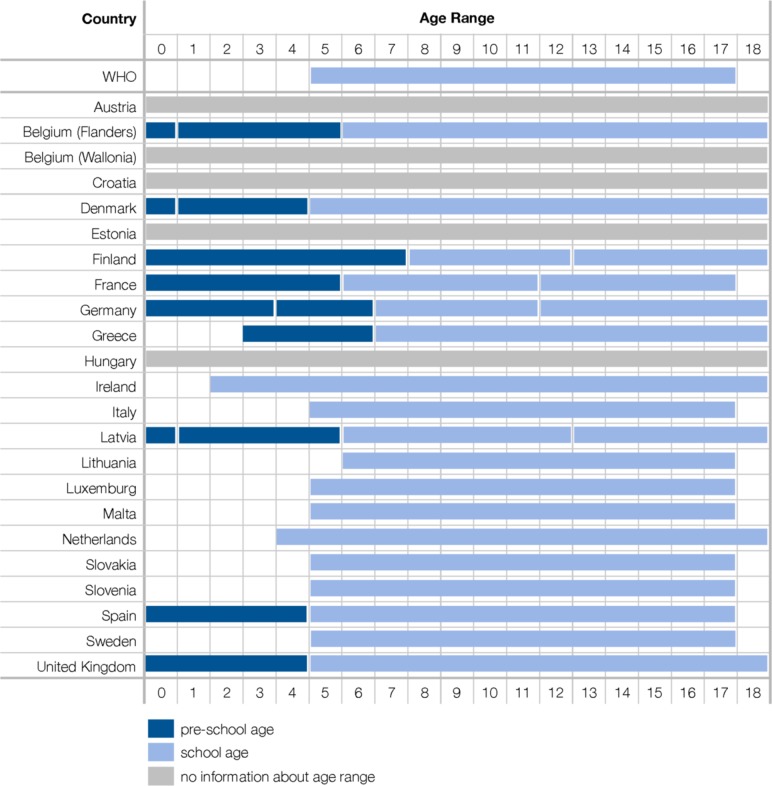
An official document could be located for 23 of the 28 EU Member States, while four are currently developing recommendations. For children and adolescents, most countries follow the 2010 WHO Global Recommendations for Physical Activity, but there are notable differences in the delimitation of age groups. 14 countries also followed WHO in their recommendations for adults, and 11 countries have additional advice on avoiding inactivity and sitting among adults. 18 Member States have recommendations for older adults, 12 of which follow WHO. Thirteen countries also address at least one special population (eg, pregnant women, people with disabilities and people with chronic diseases), but the level of detail varies substantially between countries.
The large majority of EU Member States either has physical activity recommendations in place or is in the process of developing them. There is a general tendency to use the WHO Global Recommendations as a basis, with the greatest variation observable for children and adolescents. Comparing results with a previous round of data collection shows that the number of EU countries with physical activity recommendations is increasing and that both special groups and sedentary behaviour have become more important in recent years.
我们分析了各国政府在欧盟/世界卫生组织(WHO)关于欧盟理事会跨部门促进有益健康体力活动建议实施情况联合调查中提供的有关欧盟所有成员国现行国家体力活动建议的信息。
横断面调查。
欧盟体力活动联络点网络 28 个欧盟成员国政府的代表。
国家建议:(A)体力活动的最低频率、持续时间、强度和时间长度,(B)预防不活动或久坐行为,(C)进一步建议获得其他健康益处、预防肥胖和特定类型的活动。
可以找到 28 个欧盟成员国中的 23 个成员国的正式文件,而其他 4 个成员国正在制定建议。对于儿童和青少年,大多数国家遵循 2010 年世卫组织全球体力活动建议,但年龄组的划分存在显著差异。14 个国家还在世卫组织建议的基础上对成年人提出建议,11 个国家对成年人避免不活动和久坐提出了额外建议。18 个成员国对老年人有建议,其中 12 个遵循世卫组织的建议。13 个国家还针对至少一个特殊群体(如孕妇、残疾人和慢性病患者)提出了建议,但各国之间的详细程度存在很大差异。
绝大多数欧盟成员国已经制定或正在制定体力活动建议。一般倾向于使用世卫组织全球建议作为基础,儿童和青少年的差异最大。将结果与之前一轮数据收集进行比较表明,有体力活动建议的欧盟国家数量正在增加,近年来特殊群体和久坐行为变得更加重要。