Department of Family Medicine, College of Medicine, Charles R Drew University of Medicine and Science, Los Angeles, CA, 90059, USA.
Department of Family Medicine, UCLA, Los Angeles, CA, USA.
J Racial Ethn Health Disparities. 2020 Aug;7(4):776-784. doi: 10.1007/s40615-020-00719-5. Epub 2020 Feb 21.
Although the protective effect of socioeconomic status (SES) against risk of overweight/obesity is well established, such effects may not be equal across diverse racial and ethnic groups, as suggested by the marginalization-related diminished returns (MDR) theory.
Built on the MDR theory, this study explored racial variation in the protective effect of income against overweight/obesity of Whites and Blacks with knee osteoarthritis (OA).
This cross-sectional study used baseline data of the OA Initiative, a national study of knee OA in the USA. This analysis included 4664 adults with knee OA, which was composed of 3790 White and 874 Black individuals. Annual income was the independent variable. Overweight/obesity status (body mass index more than 25 kg/m2) was the dependent variable. Race was the moderator. Logistic regressions were used for data analysis.
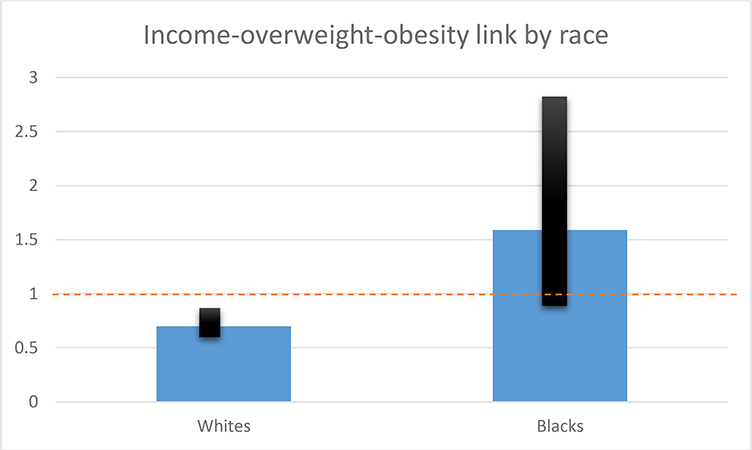
Overall, higher income was associated with lower odds of being overweight/obese. Race and income showed a statistically significant interaction on overweight/obesity status, indicating smaller protective effect of income for Blacks compared with Whites with knee OA. Race-stratified regression models revealed an inverse association between income and overweight/obesity for White but not Black patients.
While higher income protects Whites with knee OA against overweight/obesity, this effect is absent for Blacks with knee OA. Clinicians should not assume that the needs of high-income Whites and Blacks with knee OA are similar, as high-income Blacks may have greater unmet needs than high-income Whites. Racially tailored programs may help reduce the health disparities between Whites and Blacks with knee OA. The results are important given that elimination of racial disparities in obesity is a step toward eliminating racial gap in the burden of knee OA. This is particularly important given that overweight/obesity is not only a prognostic factor for OA but also a risk factor for cardiometabolic diseases and premature mortality.
尽管社会经济地位(SES)对超重/肥胖风险的保护作用已得到充分证实,但正如边缘化相关回报递减(MDR)理论所表明的那样,这种作用在不同种族和族裔群体中可能并不均等。
本研究基于 MDR 理论,探讨了 SES 对膝骨关节炎(OA)白人和黑人超重/肥胖的保护作用在不同种族间的差异。
本横断面研究使用了美国全国性膝 OA 研究——OA 倡议的基线数据。该分析纳入了 4664 名膝 OA 成年人,其中 3790 名白人,874 名黑人。年收入是自变量,超重/肥胖状态(BMI 大于 25kg/m2)是因变量,种族是调节变量。采用 logistic 回归进行数据分析。
总体而言,较高的收入与较低的超重/肥胖几率相关。种族和收入在超重/肥胖状态上存在统计学显著的交互作用,表明与膝 OA 的白人相比,收入对黑人的保护作用较小。按种族分层的回归模型显示,收入与白人膝 OA 患者的超重/肥胖呈负相关,但与黑人膝 OA 患者无关。
虽然较高的收入可以保护白人膝 OA 患者免受超重/肥胖的影响,但这种作用在黑人膝 OA 患者中并不存在。临床医生不应假设高收入的白人和黑人膝 OA 患者的需求相似,因为高收入的黑人可能比高收入的白人有更大的未满足需求。针对种族的计划可能有助于减少膝 OA 白人和黑人之间的健康差距。鉴于消除肥胖方面的种族差异是消除膝 OA 负担方面种族差距的一个步骤,因此这一结果非常重要。这一点尤为重要,因为超重/肥胖不仅是 OA 的预后因素,也是心血管代谢疾病和过早死亡的风险因素。