Cheng Yuwei, Paintsil Elijah, Ghebremichael Musie
Department of Mathematical and Computer Sciences, College of the Holy Cross, Worcester, MA, USA.
Department of Pediatrics, Yale University School of Medicine, New Haven, CT, USA.
AIDS Res Treat. 2020 Feb 7;2020:7607834. doi: 10.1155/2020/7607834. eCollection 2020.
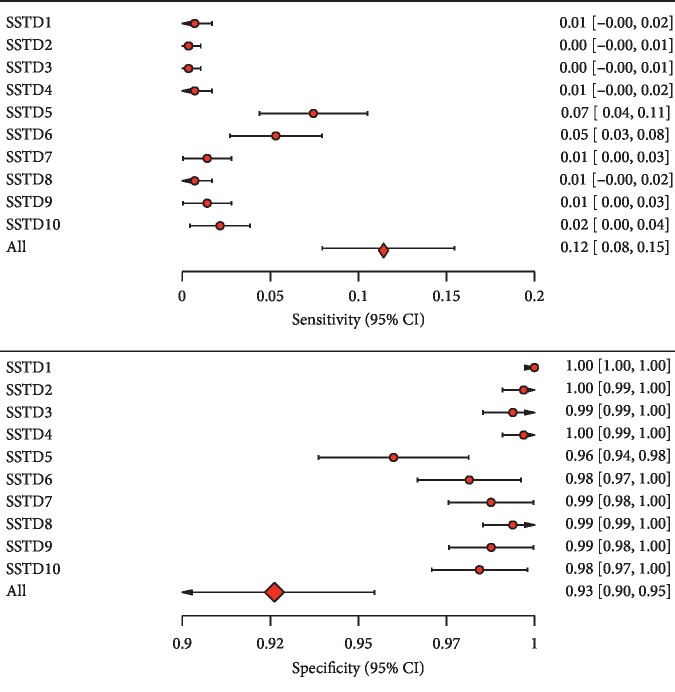
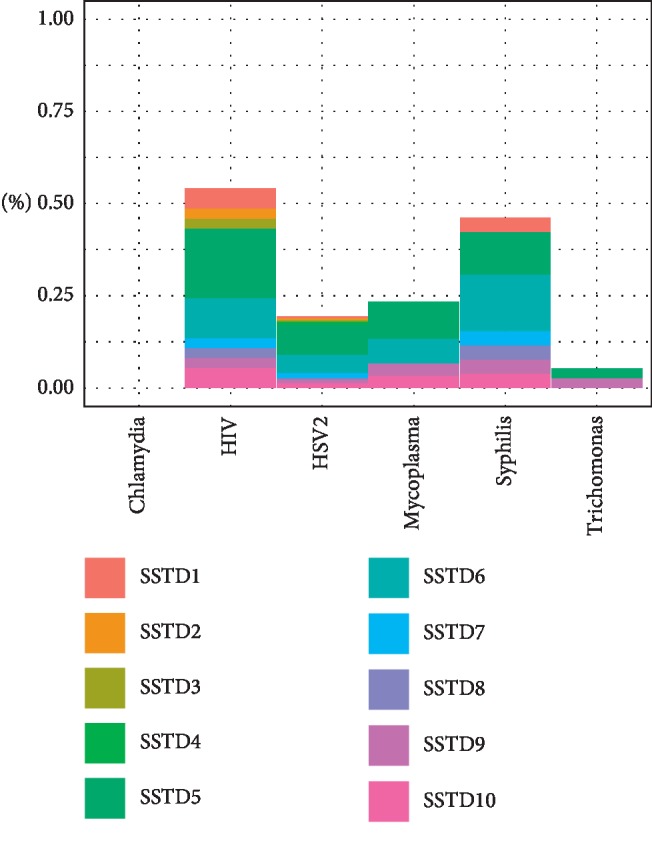
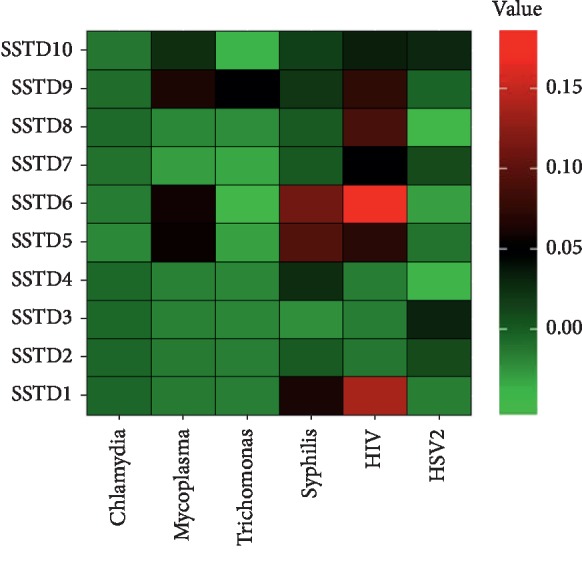
The syndromic diagnosis of sexually transmitted infections (STIs) is widely recognized as the most practical, feasible, and cost-effective diagnostic tool in resource-limited settings. This study assessed the diagnostic accuracy of syndromic versus laboratory testing of STIs among 794 men randomly selected from the Moshi district of Tanzania. Participants were interviewed with a questionnaire that included questions on history of STIs symptoms. Blood and urine samples were taken from the participants for laboratory testing. Only 7.9% of the men reported any symptoms of STI; however, 46% of them tested positive for at least one STI. There was little agreement between syndromic and laboratory-confirmed diagnoses, with low sensitivity (0.4%-7.4%) and high specificity (96%-100%) observed for each individual symptom. The area under the receiver-operating curve was 0.528 (95% CI: 0.505-0.550), indicating that the syndromic approach has a 52.8% probability of correctly identifying STIs in study participants. In conclusion, whenever possible, laboratory diagnosis of STI should be favored over syndromic diagnosis.
性传播感染(STIs)的症状诊断被广泛认为是资源有限环境中最实用、可行且具有成本效益的诊断工具。本研究评估了从坦桑尼亚莫希区随机选取的794名男性中,性传播感染症状诊断与实验室检测的诊断准确性。通过问卷调查对参与者进行访谈,问卷包含有关性传播感染症状病史的问题。采集参与者的血液和尿液样本进行实验室检测。只有7.9%的男性报告有任何性传播感染症状;然而,其中46%的人至少有一种性传播感染检测呈阳性。症状诊断与实验室确诊诊断之间几乎没有一致性,每种个体症状的敏感性较低(0.4%-7.4%),特异性较高(96%-100%)。受试者工作特征曲线下面积为0.528(95%置信区间:0.505-0.550),表明症状诊断方法在研究参与者中正确识别性传播感染的概率为52.8%。总之,只要有可能,性传播感染的实验室诊断应优于症状诊断。