National Institute for Public Health and the Environment (RIVM), Centre for Infectious Disease Control, Preparedness and Response Unit, Antonie van Leeuwenhoeklaan 9, Bilthoven 3721MA, Netherlands.
Athena Institute, Free University, Amsterdam, Netherlands.
Biomed Res Int. 2020 Jan 23;2020:5861894. doi: 10.1155/2020/5861894. eCollection 2020.
As demonstrated during the global Ebola crisis of 2014-2016, healthcare institutions in high resource settings need support concerning preparedness during threats of infectious disease outbreaks. This study aimed to exploratively develop a standardized preparedness system to use during unfolding threats of severe infectious diseases.
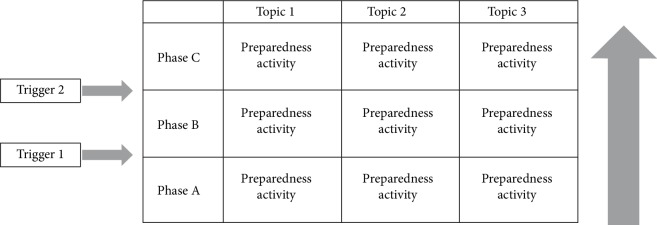
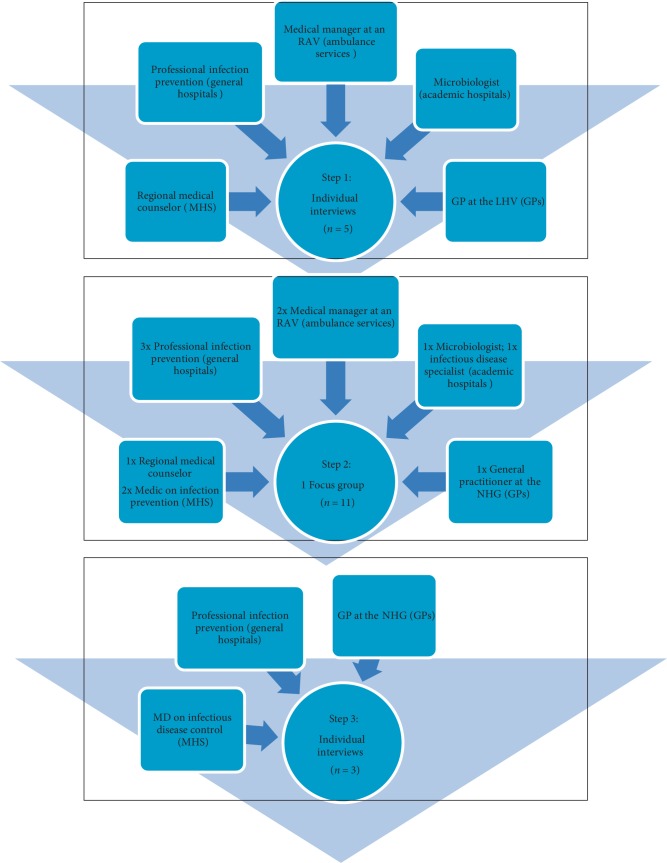
A qualitative three-step study among infectious disease prevention and control experts was performed. First, interviews ( = 5) were conducted to identify which factors trigger preparedness activities during an unfolding threat. Second, these triggers informed the design of a phased preparedness system which was tested in a focus group discussion ( = 5) were conducted to identify which factors trigger preparedness activities during an unfolding threat. Second, these triggers informed the design of a phased preparedness system which was tested in a focus group discussion ( = 5) were conducted to identify which factors trigger preparedness activities during an unfolding threat. Second, these triggers informed the design of a phased preparedness system which was tested in a focus group discussion (.
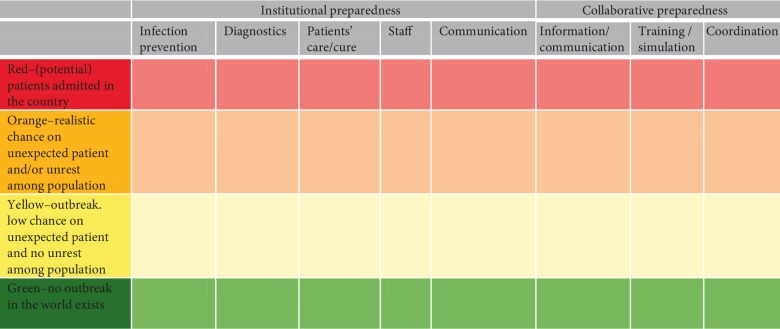
Four preparedness phases were identified: preparedness phase green is a situation without the presence of the infectious disease threat that requires centralized care, anywhere in the world. Phase yellow is an outbreak in the world with some likelihood of imported cases. Phase orange is a realistic chance of an unexpected case within the country, or unrest developing among population or staff; phase red is cases admitted to hospitals in the country, potentially causing a shortage of resources. Specific preparedness activities included infection prevention, diagnostics, patient care, staff, and communication. Consensus was reached on the need for the development of a preparedness system and national coordination during threats.
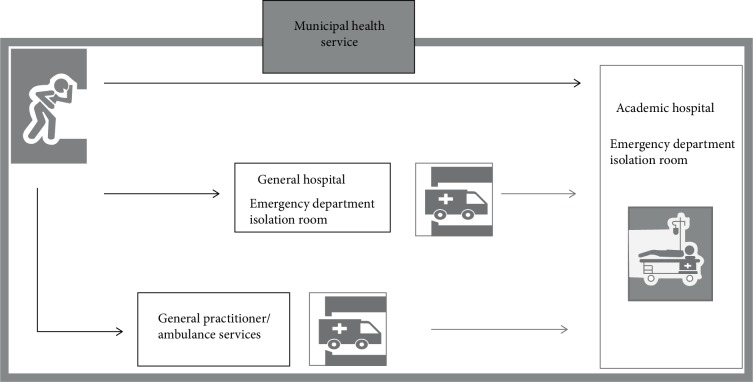
In this study, we developed a standardized system to support institutional preparedness during an increasing threat. Use of this system by both curative healthcare institutions and the (municipal) public health service, could help to effectively communicate and align preparedness activities during future threats of severe infectious diseases.
正如 2014-2016 年全球埃博拉危机所表明的那样,高资源环境下的医疗机构在传染病爆发威胁时需要得到准备方面的支持。本研究旨在探索性地制定一个标准化的准备系统,以用于严重传染病威胁的展开。
在传染病预防和控制专家中进行了一项定性的三步研究。首先,进行了访谈(=5),以确定在威胁展开时触发准备活动的因素。其次,这些触发因素为分阶段准备系统的设计提供了信息,该系统在焦点小组讨论(=5)中进行了测试,以确定在威胁展开时触发准备活动的因素。其次,这些触发因素为分阶段准备系统的设计提供了信息,该系统在焦点小组讨论(=5)中进行了测试,以确定在威胁展开时触发准备活动的因素。其次,这些触发因素为分阶段准备系统的设计提供了信息,该系统在焦点小组讨论(=5)中进行了测试。
确定了四个准备阶段:准备阶段绿色是一种没有传染病威胁的情况,需要在世界任何地方进行集中护理。黄色阶段是世界范围内爆发的传染病,有一定可能性输入病例。橙色阶段是国内出现意外病例或民众或员工中出现动乱的现实可能性;红色阶段是国内医院收治的病例,可能导致资源短缺。具体的准备活动包括感染预防、诊断、患者护理、员工和沟通。达成了在威胁期间制定准备系统和国家协调的共识。
在这项研究中,我们开发了一个标准化的系统,以支持机构在威胁增加时的准备。治疗性医疗机构和(市)公共卫生服务机构使用该系统,有助于在未来严重传染病威胁期间有效沟通和协调准备活动。