School of Medicine, Western Sydney University, Campbelltown, NSW, Australia.
Department of Respiratory Medicine, Blacktown Hospital, Blacktown, NSW, Australia.
PLoS One. 2020 Feb 24;15(2):e0229250. doi: 10.1371/journal.pone.0229250. eCollection 2020.
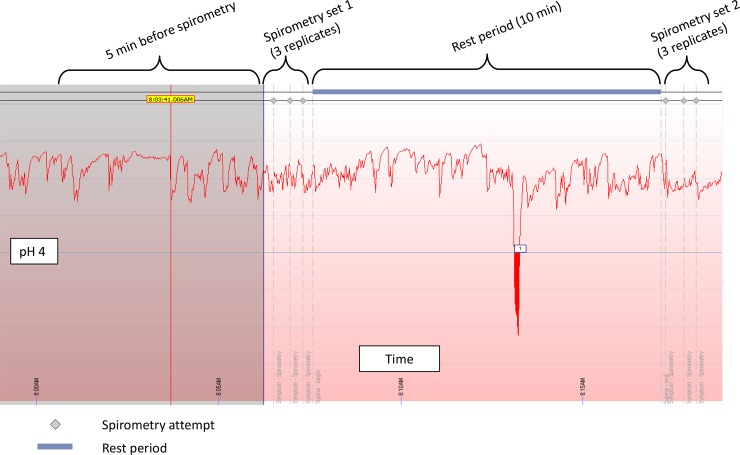
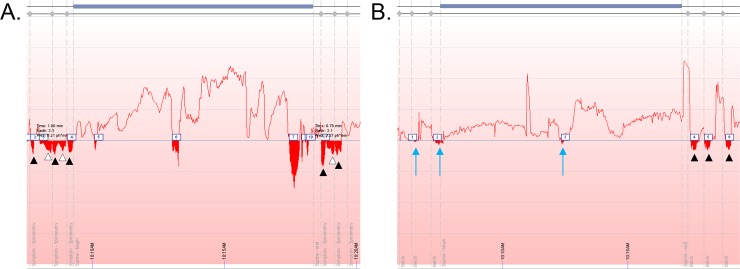
Variability during spirometry can persist despite control of technical and personal factors. We postulate spirometry induces gastro-oesophageal reflux (GOR), which may cause variability and affect results of spirometry. Fifty-eight (58) subjects undergoing GOR investigation with oesophageal manometry and 24hr pH monitoring were recruited. Oesophageal dysmotility and GOR were assessed as part of clinical care. Subjects performed 2 sets of spirometry separated by a 10-minute rest period. The assessment of GOR during spirometry procedure (defined by a lower oesophageal pH<4) started from the first set of spirometry and concluded when the second set of spirometry was completed. We calculated variability (%) of FEV1, FVC and PEFR within each set as well as changes over 10-minutes. Twenty-six subjects (45%) recorded GOR during assessment. Of these, 23 subjects recorded GOR during the 10-minute rest period. Four subjects had GOR recorded only during spirometry tests. We did not find variability of spirometry parameters between the groups with and without GOR during spirometry procedure. However, in subjects with GOR, we found small but significant reductions of PEFR (0.5L/s, 8%, p<0.001) and FEV1 (84 mL, 3%, p = 0.048) in the second set of spirometry compared to the first spirometry set. This pilot study demonstrates that GOR can occur during and following spirometry. Presence of GOR during spirometry in this patient population caused small decreases in PEFR and FEV1 when it is repeated 10-minutes later however not increase variability in a single series of measurements.
在控制了技术和个人因素后,肺活量测定中的可变性仍然可能持续存在。我们假设肺活量测定会引起胃食管反流(GOR),这可能导致可变性并影响肺活量测定的结果。我们招募了 58 名接受 GOR 调查的患者,这些患者接受了食管测压和 24 小时 pH 监测。作为临床护理的一部分,评估了食管动力障碍和 GOR。患者在 10 分钟的休息期之间进行了 2 组肺活量测定。在肺活量测定过程中(定义为下食管 pH<4)开始评估 GOR,当完成第 2 组肺活量测定时结束。我们计算了每组内 FEV1、FVC 和 PEFR 的变异率(%)以及 10 分钟内的变化。26 名患者(45%)在评估过程中记录到 GOR。其中,23 名患者在 10 分钟休息期间记录到 GOR。仅在肺活量测定试验中记录到 4 名患者的 GOR。我们没有发现在有和没有在肺活量测定过程中 GOR 的组之间的肺活量测定参数的可变性。然而,在有 GOR 的患者中,我们发现与第 1 组肺活量测定相比,第 2 组肺活量测定的 PEFR(0.5L/s,8%,p<0.001)和 FEV1(84 mL,3%,p=0.048)有较小但有统计学意义的降低。这项初步研究表明,GOR 可在肺活量测定期间和之后发生。在该患者人群中,在肺活量测定期间存在 GOR 会导致在 10 分钟后重复测量时 PEFR 和 FEV1 略有下降,但不会增加单一系列测量的可变性。