Castello Angelo, Carbone Francesco Giuseppe, Rossi Sabrina, Monterisi Simona, Federico Davide, Toschi Luca, Lopci Egesta
Nuclear Medicine, Humanitas Clinical and Research Center-IRCCS, 20089 Rozzano, Italy.
Anatomy and Histopathology, Santa Chiara Hospital, 38122 Trento, Italy.
Cancers (Basel). 2020 Feb 19;12(2):487. doi: 10.3390/cancers12020487.
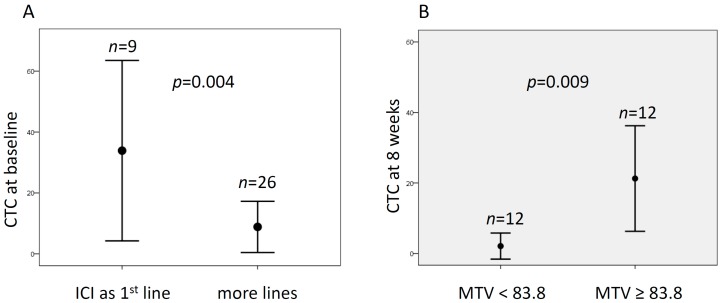
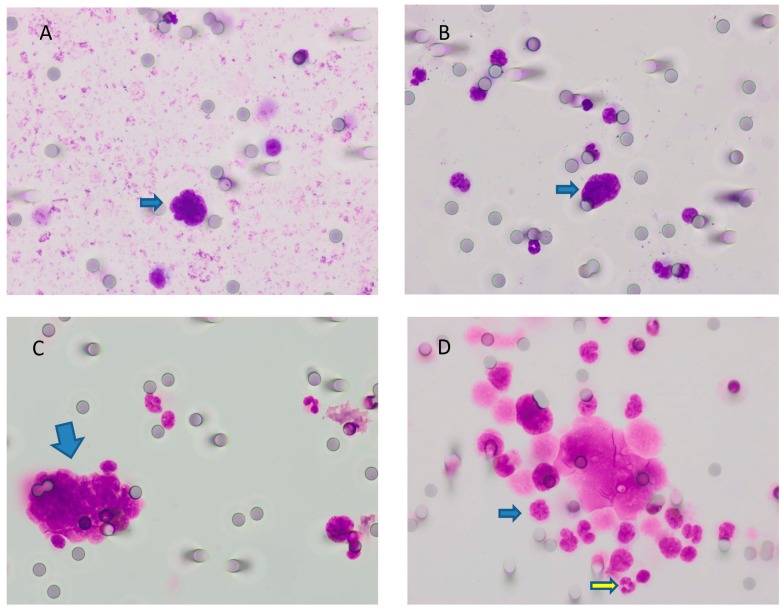
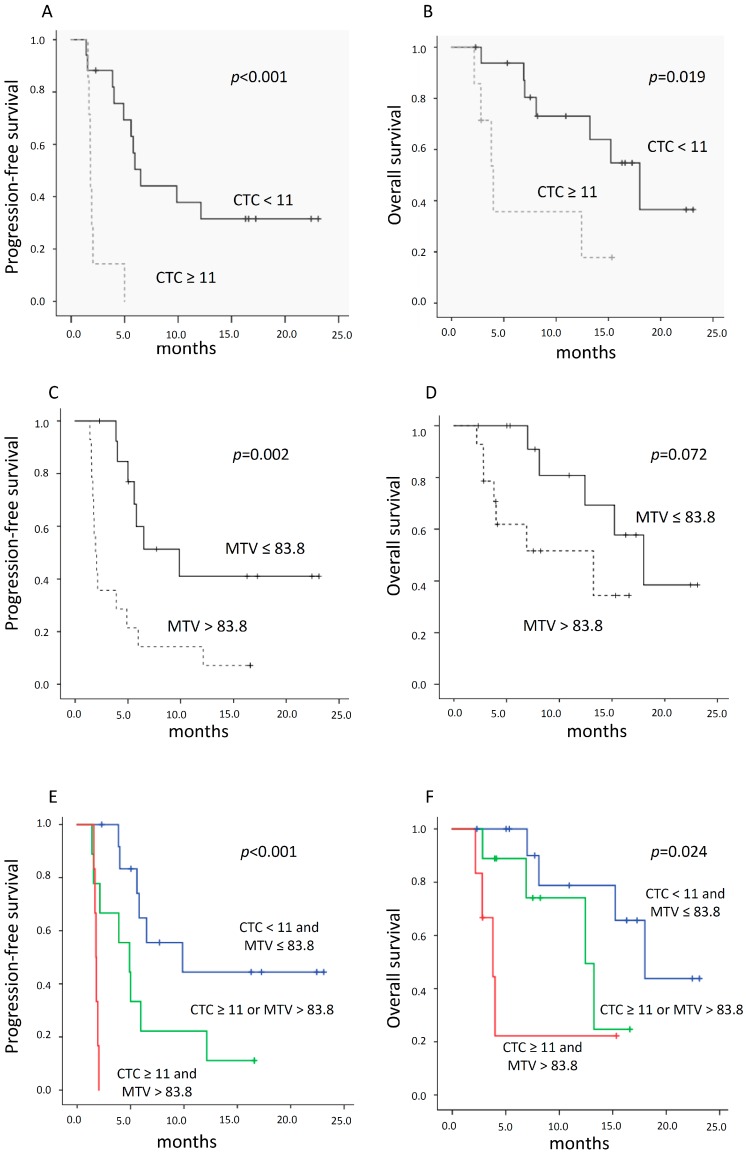
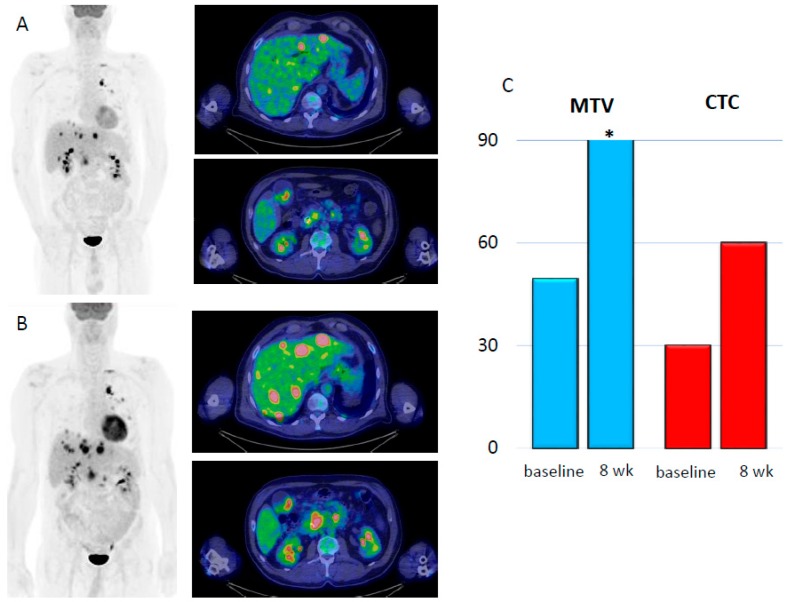
Circulating tumor cells (CTC) count and characterization have been associated with poor prognosis in recent studies. Our aim was to examine CTC count and its association with metabolic parameters and clinical outcomes in non-small cell lung carcinoma (NSCLC) patients treated with immune checkpoint inhibitors (ICI). For this prospective study, data from 35 patients (23 males, 12 females) were collected and analyzed. All patients underwent an 18F-fluorodeoxyglucose positron emission tomography/computed tomography (18F-FDG-PET/CT) scan and CTC detection through Isolation by Size of Tumor/Trophoblastic Cells (ISET) from peripheral blood samples obtained at baseline and 8 weeks after ICI initiation. Association of CTC count with clinical and metabolic characteristics was studied. Progression-free survival (PFS) and overall survival (OS) were analyzed using the Kaplan-Meier method and the log-rank test. Median follow-up was 13.2 months (range of 4.9-21.6). CTC were identified in 16 out of 35 patients (45.7%) at baseline and 10 out of 24 patients at 8 weeks (41.7%). Mean CTC numbers before and after 8 weeks were 15 ± 28 and 11 ± 19, respectively. Prior to ICI, the mean CTC number was significantly higher in treatment-naïve patients (34 ± 39 vs. 9 ± 21, = 0.004). CTC count variation (ΔCTC) was significantly associated with tumor metabolic response set by European Organization for Research and Treatment of Cancer (EORTC) criteria ( = 0.033). At the first restaging, patients with a high tumor burden, that is, metabolic tumor volume (MTV) and total lesion glycolysis (TLG), had a higher CTC count ( = 0.009). The combination of mean CTC and median MTV at 8 weeks was associated with PFS ( < 0.001) and OS ( = 0.024). Multivariate analysis identified CTC count at 8 weeks as an independent predictor for PFS and OS, whereas ΔMTV and maximum standardized uptake value variation (ΔSUVmax) was predictive for PFS and OS, respectively. Our study confirmed that CTC number is modulated by previous treatments and correlates with metabolic response during ICI. Moreover, elevated CTC count, along with metabolic parameters, were found to be prognostic factors for PFS and OS.
循环肿瘤细胞(CTC)计数及特征在近期研究中已被证实与预后不良相关。我们的目的是研究接受免疫检查点抑制剂(ICI)治疗的非小细胞肺癌(NSCLC)患者的CTC计数及其与代谢参数和临床结局的关系。在这项前瞻性研究中,我们收集并分析了35例患者(23例男性,12例女性)的数据。所有患者均接受了18F-氟脱氧葡萄糖正电子发射断层扫描/计算机断层扫描(18F-FDG-PET/CT)检查,并通过肿瘤/滋养层细胞大小分离法(ISET)从基线及ICI开始治疗8周后采集的外周血样本中检测CTC。研究了CTC计数与临床和代谢特征的相关性。采用Kaplan-Meier法和对数秩检验分析无进展生存期(PFS)和总生存期(OS)。中位随访时间为13.2个月(范围4.9 - 21.6个月)。35例患者中有16例(45.7%)在基线时检测到CTC,24例患者中有10例(41.7%)在8周时检测到CTC。8周前后的平均CTC数量分别为15±28和11±19。在接受ICI治疗前,初治患者的平均CTC数量显著更高(34±39 vs. 9±21,P = 0.004)。CTC计数变化(ΔCTC)与欧洲癌症研究与治疗组织(EORTC)标准设定的肿瘤代谢反应显著相关(P = 0.033)。在首次重新分期时,肿瘤负荷高的患者,即代谢肿瘤体积(MTV)和总病灶糖酵解(TLG)高的患者,CTC计数更高(P = 0.009)。8周时平均CTC与中位MTV的组合与PFS(P < 0.001)和OS(P = 0.024)相关。多因素分析确定8周时的CTC计数是PFS和OS的独立预测因素,而ΔMTV和最大标准化摄取值变化(ΔSUVmax)分别是PFS和OS的预测因素。我们的研究证实,CTC数量受既往治疗的调节,并与ICI治疗期间的代谢反应相关。此外,升高的CTC计数与代谢参数一起被发现是PFS和OS的预后因素。