Hammani Salim, Moulai-Mostefa Nadji, Samyn Pieter, Bechelany Mikhael, Dufresne Alain, Barhoum Ahmed
Laboratoire de Chimie Physique Moléculaire et Macromléculaire, Faculté de Science, Université de Blida, 109000 Blida, Algeria.
Laboratoire Matériaux et Environnement, Faculté des Sciences & Technologie, Université de Médéa, Ain D'Heb, 26001 Medea, Algeria.
Materials (Basel). 2020 Feb 19;13(4):926. doi: 10.3390/ma13040926.
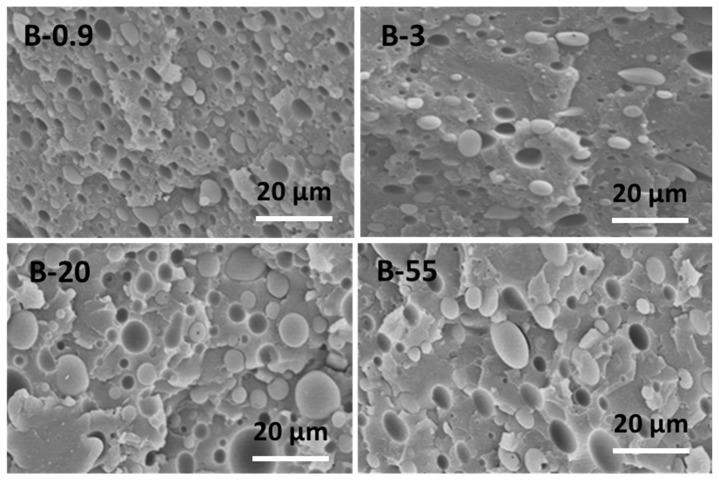
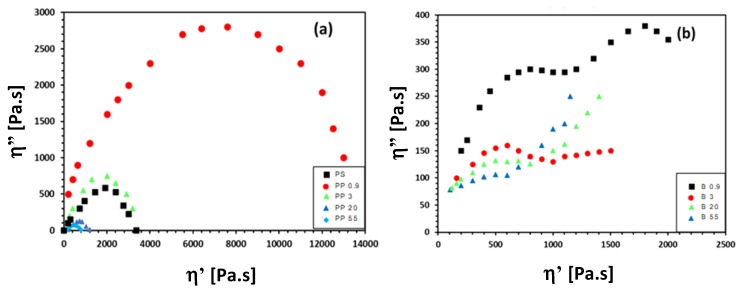
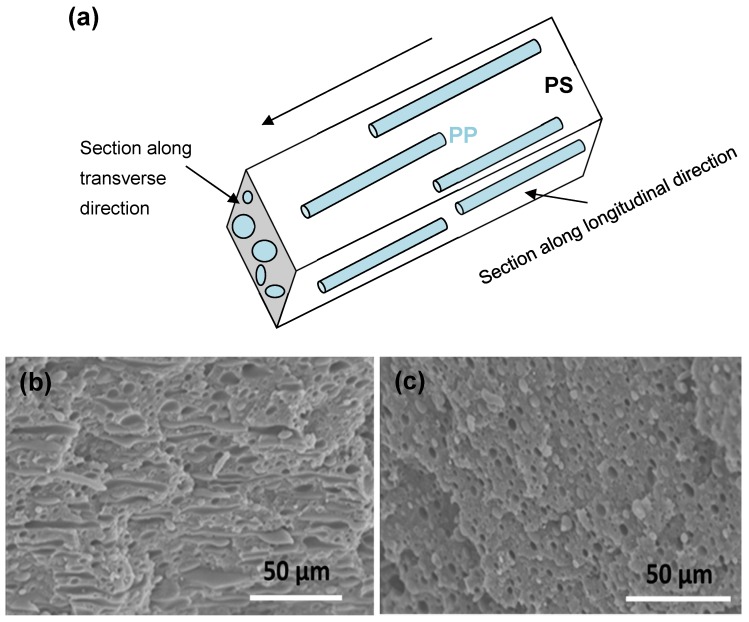
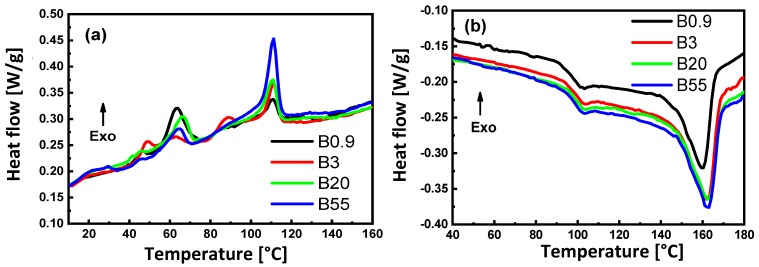
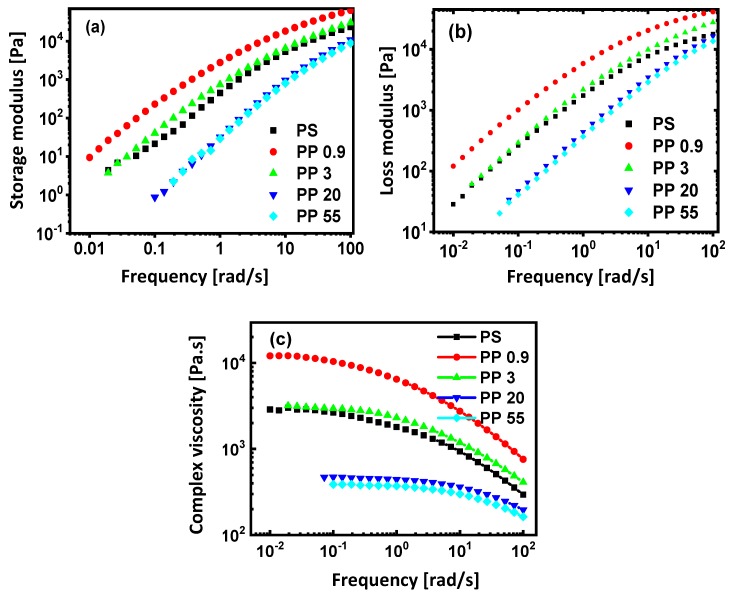
Microfibrillar and droplet morphology of polypropylene (PP) phase dispersed in polypropylene (PS) was fabricated by using melt-extrusion. This morphology was obtained by introducing isotactic PP (20 wt.%) with different viscosity in the PS matrix (80 wt.%). Furthermore, the rheological properties of the blend investigated as a function of the viscosity ratio . The variations in blend morphology were related to crystallization, melting properties, and viscoelasticity. The blends with >> 1 develop a fine morphology with PP microfibrils along the flow direction, while diameters of the dispersed PP droplets gradually increase with lower values of = 1, or << 1. Crystallinity of the prepared blends significantly decreases compared to neat PP, while the microfibrillar morphology induces homogeneous crystallization with small crystallites. This is reflected in a decrease of the crystallization temperature, small loss in the crystallinity, and lower melting temperature of the PS80/PP20 blend compared to neat PP. The storage moduli, loss moduli, and complex viscosity are highest for the microfibrillar morphology that presents retarded relaxation. The rheological properties are dominated by the dispersed phase ( > 1), or matrix ( < 1). The variation in blend properties with microfibrillar morphology can be clearly distinguished from heterogeneous blends containing PP droplets, providing an efficient tool to create a binary blend with unique properties.
通过熔融挤出制备了分散在聚苯乙烯(PS)中的聚丙烯(PP)相的微纤丝状和液滴状形态。这种形态是通过在PS基体(80 wt.%)中引入具有不同粘度的等规PP(20 wt.%)获得的。此外,研究了共混物的流变性能与粘度比的函数关系。共混物形态的变化与结晶、熔融性能和粘弹性有关。当粘度比 >> 1时,共混物形成沿流动方向具有PP微纤丝的精细形态,而当粘度比 = 1或 << 1时,分散的PP液滴直径逐渐增大。与纯PP相比,所制备共混物的结晶度显著降低,而微纤丝状形态诱导形成具有小晶粒的均匀结晶。这体现在PS80/PP20共混物与纯PP相比结晶温度降低、结晶度损失较小以及熔融温度较低。对于呈现弛豫延迟的微纤丝状形态,储能模量、损耗模量和复数粘度最高。流变性能由分散相( > 1)或基体( < 1)主导。具有微纤丝状形态的共混物性能变化可以与含有PP液滴的非均相共混物明显区分开来,为制备具有独特性能的二元共混物提供了一种有效工具。