Board of Governors Regenerative Medicine Institute, Cedars-Sinai Medical Center, Los Angeles, CA 90048, USA.
Department of Pathology and Laboratory Medicine, Cedars-Sinai Medical Center, Los Angeles, CA 90048, USA.
Int J Mol Sci. 2020 Feb 20;21(4):1438. doi: 10.3390/ijms21041438.
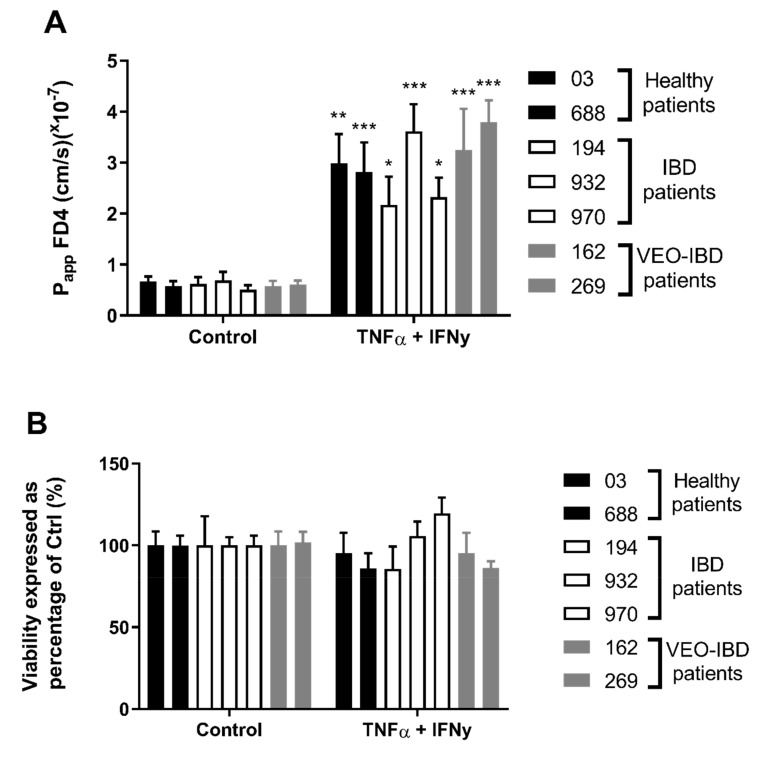
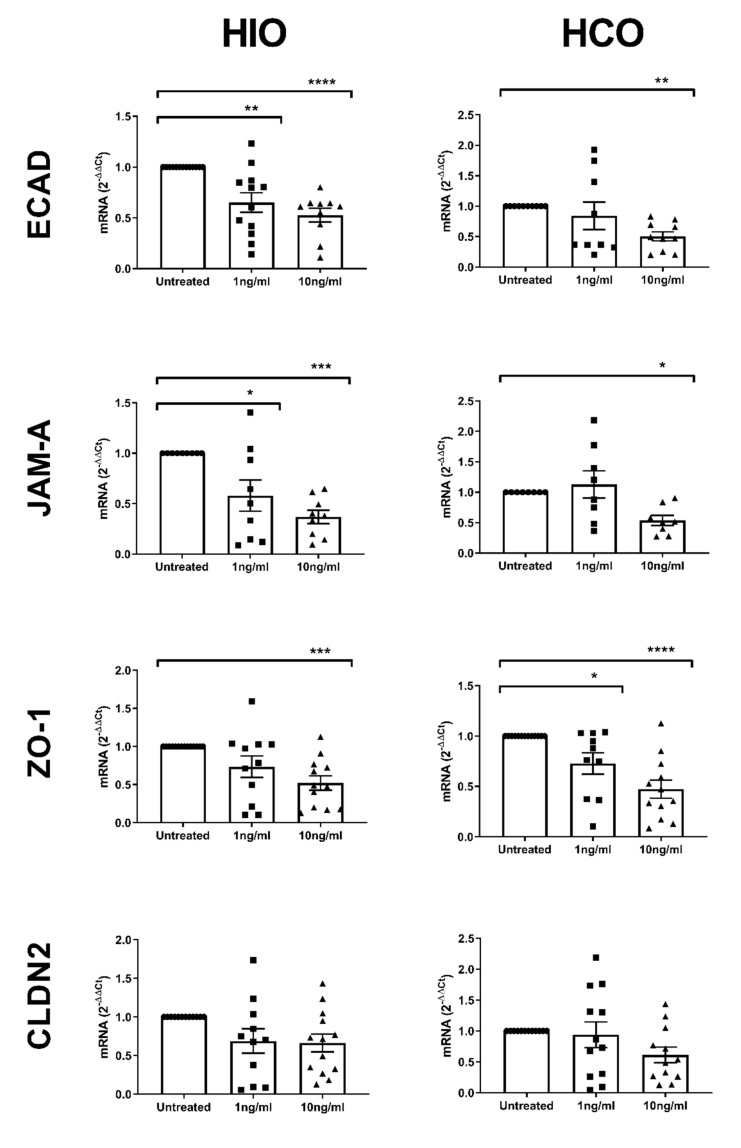
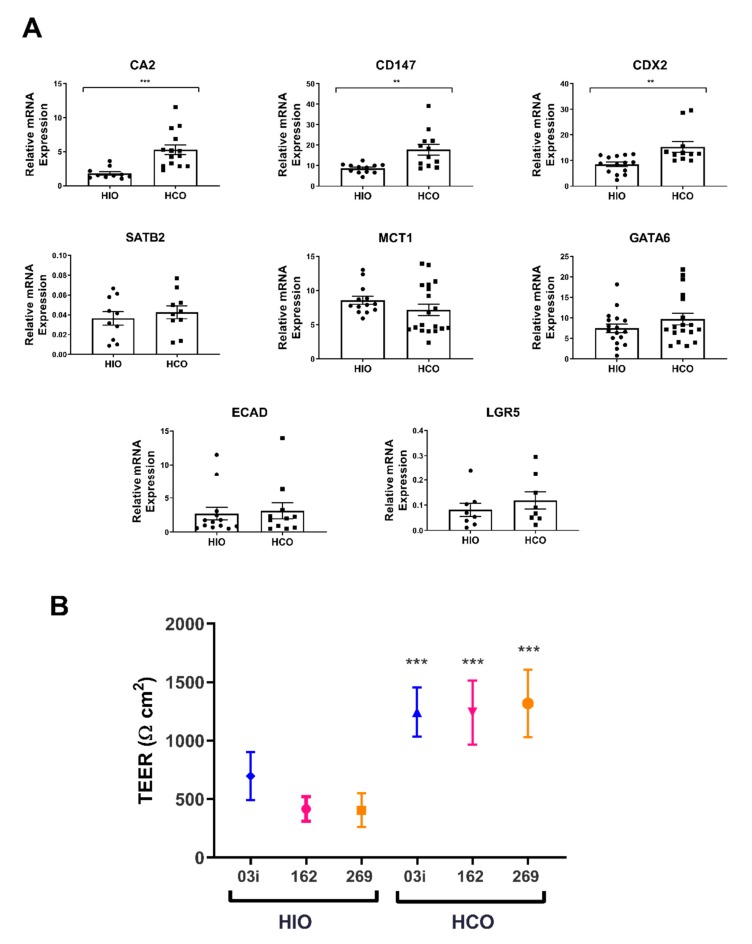
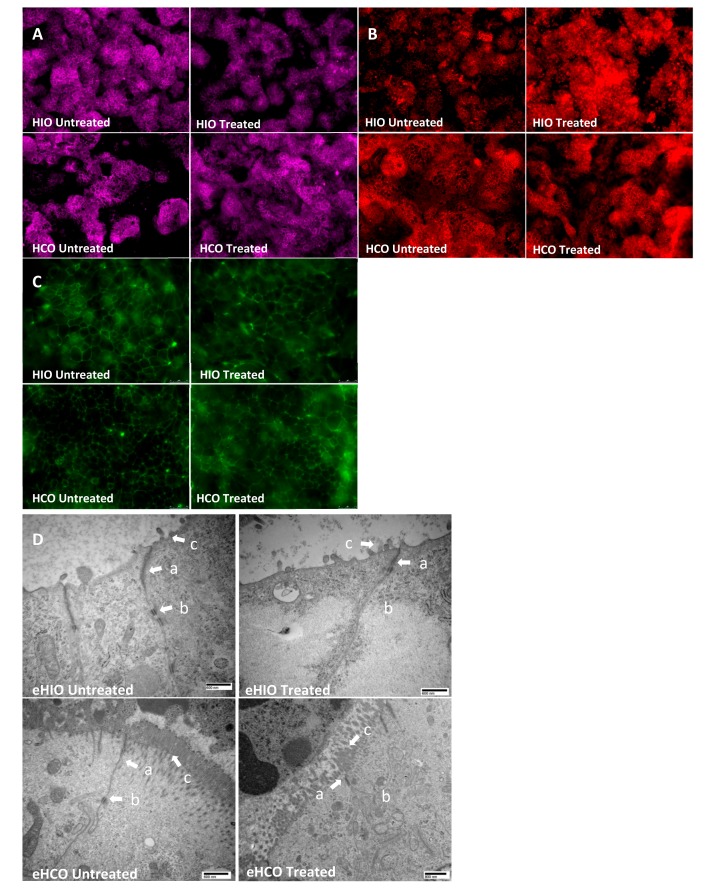
In inflammatory bowel disease (IBD), the intestinal epithelium is characterized by increased permeability both in active disease and remission states. The genetic underpinnings of this increased intestinal permeability are largely unstudied, in part due to a lack of appropriate modelling systems. Our aim is to develop an model of intestinal permeability using induced pluripotent stem cell (iPSC)-derived human intestinal organoids (HIOs) and human colonic organoids (HCOs) to study barrier dysfunction. iPSCs were generated from healthy controls, adult onset IBD, and very early onset IBD (VEO-IBD) patients and differentiated into HIOs and HCOs. EpCAM+ selected cells were seeded onto Transwell inserts and barrier integrity studies were carried out in the presence or absence of pro-inflammatory cytokines TNFα and IFNγ. Quantitative real-time PCR (qRT-PCR), transmission electron microscopy (TEM), and immunofluorescence were used to determine altered tight and adherens junction protein expression or localization. Differentiation to HCO indicated an increased gene expression of , and , and increased basal transepithelial electrical resistance compared to HIO. Permeability studies were carried out in HIO- and HCO-derived epithelium, and permeability of FD4 was significantly increased when exposed to TNFα and IFNγ. TEM and immunofluorescence imaging indicated a mislocalization of E-cadherin and ZO-1 in TNFα and IFNγ challenged organoids with a corresponding decrease in mRNA expression. Comparisons between HIO- and HCO-epithelium show a difference in gene expression, electrophysiology, and morphology: both are responsive to TNFα and IFNγ stimulation resulting in enhanced permeability, and changes in tight and adherens junction architecture. This data indicate that iPSC-derived HIOs and HCOs constitute an appropriate physiologically responsive model to study barrier dysfunction and the role of the epithelium in IBD and VEO-IBD.
在炎症性肠病 (IBD) 中,肠上皮在活动期和缓解期都表现出通透性增加。这种增加的肠通透性的遗传基础在很大程度上尚未得到研究,部分原因是缺乏适当的建模系统。我们的目标是使用诱导多能干细胞 (iPSC) 衍生的人类肠类器官 (HIO) 和人类结肠类器官 (HCO) 开发肠通透性模型,以研究屏障功能障碍。从健康对照、成人发病 IBD 和早期发病 IBD (VEO-IBD) 患者中生成 iPSC,并将其分化为 HIO 和 HCO。EpCAM+ 选择的细胞接种到 Transwell 插入物上,并在存在或不存在促炎细胞因子 TNFα 和 IFNγ 的情况下进行屏障完整性研究。使用定量实时 PCR (qRT-PCR)、透射电子显微镜 (TEM) 和免疫荧光测定来确定改变的紧密和黏附连接蛋白表达或定位。向 HCO 的分化表明与 HIO 相比, 、 和 的基因表达增加,基础跨上皮电阻增加。在 HIO 和 HCO 衍生的上皮中进行通透性研究,当暴露于 TNFα 和 IFNγ 时,FD4 的通透性显著增加。TEM 和免疫荧光成像表明 TNFα 和 IFNγ 挑战的类器官中 E-钙粘蛋白和 ZO-1 的定位错误,mRNA 表达相应下降。HIO 和 HCO 上皮之间的比较显示出基因表达、电生理学和形态学的差异:两者均对 TNFα 和 IFNγ 刺激有反应,导致通透性增强,以及紧密和黏附连接结构的变化。这些数据表明,iPSC 衍生的 HIO 和 HCO 构成了一种合适的生理反应模型,可用于研究屏障功能障碍以及上皮在 IBD 和 VEO-IBD 中的作用。