Maria Cecilia Hospital, GVM Care & Research, 48033 Cotignola (RA), Italy.
Department of Medical Sciences, University of Ferrara, 44121 Ferrara, Italy.
Int J Mol Sci. 2020 Feb 20;21(4):1452. doi: 10.3390/ijms21041452.
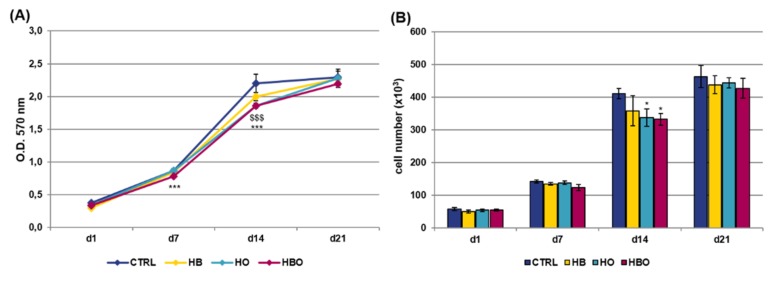
Hyperbaric oxygen (HBO) therapy has been reported to be beneficial for treating many conditions of inflammation-associated bone loss. The aim of this work was to in vitro investigate the effect of HBO in the course of osteogenesis of human Mesenchymal Stem Cells (MSCs) grown in a simulated pro-inflammatory environment. Cells were cultured with osteogenic differentiation factors in the presence or not of the pro-inflammatory cytokine Tumor Necrosis Factor- (TNF-), and simultaneously exposed daily for 60 min, and up to 21 days, at 2,4 atmosphere absolute (ATA) and 100% O. To elucidate osteogenic differentiation-dependent effects, cells were additionally pre-committed prior to treatments. Cell metabolic activity was evaluated by means of the MTT assay and DNA content quantification, whereas osteogenic and vasculogenic differentiation was assessed by quantification of extracellular calcium deposition and gene expression analysis. Metabolic activity and osteogenic properties of cells did not differ between HBO, high pressure (HB) alone, or high oxygen (HO) alone and control if cells were pre-differentiated to the osteogenic lineage. In contrast, when treatments started contextually to the osteogenic differentiation of the cells, a significant reduction in cell metabolic activity first, and in mineral deposition at later time points, were observed in the HBO-treated group. Interestingly, TNF- supplementation determined a significant improvement in the osteogenic capacity of cells subjected to HBO, which was not observed in TNF--treated cells exposed to HB or HO alone. This study suggests that exposure of osteogenic-differentiating MSCs to HBO under in vitro simulated inflammatory conditions enhances differentiation towards the osteogenic phenotype, providing evidence of the potential application of HBO in all those processes requiring bone regeneration.
高压氧(HBO)治疗已被报道对治疗多种炎症相关骨丢失疾病有益。本工作的目的是在体外研究 HBO 对在模拟炎症环境中生长的人间充质干细胞(MSCs)成骨过程的影响。细胞在存在或不存在促炎细胞因子肿瘤坏死因子-(TNF-)的情况下用成骨分化因子培养,并同时在 2 、 4 绝对大气压(ATA)和 100%氧气下每天暴露 60 分钟,最多 21 天。为了阐明成骨分化依赖性效应,细胞在处理前被预先诱导分化。通过 MTT 测定和 DNA 含量定量评估细胞代谢活性,而通过细胞外钙沉积定量和基因表达分析评估成骨和血管生成分化。如果细胞预先分化为成骨谱系,HBO、高压(HB)或高氧(HO)单独与对照相比,细胞代谢活性和成骨特性没有差异。相反,当治疗与细胞的成骨分化同时开始时,在 HBO 处理组中观察到细胞代谢活性首先降低,随后在稍后时间点观察到矿物质沉积减少。有趣的是,TNF- 补充剂确定了在 HBO 处理的细胞中观察到的成骨能力的显著改善,而在 TNF- 处理的单独暴露于 HB 或 HO 的细胞中未观察到这种改善。这项研究表明,在体外模拟炎症条件下,将成骨分化的 MSC 暴露于 HBO 可增强向成骨表型的分化,为 HBO 在所有需要骨再生的过程中的潜在应用提供了证据。