Department of Earth Sciences, Utrecht University, 3584 CB Utrecht, The Netherlands;
Department of Biology, University of Antwerp, B-2610 Wilrijk, Belgium.
Proc Natl Acad Sci U S A. 2020 Mar 10;117(10):5478-5485. doi: 10.1073/pnas.1916244117. Epub 2020 Feb 24.
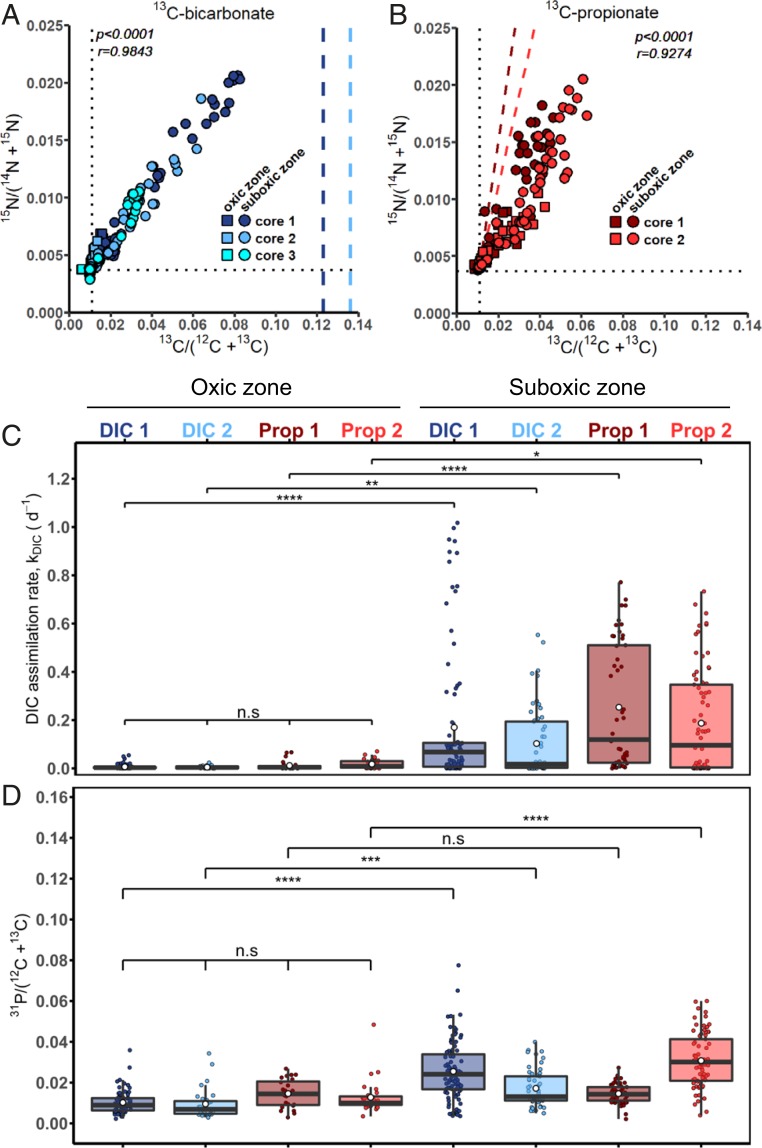
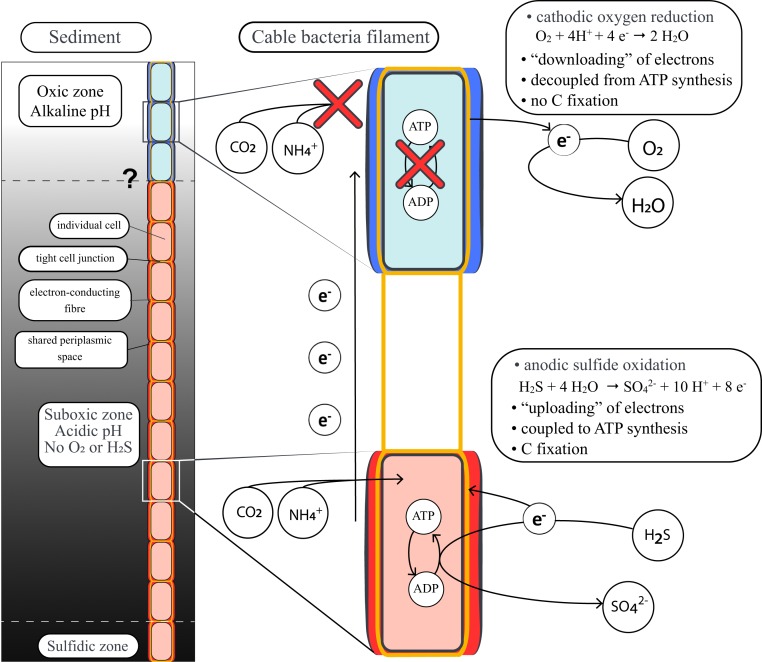
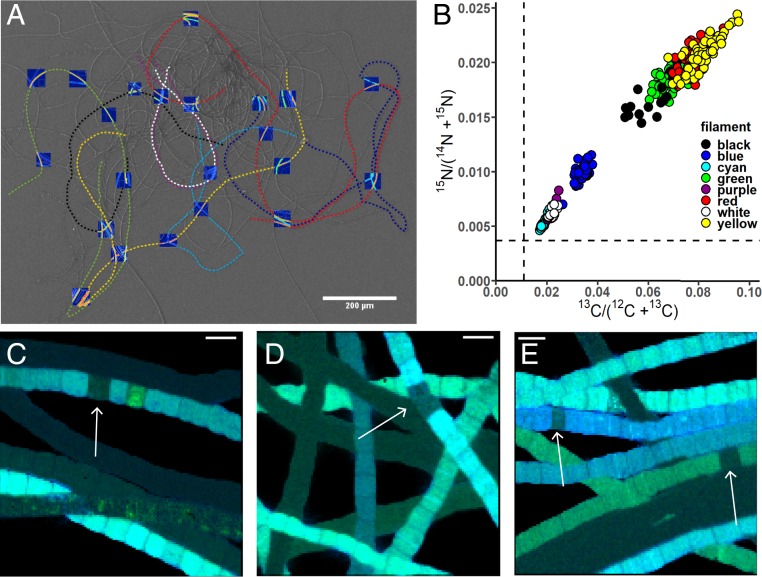
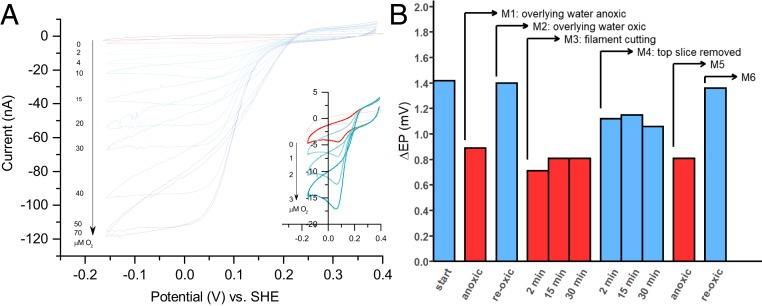
Multicellularity is a key evolutionary innovation, leading to coordinated activity and resource sharing among cells, which generally occurs via the physical exchange of chemical compounds. However, filamentous cable bacteria display a unique metabolism in which redox transformations in distant cells are coupled via long-distance electron transport rather than an exchange of chemicals. This challenges our understanding of organismal functioning, as the link among electron transfer, metabolism, energy conservation, and filament growth in cable bacteria remains enigmatic. Here, we show that cells within individual filaments of cable bacteria display a remarkable dichotomy in biosynthesis that coincides with redox zonation. Nanoscale secondary ion mass spectrometry combined with C (bicarbonate and propionate) and N-ammonia isotope labeling reveals that cells performing sulfide oxidation in deeper anoxic horizons have a high assimilation rate, whereas cells performing oxygen reduction in the oxic zone show very little or no label uptake. Accordingly, oxygen reduction appears to merely function as a mechanism to quickly dispense of electrons with little to no energy conservation, while biosynthesis and growth are restricted to sulfide-respiring cells. Still, cells can immediately switch roles when redox conditions change, and show no differentiation, which suggests that the "community service" performed by the cells in the oxic zone is only temporary. Overall, our data reveal a division of labor and electrical cooperation among cells that has not been seen previously in multicellular organisms.
多细胞性是一种关键的进化创新,导致细胞之间的协调活动和资源共享,这通常是通过化合物的物理交换来实现的。然而,丝状电缆细菌表现出一种独特的代谢方式,其中远程细胞中的氧化还原转化通过长距离电子传递而不是化合物的交换来耦合。这挑战了我们对生物体功能的理解,因为在电缆细菌中,电子传递、代谢、能量守恒和丝状生长之间的联系仍然是神秘的。在这里,我们表明,电缆细菌的单个丝状细胞内的生物合成显示出显著的二分法,与氧化还原分区一致。纳米二次离子质谱结合 C(碳酸氢盐和丙酸盐)和 N-氨同位素标记表明,在较深的缺氧层中进行硫化物氧化的细胞具有较高的同化率,而在有氧区进行氧气还原的细胞几乎没有或没有标记摄取。相应地,氧气还原似乎只是作为一种快速消耗电子的机制,几乎没有能量守恒,而生物合成和生长则限于进行硫化物呼吸的细胞。尽管如此,当氧化还原条件发生变化时,细胞可以立即切换角色,并且没有分化,这表明有氧区细胞所执行的“社区服务”只是暂时的。总的来说,我们的数据揭示了细胞之间的分工和电力合作,这在多细胞生物中以前没有见过。