Wettstein Richard W, Gardner Donna D, Wiatrek Sadie, Ramirez Kristina E, Restrepo Ruben D
Division of Respiratory Care, The University of Texas Health Science Center at San Antonio, San Antonio, TX.
Department of Respiratory Care, Texas State University, Round Rock, TX.
Can J Respir Ther. 2020 Jan 21;56:1-4. doi: 10.29390/cjrt-2019-018. eCollection 2019.
While uncuffed endotracheal tubes have been traditionally used in the pediatric intensive care unit (PICU) population, evidence suggests cuffed endotracheal tubes (ETTs) are also safe to use within this population. Nevertheless, risks related to the use of cuffed ETTs increase when guidelines for safe and appropriate use are not followed. The primary goal of this study was to measure the cuff pressure (CP) using a cuff pressure manometer in a group of intubated pediatric subjects and determine the rate of cuff underinflation (<20 cm H0) or overinflation (>30 cm H0). The secondary aim was to determine whether CP was associated to gender, age, ETT size, and PICU length of stay prior to CP measurement.
This was a prospective observational study conducted in an urban PICU. Pediatric subjects intubated with cuffed ETTs from 1 April 2017 to 1 May 2017 were included in the study. ETT CPs were measured daily to determine degree of inflation and compared according to gender, age, ETT size, and number of days intubated prior to CP measurement. Descriptive data are expressed as means and standard deviations. A two-sample test was used to compare groups according to age, gender, and number of days present. And significance was considered with a 0.05 Pearson chi test was used to evaluate correlation between CPs and size of the ETT, number of days intubated prior to CP measurement, gender, and age.
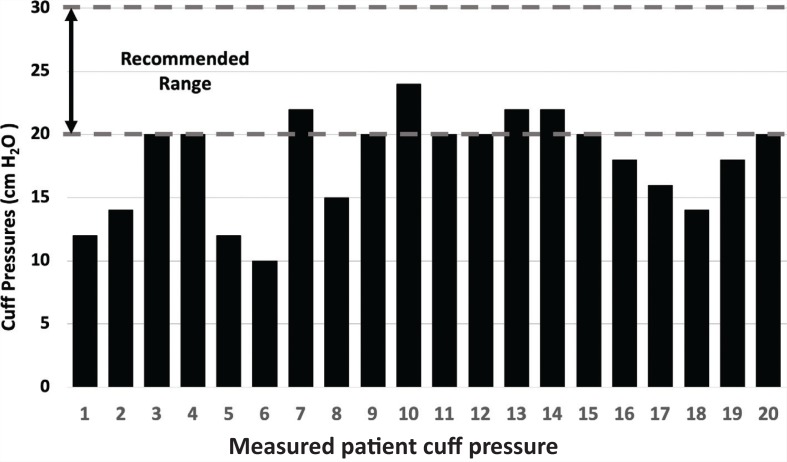
Twenty pediatric subjects admitted during the study period were included for analysis. Eleven cuff measurements were found to be within normal limits, while 9 cuff measurements were found to be underinflated. No cases of overinflation were found. There were no significant associations between CP and size of the ETT ( = -0.08), number of days intubated prior to CP measurement ( = 0.19), gender ( = 0.09), and age ( = 0.12).
Our study suggests that endotracheal cuff underinflation occurs often in the PICU population. Strategies to ensure appropriate ETT CPs are maintained are essential in the intubated pediatric population. Additional studies are necessary to develop interventions and training focused on the use of a cuff pressure manometer to measure CPs in the PICU by respiratory therapists and ensure consistent measurement using inter rater evaluation processes are needed.
虽然无套囊气管内导管传统上用于儿科重症监护病房(PICU)的患者,但有证据表明套囊气管内导管(ETT)在该人群中使用也是安全的。然而,如果不遵循安全和适当使用的指南,与使用套囊ETT相关的风险就会增加。本研究的主要目的是使用套囊压力计测量一组插管儿科患者的套囊压力(CP),并确定套囊充气不足(<20 cm H₂O)或充气过度(>30 cm H₂O)的发生率。次要目的是确定CP是否与性别、年龄、ETT尺寸以及CP测量前在PICU的住院时间有关。
这是一项在城市PICU进行的前瞻性观察性研究。纳入了2017年4月1日至2017年5月1日期间使用套囊ETT插管的儿科患者。每天测量ETT的CP以确定充气程度,并根据性别、年龄、ETT尺寸以及CP测量前的插管天数进行比较。描述性数据以均值和标准差表示。使用双样本t检验根据年龄、性别和住院天数比较组间差异。显著性水平设定为α = 0.05。使用Pearson卡方检验评估CP与ETT尺寸、CP测量前的插管天数、性别和年龄之间的相关性。
研究期间收治的20名儿科患者纳入分析。发现11次套囊测量在正常范围内,而9次套囊测量充气不足。未发现充气过度的情况。CP与ETT尺寸(r = -0.08)、CP测量前的插管天数(r = 0.19)、性别(r = 0.09)和年龄(r = 0.12)之间均无显著相关性。
我们的研究表明,PICU患者中套囊充气不足的情况经常发生。在插管的儿科患者中,确保维持适当的ETT CP的策略至关重要。需要开展更多研究来制定干预措施和培训,重点是由呼吸治疗师在PICU中使用套囊压力计测量CP,并通过评估者间评估过程确保测量的一致性。