Stankiewicz Michal, Li Winnie, Rosewall Tara, Tadic Tony, Dickie Colleen, Velec Michael
Radiation Medicine Program, Princess Margaret Cancer Centre, University Health Network Toronto, Canada.
Department of Radiation Oncology, University of Toronto, Toronto, Canada.
Tech Innov Patient Support Radiat Oncol. 2019 Dec 16;12:50-55. doi: 10.1016/j.tipsro.2019.10.003. eCollection 2019 Dec.
Substantial, unanticipated anatomic variances during cone-beam CT (CBCT)-guided radiotherapy can potentially impact treatment accuracy and clinical outcomes. This study assessed patterns of practice of CBCT variances reported by RTTs and subsequent interventions for multiple-disease sites.
A chart review was conducted at a large cancer centre for patients treated with daily online CBCT-guided radiotherapy. Patients selected for review were identified via RTT-reported variances that then triggered offline multi-disciplinary assessment. Cases were categorized by the type of anatomic variance observed on CBCT and any further interventions recorded such as un-scheduled adaptive re-planning.
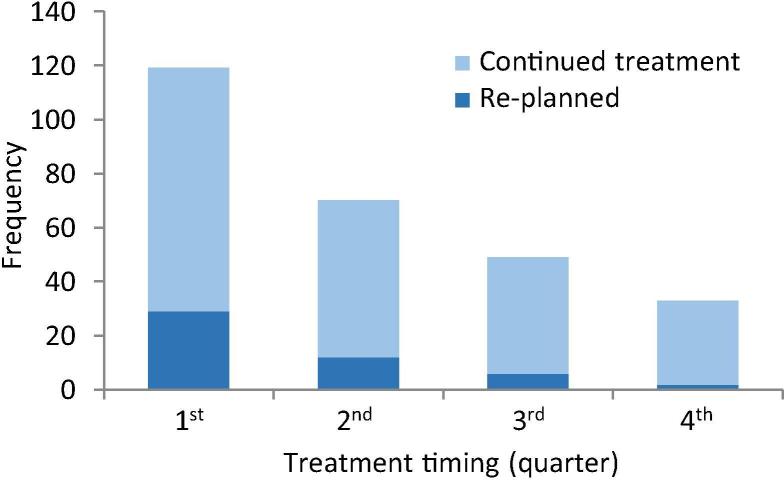
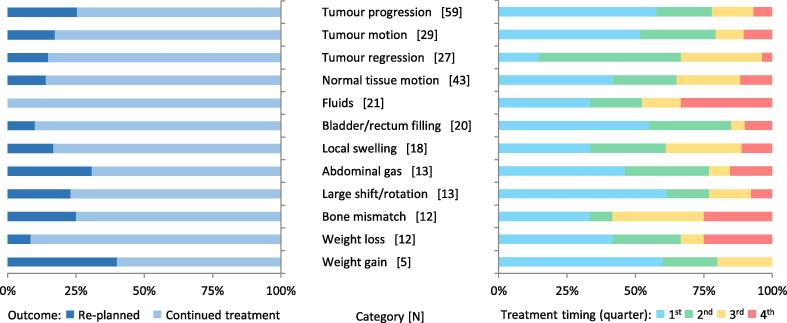
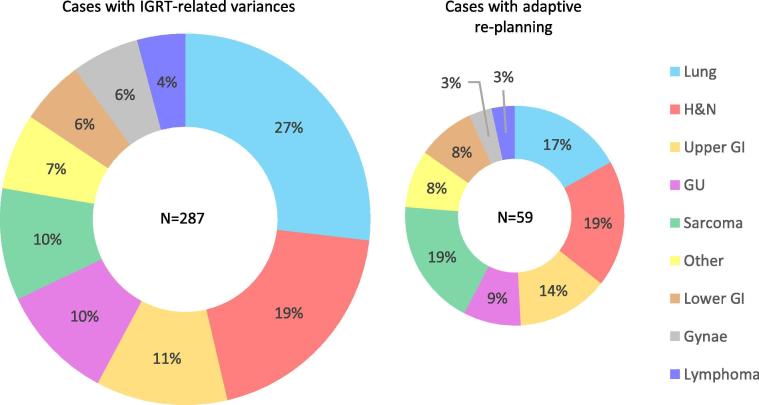
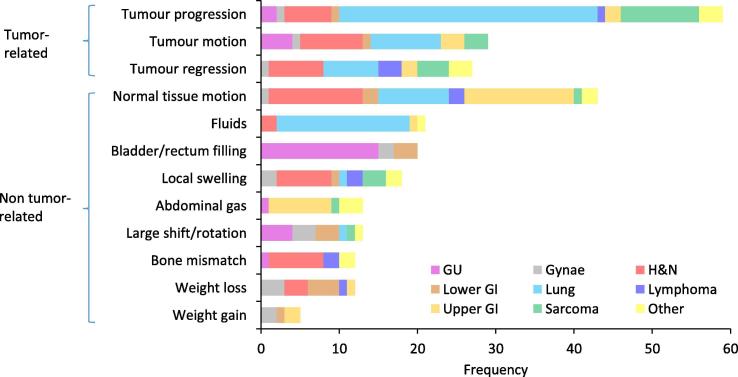
Over a 1-year period, 287 variances from 261 patients were identified (6.2% of the 4207 patients treated with daily CBCT-guided radiotherapy), most often occurring within the first 5 fractions of the treatment course. Of these variances, 21% (59/287) were re-planned and 3.5% (10/287) discontinued treatment altogether. Lung was the most frequent disease-site (27% of 287 variances) reported with IGRT-related variances although head and neck and sarcoma were most frequently re-planned (19% of 59 re-plans for each site). Technical or clinical rationales for re-planning were not routinely documented in patient medical records. All disease-sites had numerous categories of variances. Three of the four most frequent categories were for tumor-related changes on CBCT, and the re-planning rate was highest for tumor progression at 25%. Normal tissue variances were the second most frequency category, and re-planned in 14% of those cases.
RTTs identified a wide range of anatomic variances during CBCT-guided radiotherapy. In a minority of cases, these substantially altered the care plan including adaptive re-planning or treatment discontinuation. Improved understanding of the clinical decisions in these cases would aid in developing more routine, systematic adaptive strategies.
在锥形束CT(CBCT)引导的放射治疗过程中,出现大量意外的解剖学差异可能会影响治疗准确性和临床结果。本研究评估了放射治疗技师(RTT)报告的CBCT差异模式以及针对多个疾病部位的后续干预措施。
在一家大型癌症中心对接受每日在线CBCT引导放射治疗的患者进行病历审查。通过RTT报告的差异来确定被选入审查的患者,这些差异随后引发离线多学科评估。病例根据CBCT上观察到的解剖学差异类型以及记录的任何进一步干预措施进行分类,如非计划适应性重新规划。
在1年期间,共识别出261例患者的287个差异(占4207例接受每日CBCT引导放射治疗患者的6.2%),最常出现在治疗疗程的前5次分割中。在这些差异中,21%(59/287)进行了重新规划,3.5%(10/287)完全停止了治疗。肺部是报告与图像引导放射治疗(IGRT)相关差异最频繁的疾病部位(287个差异中的27%),尽管头颈部和肉瘤是最常进行重新规划的部位(每个部位的59次重新规划中有19%)。重新规划的技术或临床理由在患者病历中未常规记录。所有疾病部位都有多种差异类别。四个最常见类别中的三个是CBCT上与肿瘤相关的变化,肿瘤进展的重新规划率最高,为25%。正常组织差异是第二常见类别,其中14%进行了重新规划。
RTT在CBCT引导的放射治疗过程中识别出了广泛的解剖学差异。在少数情况下,这些差异极大地改变了护理计划,包括适应性重新规划或治疗中断。更好地理解这些情况下的临床决策将有助于制定更常规、系统的适应性策略。