Li Winnie, Appiah Samuel, Hill Christine, Becker Nathan, Catton Charles, Chung Peter, Shultz David, Ferguson Peter, O'Sullivan Brian, Dickie Colleen
Radiation Medicine Program, Princess Margaret Cancer Centre, Toronto, ON, Canada.
Department of Radiation Oncology, University of Toronto, Toronto, ON, Canada.
Tech Innov Patient Support Radiat Oncol. 2018 Feb 4;5:3-8. doi: 10.1016/j.tipsro.2018.01.001. eCollection 2018 Mar.
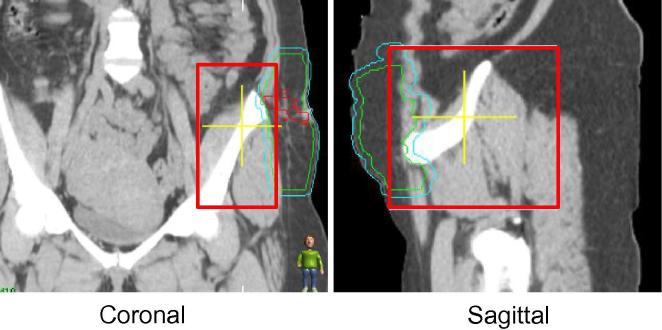
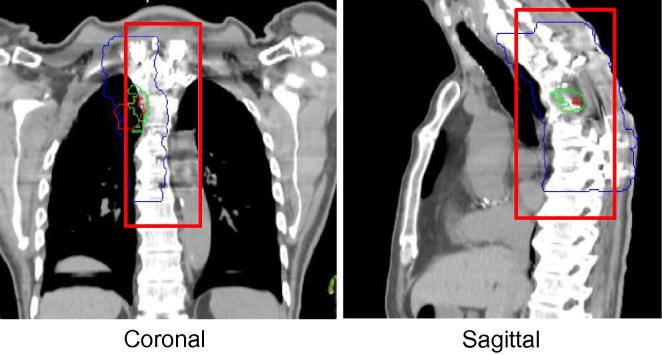
Region-of-interest (ROI) guidelines for online cone-beam computed tomography (CBCT) radiotherapy may improve matching reproducibility and reduce inter-user variability of soft tissue sarcoma (STS) image guidance. The purpose of this work is to standardize ROI STS CBCT image registration guidelines using the plan-do-study-act (PDSA) cycle for the lower extremity, retroperitoneal, pelvis, and thorax.
Based on anatomic bony surrogates, initial ROI matching guidelines for STS were developed by a team of radiation therapists, physicists and oncologists (Plan). Retrospective, qualitative evaluation of the guidelines was completed by the designated sarcoma lead therapist to determine clinical feasibility (Do). Validation of the ROI guidelines was performed through independent evaluation by radiation therapy CBCT imaging experts on a cohort of 10 patients per anatomic region (Study).
Draft ROI guidelines were evaluated by 2 independent observers who registered weekly CBCT images to test their validity. Each observer assessed 5 patients per anatomic site, testing ROI options for accuracy of image registration and feasibility, while some ROI borders were adjusted based on algorithm matching performance. Validated ROI guidelines were presented to the sarcoma multidisciplinary site group, and an inter-professional committee of imaging experts for approval prior to clinical implementation (Act).
ROI matching guidelines for STS IGRT were standardized for 4 anatomic sites using the PDSA cycle for change testing and implementation. IGRT guidelines are intended to improve STS image registration reproducibility, and in turn, are expected to improve the confidence of IGRT decision making and workflow efficiencies for a rare disease with diverse presentation.
在线锥形束计算机断层扫描(CBCT)放射治疗的感兴趣区域(ROI)指南可能会提高软组织肉瘤(STS)图像引导的匹配重复性并减少用户间的变异性。本研究的目的是使用计划-实施-研究-改进(PDSA)循环,针对下肢、腹膜后、骨盆和胸部标准化ROI STS CBCT图像配准指南。
基于解剖学骨替代物,由放射治疗师、物理学家和肿瘤学家团队制定了STS的初始ROI匹配指南(计划)。指定的肉瘤首席治疗师完成了对指南的回顾性定性评估,以确定临床可行性(实施)。通过放射治疗CBCT成像专家对每个解剖区域的10名患者队列进行独立评估,对ROI指南进行了验证(研究)。
2名独立观察者对ROI指南草案进行了评估,他们对每周的CBCT图像进行配准以测试其有效性。每位观察者评估每个解剖部位的5名患者,测试ROI选项在图像配准准确性和可行性方面的表现,同时根据算法匹配性能调整了一些ROI边界。在临床实施之前,将经过验证的ROI指南提交给肉瘤多学科站点组和成像专家跨专业委员会批准(改进)。
使用PDSA循环进行变更测试和实施,针对4个解剖部位对STS图像引导放射治疗(IGRT)的ROI匹配指南进行了标准化。IGRT指南旨在提高STS图像配准的重复性,进而有望提高IGRT决策的可信度以及针对表现多样的罕见疾病的工作流程效率。