Department of Neuropsychiatry, Hallym University Dongtan Sacred Heart Hospital, Hwaseong, Republic of Korea.
Department of Psychiatry, Hallym University College of Medicine, Chuncheon, Republic of Korea.
PLoS Med. 2020 Feb 25;17(2):e1003022. doi: 10.1371/journal.pmed.1003022. eCollection 2020 Feb.
An emerging body of literature has indicated that moderate alcohol intake may be protective against Alzheimer disease (AD) dementia. However, little information is available regarding whether moderate alcohol intake is related to reductions in amyloid-beta (Aβ) deposition, or is protective via amyloid-independent mechanisms in the living human brain. Here we examined the associations of moderate alcohol intake with in vivo AD pathologies, including cerebral Aβ deposition, neurodegeneration of AD-signature regions, and cerebral white matter hyperintensities (WMHs) in the living human brain.
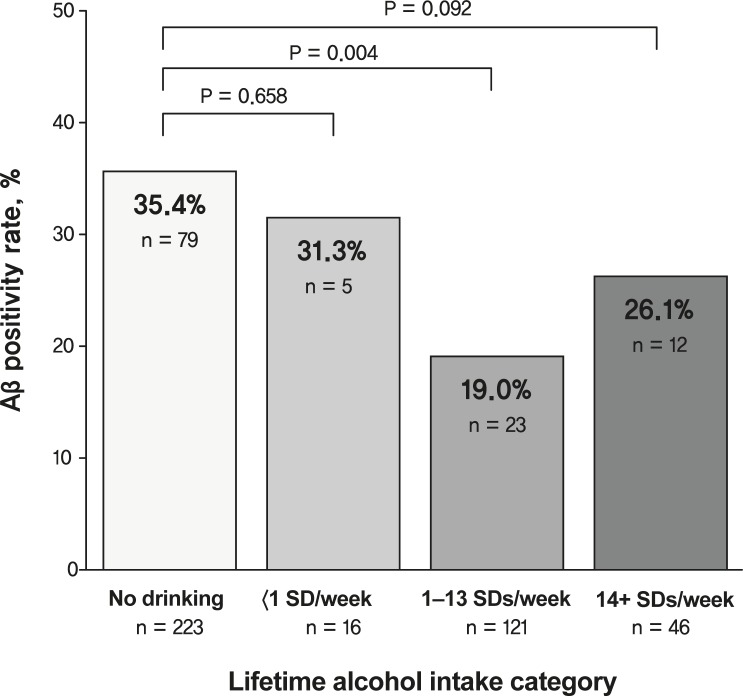
The present study was part of the Korean Brain Aging Study for Early Diagnosis and Prediction of Alzheimer's Disease (KBASE), an ongoing prospective cohort study that started in 2014. As of November 2016, 414 community-dwelling individuals with neither dementia nor alcohol-related disorders (280 cognitively normal [CN] individuals and 134 individuals with mild cognitive impairment [MCI]) between 56 and 90 years of age (mean age 70.9 years ± standard deviation 7.8; male, n [%] = 180 [43.5]) were recruited from 4 sites (i.e., 2 university hospitals and 2 public centers for dementia prevention and management) around Seoul, South Korea. All the participants underwent comprehensive clinical assessments comprising lifetime and current histories of alcohol intake and multimodal brain imaging, including [11C] Pittsburgh compound B positron emission tomography (PET), [18F] fluorodeoxyglucose (FDG) PET, and magnetic resonance imaging (MRI) scans. Lifetime and current alcohol intake were categorized as follows: no drinking, <1 standard drink (SD)/week, 1-13 SDs/week, and 14+ SDs/week. A moderate lifetime alcohol intake (1-13 SDs/week) was significantly associated with a lower Aβ positivity rate compared to the no drinking group, even after controlling for potential confounders (odds ratio 0.341, 95% confidence interval 0.163-0.714, p = 0.004). In contrast, current alcohol intake was not associated with amyloid deposition. Additionally, alcohol intake was not related to neurodegeneration of AD-signature regions or cerebral WMH volume. The present study had some limitations in that it had a cross-sectional design and depended on retrospective recall for alcohol drinking history.
In this study, we observed in middle- and old-aged individuals with neither dementia nor alcohol-related disorders that moderate lifetime alcohol intake was associated with lower cerebral Aβ deposition compared to a lifetime history of not drinking. Moderate lifetime alcohol intake may have a beneficial influence on AD by reducing pathological amyloid deposition rather than amyloid-independent neurodegeneration or cerebrovascular injury.
越来越多的文献表明,适量饮酒可能对阿尔茨海默病(AD)痴呆有保护作用。然而,关于适量饮酒是否与减少淀粉样蛋白-β(Aβ)沉积有关,或者是否通过活人大脑中与淀粉样蛋白无关的机制起到保护作用,目前还知之甚少。在此,我们研究了适量饮酒与活人大脑 AD 病理的关联,包括脑内 Aβ沉积、AD 特征区域的神经退行性变以及脑白质高信号(WMHs)。
本研究是韩国大脑衰老早期诊断和预测阿尔茨海默病研究(KBASE)的一部分,这是一项正在进行的前瞻性队列研究,始于 2014 年。截至 2016 年 11 月,共招募了 414 名无痴呆和酒精相关疾病的社区居民(280 名认知正常[CN]个体和 134 名轻度认知障碍[MCI]个体),年龄在 56-90 岁之间(平均年龄 70.9 岁±7.8 岁;男性,n [%]=180 [43.5%]),来自韩国首尔附近的 4 个地点(即 2 所大学医院和 2 个公共痴呆预防和管理中心)。所有参与者都接受了全面的临床评估,包括终生和当前的饮酒史以及多模态脑成像,包括[11C]匹兹堡化合物 B 正电子发射断层扫描(PET)、[18F]氟脱氧葡萄糖(FDG)PET 和磁共振成像(MRI)扫描。终生和当前饮酒量分为以下几类:不饮酒、每周<1 标准饮品(SD)、每周 1-13 SD 和每周 14+ SD。与不饮酒组相比,终生适度饮酒(每周 1-13 SD)与较低的 Aβ阳性率显著相关,即使在控制了潜在混杂因素后也是如此(比值比 0.341,95%置信区间 0.163-0.714,p=0.004)。相比之下,当前饮酒量与淀粉样蛋白沉积无关。此外,饮酒量与 AD 特征区域的神经退行性变或脑白质高信号体积无关。本研究存在一些局限性,例如它是横断面设计,并且依赖于对饮酒史的回顾性回忆。
在本研究中,我们观察到在无痴呆和酒精相关疾病的中老年个体中,与终生不饮酒相比,终生适度饮酒与较低的脑内 Aβ沉积有关。适度的终生饮酒可能通过减少病理性淀粉样蛋白沉积而不是与淀粉样蛋白无关的神经退行性变或脑血管损伤对 AD 产生有益影响。