Mekuriyaw Abebayehu Melesew, Mihret Muhabaw Shumye, Yismaw Ayenew Engida
Deneba Primary Hospital, North Shoa, Amhara Regional Health Bureau, Department of Midwifery, Ethiopia.
Department of Clinical Midwifery, School of Midwifery, College of Medicine and Health Sciences, University of Gondar, Ethiopia.
Int J Pediatr. 2020 Jan 8;2020:1854073. doi: 10.1155/2020/1854073. eCollection 2020.
Preterm birth refers to a birth of a baby before 37 completed weeks of gestation and after fetal viability. It is now the leading cause of new born deaths. Although identifying its common risk factors is mandatory to decrease preterm birth and thereby neonatal deaths, there was a dearth of studies in the study area.
The aim of this study was to identify determinants of preterm birth among women who gave birth in Amhara region referral hospitals, Northwest Ethiopia, 2018.
An institutional based case-control study was conducted from September 01 to December 01/2018. A total of 405 mothers (135 cases and 270 controls) were included in the study. Multistage sampling technique was employed. Data were collected using structured questionnaire through face to face interview and checklist via Chart review. Data were entered into Epi Info version 7 and export to Statistical Package for Social Sciences (SPSS) version 20 for analysis. Descriptive statics like mean, frequency and percentage was used to describe the characteristics of participants. Both bivariable and multivariable analyses were carried out. Variable having -value <0.05 in binary logistic regression were the candidate for multivariable analyses. Finally, the statistical significance of the study was claimed based on the Adjusted Odds Ratio (AOR) with 95% Confidence Interval (CI) and its -value <0.05.
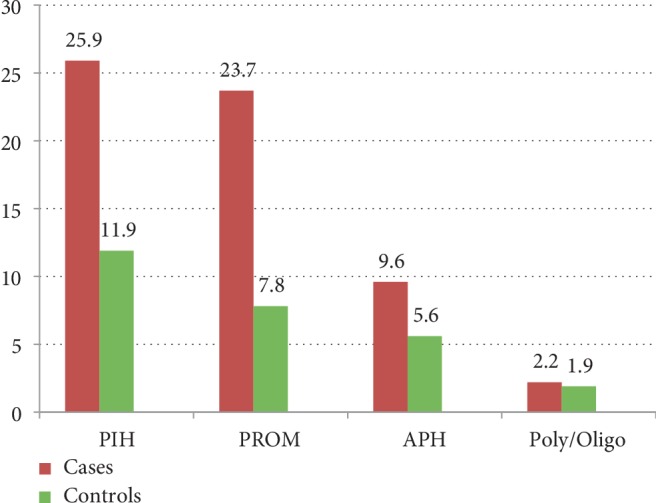
The result of multivariable analysis show that mothers with no formal education (AOR = 2.24; 95% CI: 1.28, 3.91), history of abortion (AOR = 2.92; 95% CI: 1.3, 6.4), multiple gestation (AOR = 4.1; 95% CI: 1.7, 9.8), hemoglobin level <11 gm/dl (AOR = 2.75; 95% CI: 1.11, 7.31), premature rupture of membrane (AOR = 6.4; 95% CI: 3.23, 12.7) and pregnancy induced hypertension (AOR = 4.74; 95% CI: 2.49, 9.0) had statistically significant association with experiencing preterm birth.
Most of the determinants of preterm birth found to be modifiable. Thus, putting emphasis for prevention of obstetric and gynecologic complications such as anemia, premature rupture of membrane and abortion would decrease the incidence of preterm birth. Moreover, strengthening Information Communication Education about prevention of preterm birth was recommended.
早产是指胎儿在妊娠满37周前且具有生存能力后出生。它是目前新生儿死亡的主要原因。尽管识别其常见风险因素对于降低早产率从而减少新生儿死亡至关重要,但该研究领域的研究却很匮乏。
本研究旨在确定2018年在埃塞俄比亚西北部阿姆哈拉地区转诊医院分娩的妇女中早产的决定因素。
2018年9月1日至12月1日进行了一项基于机构的病例对照研究。该研究共纳入405名母亲(135例病例和270例对照)。采用多阶段抽样技术。通过面对面访谈使用结构化问卷收集数据,并通过病历审查使用清单收集数据。数据录入Epi Info 7版本,并导出到社会科学统计软件包(SPSS)20版本进行分析。使用均值、频率和百分比等描述性统计量来描述参与者的特征。进行了双变量和多变量分析。在二元逻辑回归中P值<0.05的变量是多变量分析的候选变量。最后,根据调整后的比值比(AOR)及其95%置信区间(CI)以及P值<0.05来确定研究的统计学意义。
多变量分析结果显示,未接受正规教育的母亲(AOR = 2.24;95% CI:1.28,3.91)、有流产史(AOR = 2.92;95% CI:1.3,6.4)、多胎妊娠(AOR = 4.1;95% CI:1.7,9.8)、血红蛋白水平<11 g/dl(AOR = 2.75;95% CI:1.11,7.31)、胎膜早破(AOR = 6.4;95% CI:3.23,12.7)和妊娠高血压(AOR = 4.74;95% CI:2.49,9.0)与早产有统计学意义的关联。
发现大多数早产的决定因素是可改变的。因此,重视预防贫血、胎膜早破和流产等妇产科并发症将降低早产发生率。此外,建议加强关于预防早产的信息传播教育。