Shih Meng-Ling, Morgan John A
Davidson School of Chemical Engineering, Purdue University, West Lafayette, IN, 47907, USA.
Metab Eng Commun. 2020 Feb 1;10:e00123. doi: 10.1016/j.mec.2020.e00123. eCollection 2020 Jun.
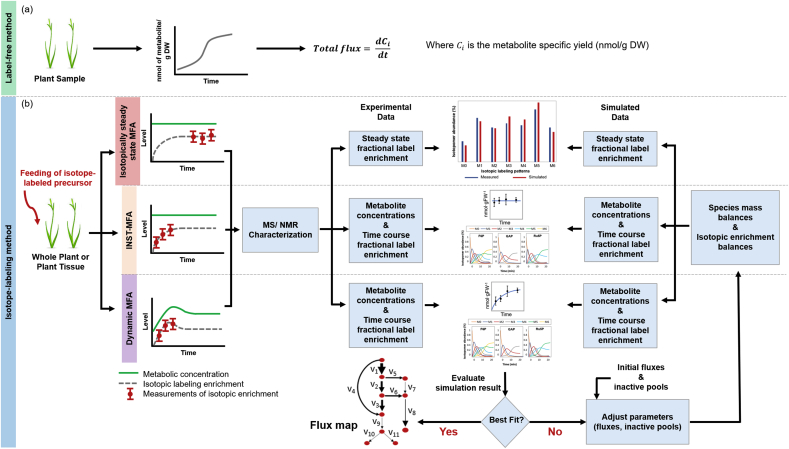
Numerous secondary metabolites from plants are important for their medicinal, nutraceutical or sensory properties. Recently, significant progress has been made in the identification of the genes and enzymes of plant secondary metabolic pathways. Hence, there is interest in using synthetic biology to enhance the production of targeted valuable metabolites in plants. In this article, we examine the contribution that metabolic flux analysis will have on informing the rational selection of metabolic engineering targets as well as analysis of carbon and energy efficiency. Compared to microbes, plants have more complex tissue, cellular and subcellular organization, making precise metabolite concentration measurements more challenging. We review different techniques involved in quantifying flux and provide examples illustrating the application of the techniques. For linear and branched pathways that lead to end products with low turnover, flux quantification is straightforward and doesn't require isotopic labeling. However, for metabolites synthesized via parallel pathways, there is a requirement for isotopic labeling experiments. If the fed isotopically labeled carbons don't scramble, one needs to apply transient label balancing methods. In the transient case, it is also necessary to measure metabolite concentrations. While flux analysis is not able to directly identify mechanisms of regulation, it is a powerful tool to examine flux distribution at key metabolic nodes in intermediary metabolism, detect flux to wasteful side pathways, and show how parallel pathways handle flux in wild-type and engineered plants under a variety of physiological conditions.
植物中的许多次生代谢产物因其药用、营养保健或感官特性而具有重要意义。近年来,在植物次生代谢途径的基因和酶的鉴定方面取得了重大进展。因此,人们对利用合成生物学提高植物中目标有价值代谢产物的产量产生了兴趣。在本文中,我们研究了代谢通量分析在为代谢工程靶点的合理选择提供信息以及分析碳和能量效率方面的作用。与微生物相比,植物具有更复杂的组织、细胞和亚细胞结构,这使得精确测量代谢物浓度更具挑战性。我们回顾了定量通量所涉及的不同技术,并提供了说明这些技术应用的示例。对于导致周转缓慢的终产物的线性和分支途径,通量定量很直接,不需要同位素标记。然而,对于通过平行途径合成的代谢物,则需要进行同位素标记实验。如果所添加的同位素标记碳不发生混排,则需要应用瞬态标记平衡方法。在瞬态情况下,测量代谢物浓度也是必要的。虽然通量分析不能直接确定调控机制,但它是一种强大的工具,可用于研究中间代谢中关键代谢节点的通量分布、检测通向浪费性旁路的通量,并展示在各种生理条件下野生型和工程植物中平行途径如何处理通量。