Hoermann Rudolf, Midgley John E M, Larisch Rolf, Dietrich Johannes W
Department for Nuclear Medicine, Klinikum Lüdenscheid, Paulmannshöherstr. 14, 58515 Lüdenscheid, Germany.
North Lakes Clinical, 20 Wheatley Avenue, Ilkley LS29 8PT, UK.
J Clin Transl Endocrinol. 2020 Feb 8;19:100219. doi: 10.1016/j.jcte.2020.100219. eCollection 2020 Mar.
Subclinical hyperthyroidism/thyrotoxicosis originates from different causes and clinical conditions, sharing the laboratory constellation of a suppressed TSH in the presence of thyroid hormone concentrations within the reference range.
Presentation of hyperthyroidism can manifest itself in several ways. We questioned whether there is either a consistent biochemical equivalence of thyroid hormone response to these diagnostic categories, or a high degree of heterogeneity may exist both within and between the different clinical manifestations.
This secondary analysis of a former prospective cross-sectional trial involved 461 patients with untreated thyroid autonomy, Graves' disease or on levothyroxine (LT4) after thyroidectomy for thyroid carcinoma. TSH response and biochemical equilibria between TSH and thyroid hormones were contrasted between endogenous hyperthyroidism and thyrotoxicosis (LT4 overdose).
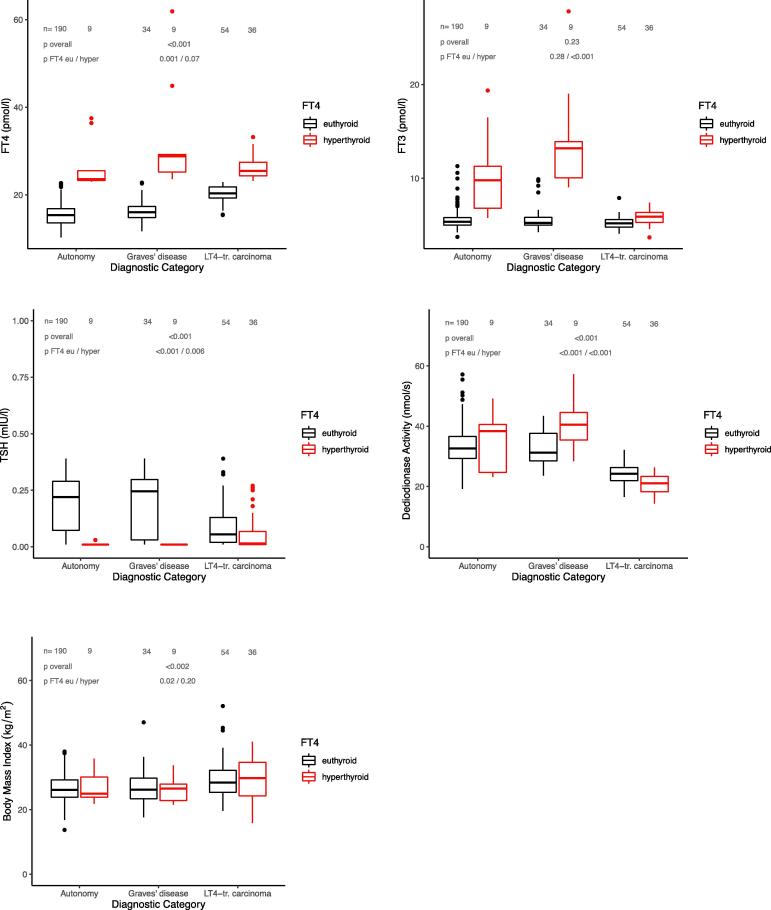
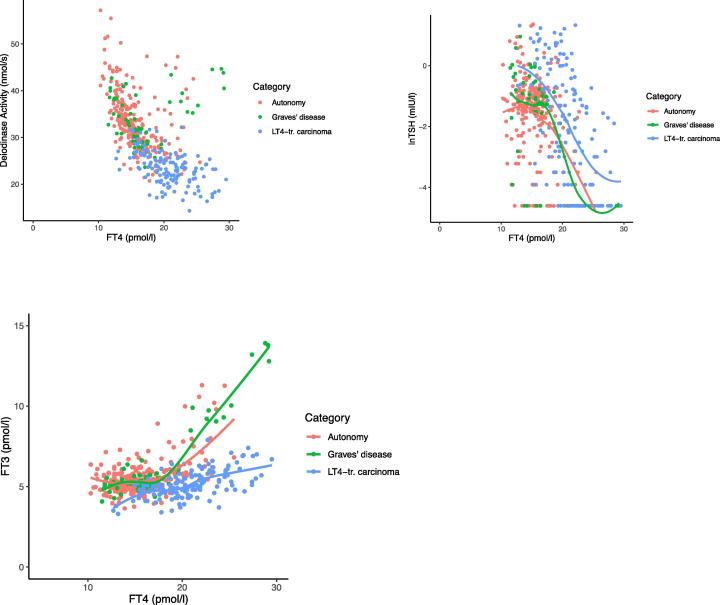
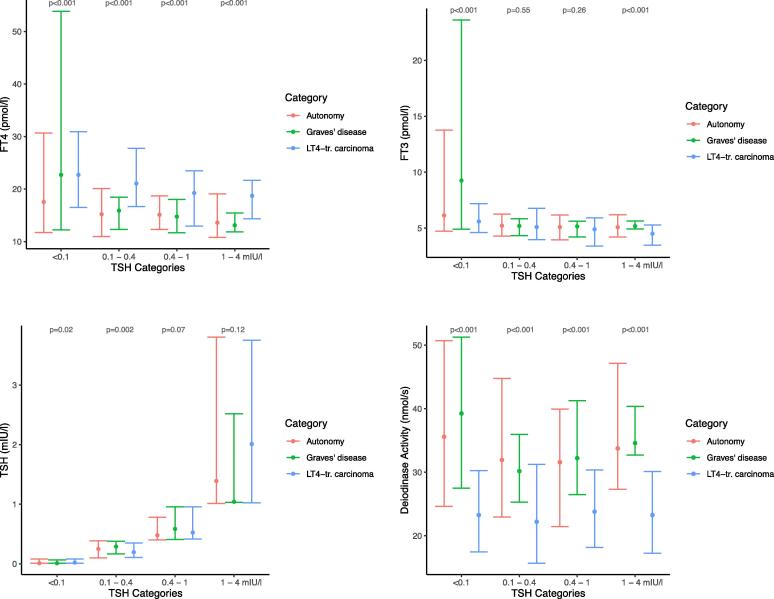
Concentrations of FT4, FT3, TSH, deiodinase activity and BMI differed by diagnostic category. Over various TSH strata, FT4 concentrations were significantly higher in LT4-treated thyroid carcinoma patients, compared to the untreated diseases, though FT3 levels remained comparable. They were concentrated in the upper FT4- but low deiodinase range, distinguishing them from patients with thyroid autonomy and Graves' disease. In exogenous thyrotoxicosis, TSH and FT3 were less responsive to FT4 concentrations approaching its upper normal/hyperthyroid range.
The presence or lack of TSH feedforward activity determines the system response in the thyroid-active (hyperthyroidism) and no-thyroid response to treatment (thyrotoxicosis). This rules out a consistent thread of thyroid hormone response running through the different diagnostic categories. TSH measurements should therefore be interpreted conditionally and differently in subclinical hyperthyroidism and thyrotoxicosis.
亚临床甲状腺功能亢进/甲状腺毒症源于不同病因和临床情况,其实验室特征为促甲状腺激素(TSH)被抑制,而甲状腺激素浓度在参考范围内。
甲状腺功能亢进的表现形式多样。我们探讨甲状腺激素对这些诊断类别是否存在一致的生化反应,或者在不同临床表现内部及之间是否可能存在高度异质性。
这项对既往前瞻性横断面试验的二次分析纳入了461例未经治疗的甲状腺自主性疾病、格雷夫斯病患者,或甲状腺癌甲状腺切除术后服用左甲状腺素(LT4)的患者。对比内源性甲状腺功能亢进和甲状腺毒症(LT4过量)之间的TSH反应以及TSH与甲状腺激素之间的生化平衡。
游离甲状腺素(FT4)、游离三碘甲状腺原氨酸(FT3)、TSH、脱碘酶活性和体重指数(BMI)因诊断类别而异。在不同的TSH分层中,与未经治疗的疾病相比,接受LT4治疗的甲状腺癌患者的FT4浓度显著更高,尽管FT3水平相当。他们集中在FT4较高但脱碘酶水平较低的范围内,这将他们与甲状腺自主性疾病和格雷夫斯病患者区分开来。在外源性甲状腺毒症中,当FT4浓度接近其正常上限/甲状腺功能亢进范围时,TSH和FT3对其反应较小。
TSH前馈活性的存在或缺乏决定了甲状腺活跃(甲状腺功能亢进)和无甲状腺反应(甲状腺毒症)对治疗的系统反应。这排除了贯穿不同诊断类别的一致的甲状腺激素反应线索。因此,在亚临床甲状腺功能亢进和甲状腺毒症中,TSH测量结果应根据具体情况进行不同的解读。