Servicio de Urgencia Infantil, Hospital Clínico de la Universidad de Chile "Dr. José Joaquín Aguirre", Santiago, Chile.
Laboratorio de Salud Pública Ambiental y Laboral, Secretaría Regional Ministerial de Salud Región Metropolitana, Santiago, Chile.
Microb Genom. 2020 Mar;6(3). doi: 10.1099/mgen.0.000340.
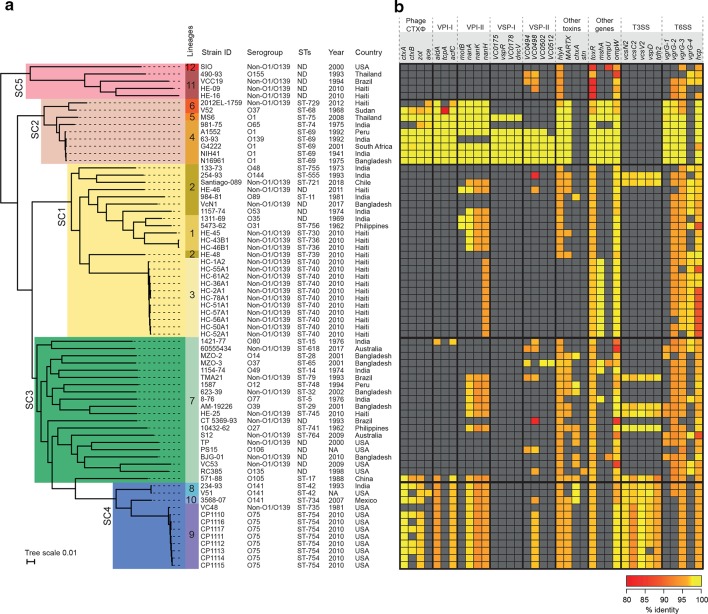
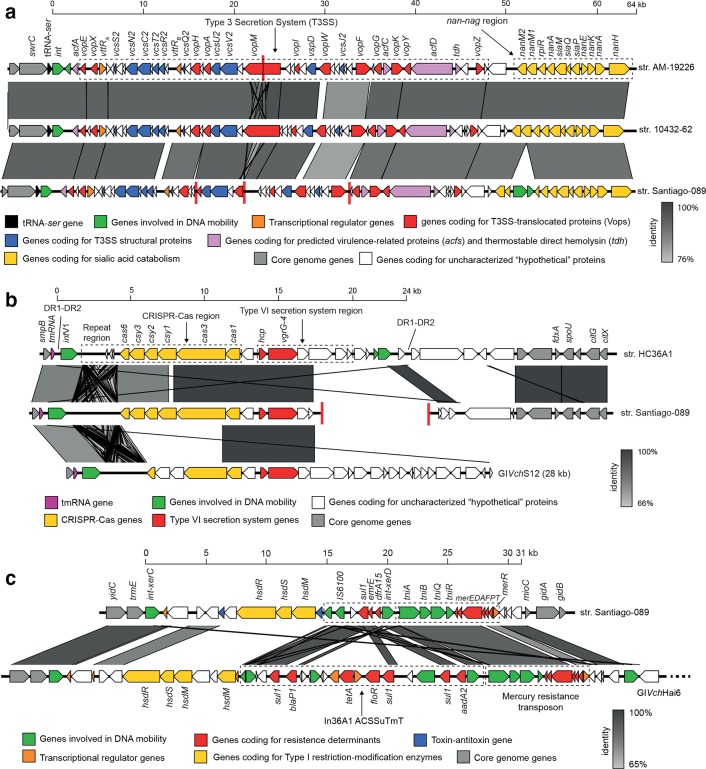
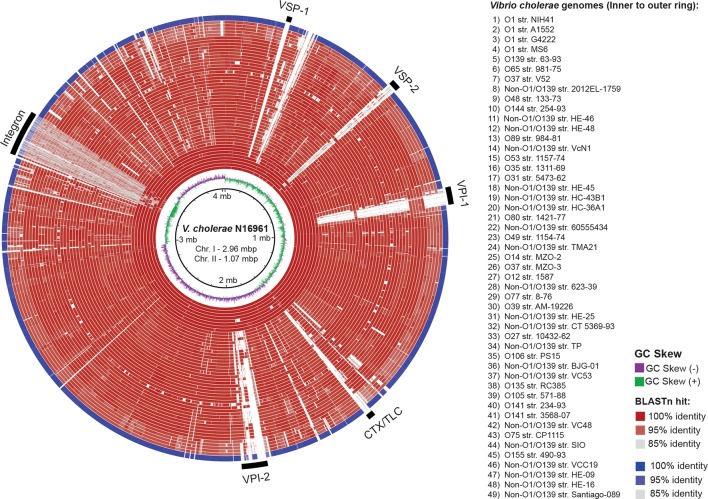
is a human pathogen, which is transmitted by the consumption of contaminated food or water. strains belonging to the serogroups O1 and O139 can cause cholera outbreaks and epidemics, a severe life-threatening diarrheal disease. In contrast, serogroups other than O1 and O139, denominated as non-O1/non-O139, have been mainly associated with sporadic cases of moderate or mild diarrhea, bacteremia and wound infections. Here we investigated the virulence determinants and phylogenetic origin of a non-O1/non-O139 strain that caused a gastroenteritis outbreak in Santiago, Chile, 2018. We found that this outbreak strain lacks the classical virulence genes harboured by O1 and O139 strains, including the cholera toxin (CT) and the toxin-coregulated pilus (TCP). However, this strain carries genomic islands (GIs) encoding Type III and Type VI secretion systems (T3SS/T6SS) and antibiotic resistance genes. Moreover, we found these GIs are wide distributed among several lineages of non-O1/non-O139 strains. Our results suggest that the acquisition of these GIs may enhance the virulence of non-O1/non-O139 strains that lack the CT and TCP-encoding genes. Our results highlight the pathogenic potential of these strains.
是一种人类病原体,通过食用受污染的食物或水传播。血清群 O1 和 O139 菌株可引起霍乱暴发和流行,这是一种严重的危及生命的腹泻病。相比之下,血清群 O1 和 O139 以外的血清群,称为非 O1/非 O139,主要与散发性中度或轻度腹泻、菌血症和伤口感染有关。在这里,我们研究了引起 2018 年智利圣地亚哥肠胃炎暴发的非 O1/非 O139 菌株的毒力决定因素和系统发育起源。我们发现,这种暴发菌株缺乏 O1 和 O139 菌株所具有的经典毒力基因,包括霍乱毒素(CT)和毒素调节菌毛(TCP)。然而,该菌株携带编码 III 型和 VI 型分泌系统(T3SS/T6SS)和抗生素抗性基因的基因组岛(GI)。此外,我们发现这些 GI 广泛分布在非 O1/非 O139 菌株的几个谱系中。我们的结果表明,这些 GI 的获得可能增强了缺乏 CT 和 TCP 编码基因的非 O1/非 O139 菌株的毒力。我们的研究结果强调了这些菌株的致病潜力。