Department of Cardiovascular Imaging and Dynamics, University of Leuven (KU Leuven), Leuven, Belgium.
Department of Cardiology, University of Medicine and Pharmacy of Craiova, Craiova, Romania.
PLoS One. 2020 Feb 26;15(2):e0228027. doi: 10.1371/journal.pone.0228027. eCollection 2020.
The slope of the relationship between segmental PreS and total systolic shortening (S) has been proposed as a non-invasive index of left ventricular contractility. The aim of this study was to correlate this novel parameter to invasive gold standard measurements of contractility and to investigate how it is influenced by afterload.
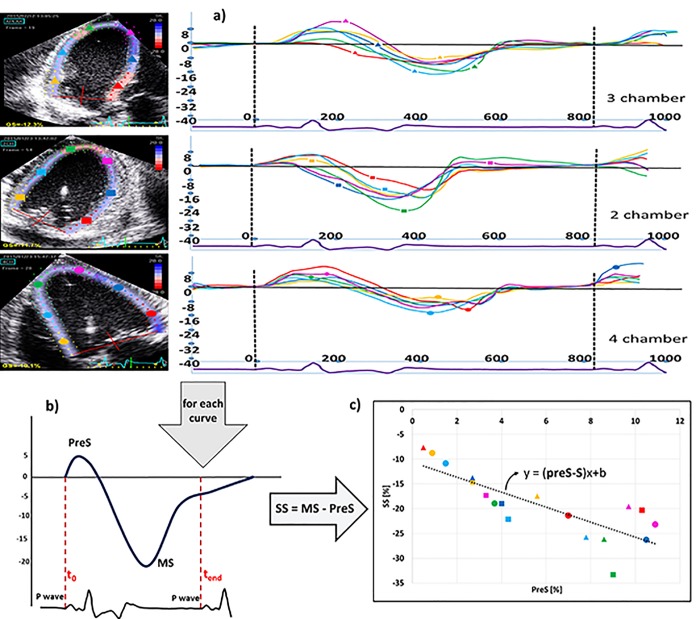
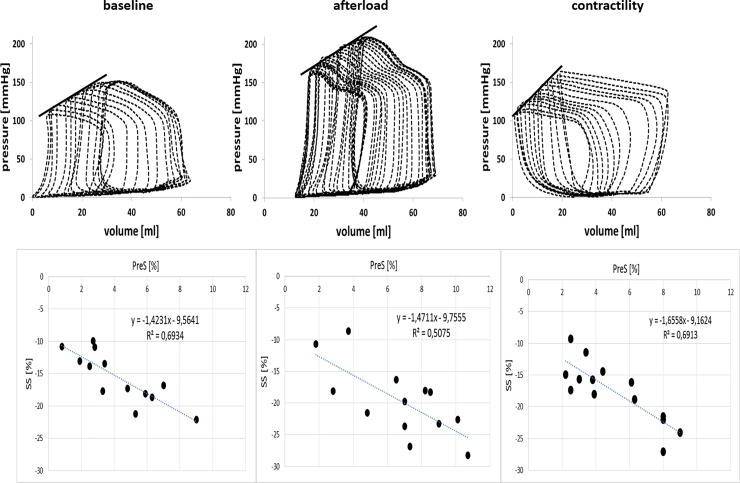
In domestic pigs, afterload was increased by either balloon inflation in the aorta or by administration of phenylephrine while contractility was increased by dobutamine infusion. During all interventions, left ventricular pressure-volume measurements and trans-diaphragmatic two-dimensional echocardiographic images were acquired. The PreS-S slope was constructed from 18 segmental strain curves obtained by speckle tracking analysis and compared to the slope of the end systolic PV relationship (Emax) and the pre-load recruitable stroke work (PRSW).
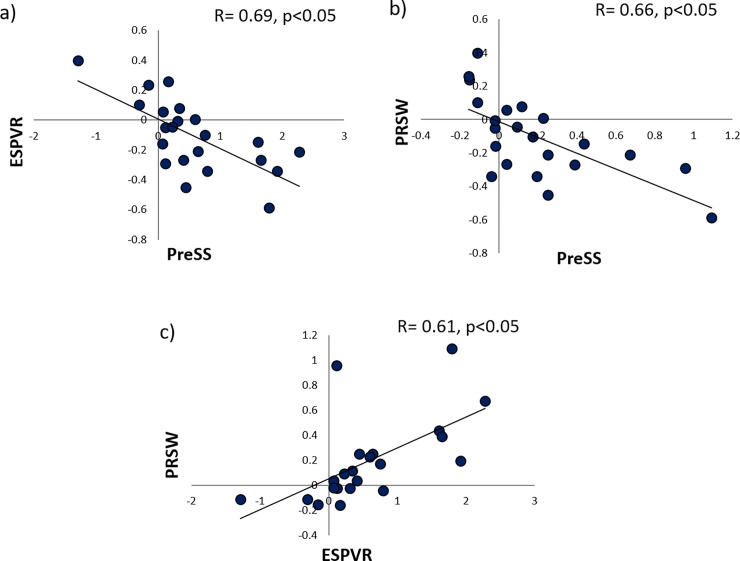
Sixteen datasets of increased contractility and afterload were analyzed. During dobutamine infusion, the LV volumes decreased (p<0.05) while ejection fraction increased (p<0.05). Emax, PRSW and the slope of the intra-ventricular PreS-S relation increased significantly during dobutamine infusion. Afterload increase led to increase in systolic blood pressure (105±16mmHg vs. 138±25mmHg; p<0.01) and decrease of LV stroke volume and ejection fraction (p<0.01). The PreS-S slope was not influenced by loading conditions in concordance with the PRSW findings. The absolute values of the PreS-S slope did not correlate with Emax or PRSW. However, the change of the PreS-S slope in relation with different interventions demonstrated good correlation with changes in PRSW or Emax, (r = 0.66, p<0.05 and r = 0.69, p<0.05).
The slope of the PreS-S relationship is sensitive to changes in inotropy and is less load-dependent than conventional non-invasive parameters of left ventricular function. The magnitude of the change of this slope correlates well with changes in invasive contractility measurements making it an attractive parameter to assess contractile reserve or contractile changes during longitudinal follow-up of patients.
节段性前间隔应变(PreS)与整体收缩期缩短(S)之间的斜率已被提出作为一种评估左心室收缩力的非侵入性指标。本研究的目的是将该新参数与收缩力的有创金标准测量相关联,并研究其如何受后负荷的影响。
在国内猪中,通过在主动脉中充气或给予去氧肾上腺素来增加后负荷,同时通过给予多巴酚丁胺输注来增加收缩力。在所有干预期间,获取左心室压力-容积测量和经膈肌二维超声心动图图像。从通过斑点追踪分析获得的 18 个节段应变曲线构建 PreS-S 斜率,并与收缩末期 PV 关系的斜率(Emax)和预负荷可获取的冲程功(PRSW)进行比较。
分析了 16 个增加收缩力和后负荷的数据集。在多巴酚丁胺输注期间,LV 容积减少(p<0.05),而射血分数增加(p<0.05)。在多巴酚丁胺输注期间,Emax、PRSW 和室内 PreS-S 关系的斜率显著增加。后负荷增加导致收缩压升高(105±16mmHg 比 138±25mmHg;p<0.01)和 LV 每搏量和射血分数降低(p<0.01)。与 PRSW 的发现一致,PreS-S 斜率不受负荷条件的影响。PreS-S 斜率的绝对值与 Emax 或 PRSW 无关。然而,与不同干预措施相关的 PreS-S 斜率的变化与 PRSW 或 Emax 的变化具有良好的相关性(r=0.66,p<0.05 和 r=0.69,p<0.05)。
PreS-S 关系的斜率对变力性变化敏感,并且比左心室功能的常规非侵入性参数受负荷影响更小。该斜率变化的幅度与有创收缩力测量的变化很好地相关,使其成为评估收缩储备或患者纵向随访期间收缩变化的有吸引力的参数。