Yang Qin, Zhang Yingxiao, Zeng Qinglian, Yang Chan, Shi Jiale, Zhang Chunlin, Ni Xia, Du Zhipeng, Tang Ziwei, Hu Jinbo, Li Xuemei, Cai Jiahui, Li Qifu, Cheng Qingfeng
Department of Endocrinology, The First Affiliated Hospital of Chongqing Medical University, Chongqing, People's Republic of China.
Diabetes Metab Syndr Obes. 2020 Feb 13;13:377-386. doi: 10.2147/DMSO.S237362. eCollection 2020.
The present study was designed to determine the relationships between sarcopenia and diabetic peripheral neuropathy (DPN) in patients with type 2 diabetes mellitus (T2DM) and diabetic foot disease (DFD) respectively.
A total of 1104 patients with T2DM and 257 patients with DFD were included in the study, which was designed as a cross-sectional study. Body composition was assessed using dual-energy X-ray-absorptiometry (DXA). The diagnosis of sarcopenia was based on the Baumgartner criteria. DPN was assessed by Neuropathy symptom score (NSS) and Neuropathy disability score (NDS), and the severity of neuropathy was divided into non-neuropathy symptom (NS), Mild NS, Moderate NS and Severe NS according to NSS. Logistic regression analyses were carried out to determine the relations of sarcopenia and DPN in patients with T2DM and NSS in patients with DFD, respectively.
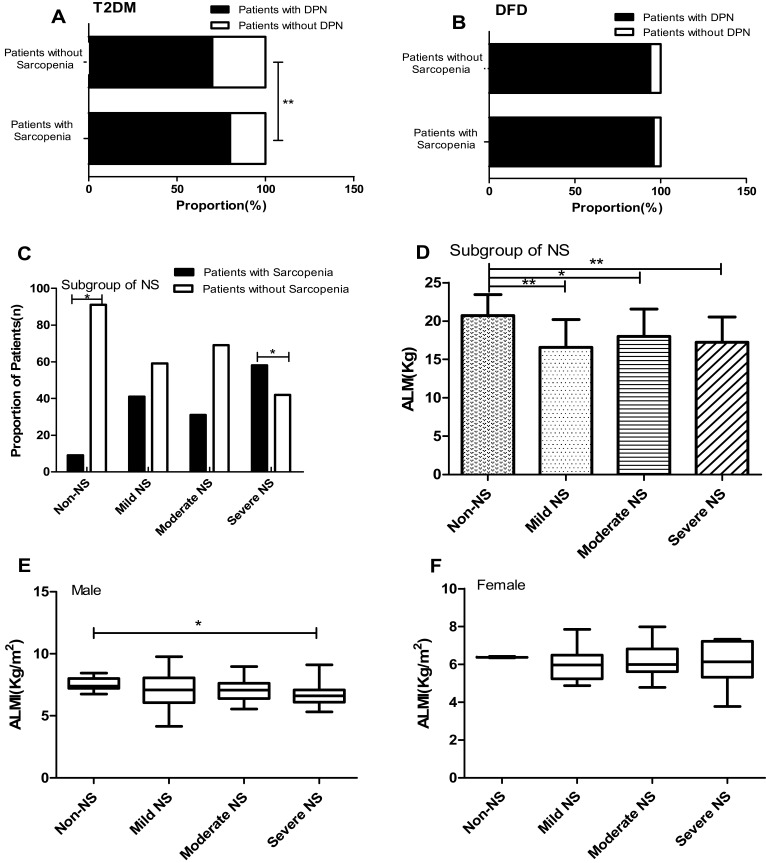
The prevalence of DPN was 80.0% in T2DM patients with sarcopenia and 70.3% in non-sarcopenia patients (P=0.007). Logistic regression analyses showed DPN was one of the independent risk factors for sarcopenia in T2DM patients (OR 1.564 [95% CI: 1.004, 2.435], P=0.048). The prevalence of DPN had no statistical significance in DFD patients with or without sarcopenia. However, the NSS of DFD patients with sarcopenia was higher than that of non-sarcopenia patients. In the multivariate logistic regression analysis, NSS was determined to be associated with sarcopenia in DFD patients (OR 1.387[95% CI: 1.074, 1.789], P=0.012). The appendicular lean mass (ALM) of DFD patients without NS was higher than patients with mild, moderate and severe NS (20.71±2.73 vs 16.57±3.62 vs 17.99±3.54 vs 17.23±3.29 Kg, P=0.028).
DPN is an independent risk factor for sarcopenia in patients with T2DM and NSS is also independently correlated with sarcopenia in patients with DFD, with the latter being more obvious with the aggravation of neurological symptoms in DFD patients.
本研究旨在分别确定2型糖尿病(T2DM)患者和糖尿病足病(DFD)患者中肌肉减少症与糖尿病周围神经病变(DPN)之间的关系。
本研究共纳入1104例T2DM患者和257例DFD患者,采用横断面研究设计。使用双能X线吸收法(DXA)评估身体成分。肌肉减少症的诊断基于鲍姆加特纳标准。通过神经病变症状评分(NSS)和神经病变残疾评分(NDS)评估DPN,并根据NSS将神经病变的严重程度分为无神经病变症状(NS)、轻度NS、中度NS和重度NS。分别进行逻辑回归分析以确定T2DM患者中肌肉减少症与DPN以及DFD患者中NSS之间的关系。
肌肉减少症的T2DM患者中DPN的患病率为80.0%,非肌肉减少症患者中为70.3%(P = 0.007)。逻辑回归分析显示DPN是T2DM患者肌肉减少症的独立危险因素之一(OR 1.564 [95% CI:1.004, 2.435],P = 0.048)。DPN在有或无肌肉减少症的DFD患者中的患病率无统计学意义。然而,有肌肉减少症的DFD患者的NSS高于无肌肉减少症的患者。在多变量逻辑回归分析中,确定NSS与DFD患者的肌肉减少症相关(OR 1.387[95% CI:1.074, 1.789],P = 0.012)。无NS的DFD患者的四肢瘦体重(ALM)高于轻度、中度和重度NS患者(20.71±2.73 vs 16.57±3.62 vs 17.99±3.54 vs 17.23±3.29 Kg,P = 0.028)。
DPN是T2DM患者肌肉减少症的独立危险因素,NSS也与DFD患者的肌肉减少症独立相关,随着DFD患者神经症状加重,后者更为明显。