Sarantis Panagiotis, Koustas Evangelos, Papadimitropoulou Adriana, Papavassiliou Athanasios G, Karamouzis Michalis V
Molecular Oncology Unit, Department of Biological Chemistry, Medical School, National and Kapodistrian University of Athens, Athens 11527, Greece.
Center of Basic Research, Biomedical Research Foundation of the Academy of Athens, Athens 11527, Greece.
World J Gastrointest Oncol. 2020 Feb 15;12(2):173-181. doi: 10.4251/wjgo.v12.i2.173.
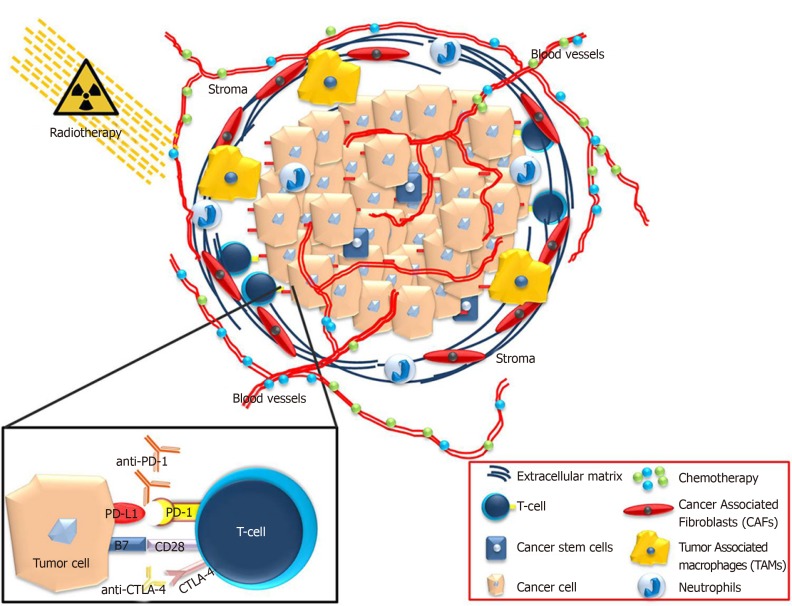
Pancreatic ductal adenocarcinoma (PDAC) is one of the most lethal diseases, with an average 5-year survival rate of less than 10%. Unfortunately, the majority of patients have unresectable, locally advanced, or metastatic disease at the time of diagnosis. Moreover, traditional treatments such as chemotherapy, surgery, and radiation have not been shown to significantly improve survival. Recently, there has been a swift increase in cancer treatments that incorporate immunotherapy-based strategies to target all the stepwise events required for tumor initiation and progression. The results in melanoma, non-small-cell lung cancer and renal cell carcinoma are very encouraging. Unfortunately, the application of checkpoint inhibitors, including anti-CTLA4, anti-PD-1, and anti-PD-L1 antibodies, in pancreatic cancer has been disappointing. Many studies have revealed that the PDAC microenvironment supports tumor growth, promotes metastasis and consists of a physical barrier to drug delivery. Combination therapies hold great promise for enhancing immune responses to achieve a better therapeutic effect. In this review, we provide an outline of why pancreatic cancer is so lethal and of the treatment hurdles that exist. Particular emphasis is given to the role of the tumor microenvironment, and some of the latest and most promising studies on immunotherapy in PDAC are also presented.
胰腺导管腺癌(PDAC)是最致命的疾病之一,平均5年生存率不到10%。不幸的是,大多数患者在诊断时已处于不可切除、局部晚期或转移性疾病状态。此外,化疗、手术和放疗等传统治疗方法尚未显示能显著提高生存率。最近,采用基于免疫疗法的策略来针对肿瘤发生和进展所需的所有逐步事件的癌症治疗方法迅速增加。在黑色素瘤、非小细胞肺癌和肾细胞癌中的结果非常令人鼓舞。不幸的是,包括抗CTLA4、抗PD-1和抗PD-L1抗体在内的检查点抑制剂在胰腺癌中的应用一直令人失望。许多研究表明,PDAC微环境支持肿瘤生长、促进转移,并构成药物递送的物理屏障。联合疗法在增强免疫反应以获得更好治疗效果方面具有很大潜力。在这篇综述中,我们概述了胰腺癌如此致命的原因以及存在的治疗障碍。特别强调了肿瘤微环境的作用,还介绍了一些关于PDAC免疫疗法的最新且最有前景的研究。