Vengaloor Thomas Toms, Nittala Mary R, Bhanat Eldrin, Albert Ashley A, Vijayakumar Srinivasan
Radiation Oncology, University of Mississippi Medical Center, Jackson, USA.
Cureus. 2020 Jan 16;12(1):e6679. doi: 10.7759/cureus.6679.
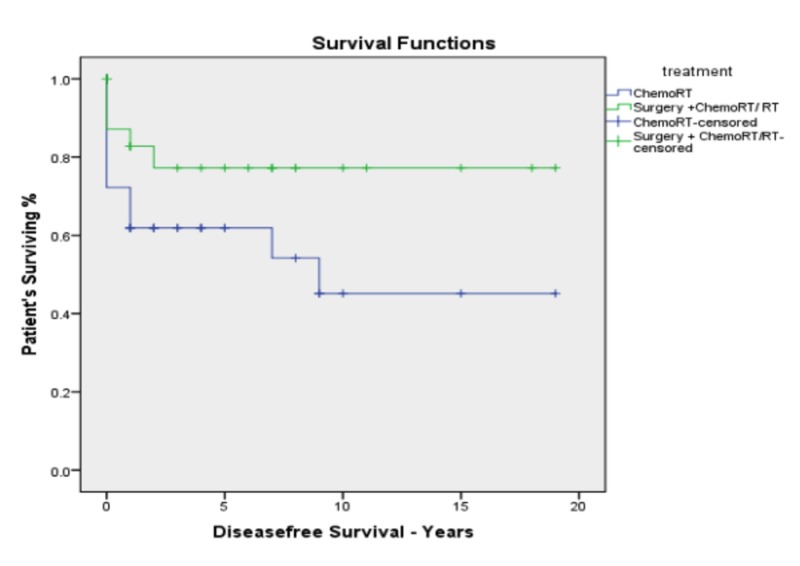
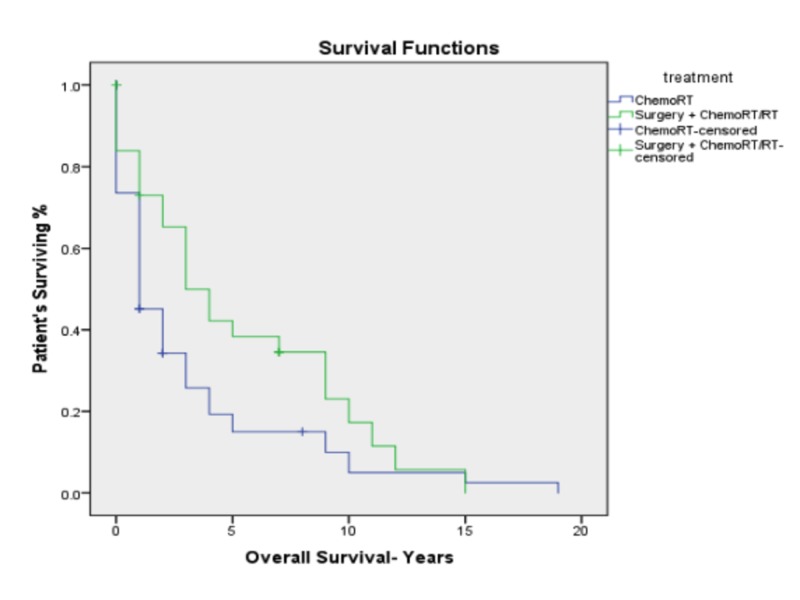
Introduction Due to conflicting data in the literature, there is a continuing debate on whether advanced hypopharyngeal carcinoma patients should be treated with definitive surgery or chemoradiotherapy. The purpose of this study is to evaluate the management and outcomes of advanced hypopharyngeal carcinoma in a tertiary care institution over the last 25 years. Methods An Institutional Review Board (IRB)-approved and HIPPA-compliant retrospective analysis was performed of patients with advanced-stage squamous cell carcinoma of the hypopharynx treated at our institution between January 1994 and December 2018. Data regarding demographics, stage, treatment, and follow-up were collected. Outcomes including median survival and overall survival were calculated using the Kaplan Meier method. All analyses were performed using SPSS v. 24. Results This study included a total of 103 advanced stage hypopharyngeal cancer patients. The median age for this cohort is 61 years (range: 41-88, SD 9.3). Of the total 103 eligible patients treated, 92 (89.3%) were male and 11 (10.7%) female; 61 (59.2%) were African Americans, 39 (37.9%) were Caucasians and three (2.9%) were other races. Seventeen patients (16.5%) had stage III disease, whereas 86 (83.5%) patients were diagnosed with Stage IV A or B disease. Seventy-two patients (69.9%) were treated with definitive chemoradiotherapy (ChemoRT group), and 31 patients (30.1%) underwent primary surgery with or without adjuvant treatments (Surgery group). The two treatment groups were similar in terms of age, gender, ethnicity, alcohol status, N staging, and subsites but were significantly different for smoking status ( = 0.035) and T staging (= 0.024). The median follow-up was 17 months. The median survival of the overall cohort was 26 months, and five-year overall survival was 25.5%. The median survival was found to be significantly better for the surgery group as compared to the definitive chemoradiotherapy group (43 months vs 16 months, = 0.049). The five-year overall survival (OS; 41.5% vs 18.5%, = 0.049) and disease-free survival (DFS; 75.3% vs 56%; = 0.029) were significantly better for patients in the surgery group compared to the chemoradiotherapy group. On multivariate Cox-regression analysis, lymph nodal status (HR = 1.27, CI: 1.00-1.62, = 0.047) and chemoradiation treatment (HR = 1.82, CI: 1.00-3.29, = 0.048) were associated with higher risk of mortality. Conclusion In our single institutional experience of advanced hypopharyngeal carcinoma management, the five-year overall survival rate was found to be 25.5 % and was the poorest among head and neck cancers. The patients with advanced hypopharyngeal cancer treated with surgery followed by adjuvant radiation or chemoradiation have significantly improved overall survival compared to those treated with definitive chemoradiotherapy. Further research warranted for early detection and better treatment to improve the cure rate in hypopharyngeal carcinoma patients.
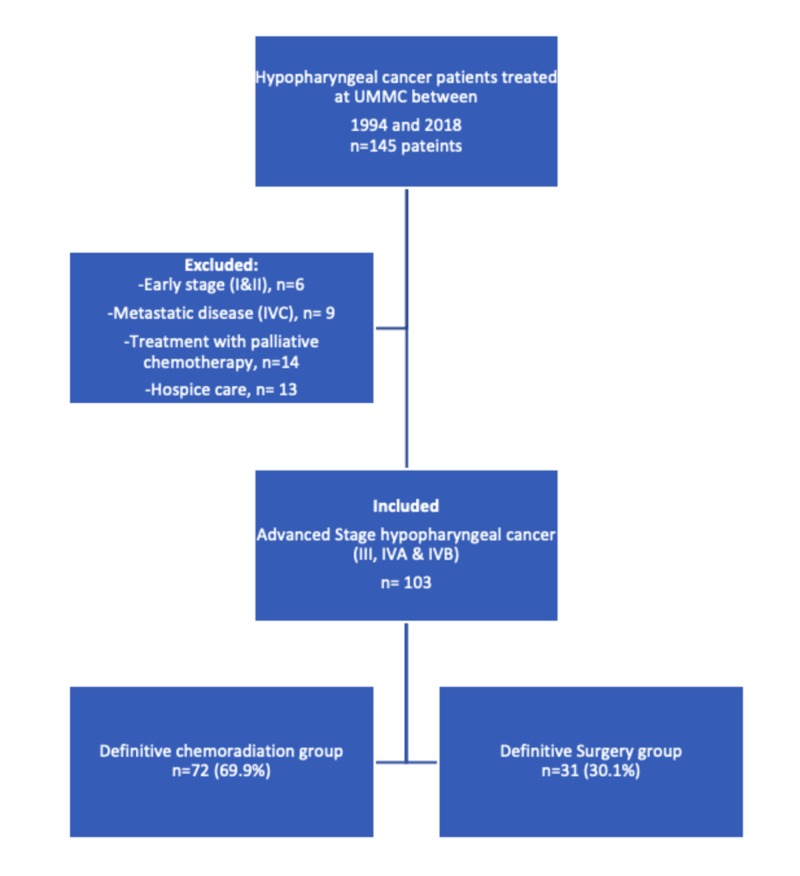
引言 由于文献中的数据相互矛盾,关于晚期下咽癌患者应接受根治性手术还是放化疗一直存在争议。本研究的目的是评估过去25年中一家三级医疗机构对晚期下咽癌的治疗及结果。方法 对1994年1月至2018年12月在本机构接受治疗的晚期下咽鳞状细胞癌患者进行了一项经机构审查委员会(IRB)批准且符合HIPPA规定的回顾性分析。收集了有关人口统计学、分期、治疗和随访的数据。使用Kaplan Meier方法计算包括中位生存期和总生存期在内的结果。所有分析均使用SPSS v. 24进行。结果 本研究共纳入103例晚期下咽癌患者。该队列的中位年龄为61岁(范围:41 - 88岁,标准差9.3)。在总共103例符合条件的患者中,92例(89.3%)为男性,11例(10.7%)为女性;61例(59.2%)为非裔美国人,39例(37.9%)为白种人,3例(2.9%)为其他种族。17例患者(16.5%)患有III期疾病,而86例(83.5%)患者被诊断为IV A期或B期疾病。72例患者(69.9%)接受了根治性放化疗(放化疗组),31例患者(30.1%)接受了一期手术,有无辅助治疗(手术组)。两个治疗组在年龄、性别、种族、饮酒状况、N分期和亚部位方面相似,但在吸烟状况(P = 0.035)和T分期(P = 0.024)方面有显著差异。中位随访时间为17个月。整个队列的中位生存期为26个月,五年总生存率为25.5%。发现手术组的中位生存期明显优于根治性放化疗组(43个月对16个月,P = 0.049)。与放化疗组相比,手术组患者的五年总生存率(OS;41.5%对18.5%,P = 0.049)和无病生存率(DFS;75.3%对56%;P = 0.029)明显更好。在多变量Cox回归分析中,淋巴结状态(HR = 1.27,CI:1.00 - 1.62,P = 0.047)和放化疗治疗(HR = 1.82,CI:1.00 - 3.29,P = 0.048)与较高的死亡风险相关。结论 在我们单一机构对晚期下咽癌治疗的经验中,发现五年总生存率为25.5%,是头颈癌中最差的。与接受根治性放化疗的患者相比,接受手术加辅助放疗或放化疗的晚期下咽癌患者的总生存率有显著提高。需要进一步研究以进行早期检测和更好的治疗,以提高下咽癌患者的治愈率。