Radiology Intervention Department, Puyang Oilfield General Hospital, Puyang, China.
Radiology Intervention Department, First Affiliated Hospital of Zhengzhou University, Zhengzhou, China.
Can J Gastroenterol Hepatol. 2020 Feb 11;2020:5143013. doi: 10.1155/2020/5143013. eCollection 2020.
. Upper gastrointestinal bleeding is a threat to patients with gastric varices (GVs). Previous studies have concluded that both transjugular intrahepatic portosystemic shunt (TIPS) and balloon-occluded retrograde transvenous obliteration (BRTO) are effective treatments for patients with GV. We aimed to compare the efficiency and outcomes of these two procedures in GV patients through meta-analysis.
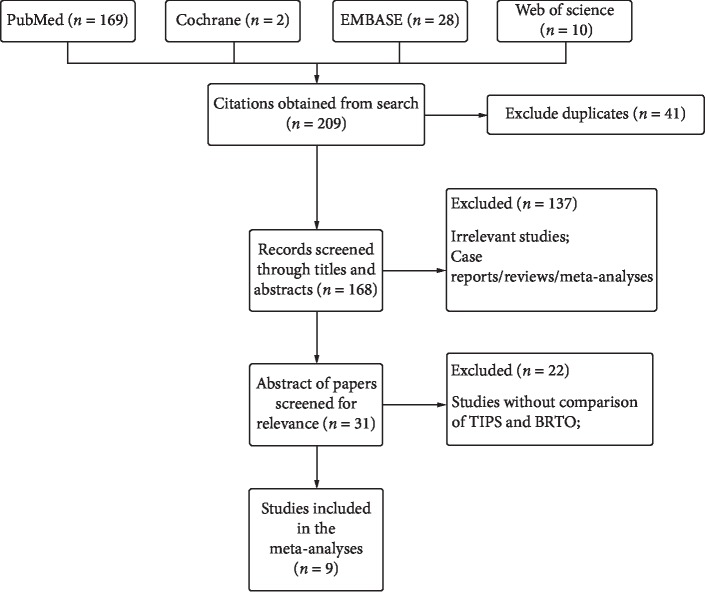
The PubMed, Cochrane Library, EMBASE, and Web of Science databases were searched using the keywords: GV, bleeding, TIPS, and BRTO to identify relevant randomized controlled trials and cohort studies. The overall survival (OS) rate, imminent haemostasis rate, rebleeding rate, technical success rate, procedure complication rate (hepatic encephalopathy and aggravated ascites), and Child-Pugh score were evaluated. Randomized clinical trials and cohort studies comparing TIPS and BRTO for GV due to portal hypertension were included in our meta-analysis. Two independent reviewers performed data extraction and assessed the study quality. A meta-analysis was performed to calculate risk ratios (RRs), mean differences (MDs), and 95% CIs using random effects models.
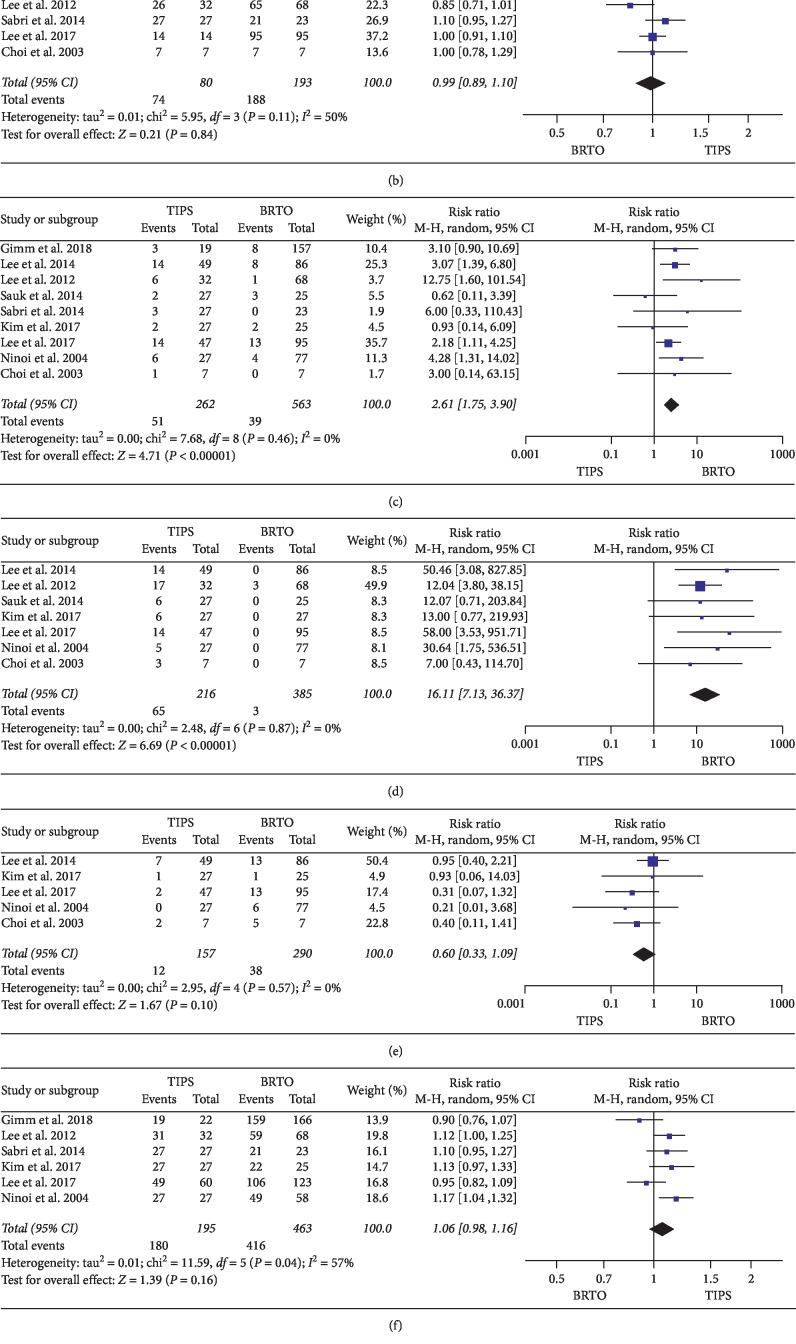
A total of nine studies fulfilled the inclusion criteria. There was a significant difference between TIPS and BRTO in the OS rate (RR, 0.81 (95% CI, 0.66 to 0.98); =0.03) and rebleeding rate (RR, 2.61 (95% CI, 1.75 to 3.90); =0.03) and rebleeding rate (RR, 2.61 (95% CI, 1.75 to 3.90); =0.03) and rebleeding rate (RR, 2.61 (95% CI, 1.75 to 3.90); =0.03) and rebleeding rate (RR, 2.61 (95% CI, 1.75 to 3.90); =0.03) and rebleeding rate (RR, 2.61 (95% CI, 1.75 to 3.90); =0.03) and rebleeding rate (RR, 2.61 (95% CI, 1.75 to 3.90); =0.03) and rebleeding rate (RR, 2.61 (95% CI, 1.75 to 3.90).
In this meta-analysis, BRTO brought more benefits to patients, with a higher OS rate and lower rebleeding rate. BRTO is a feasible method for GVB.
通过荟萃分析比较两种方法治疗胃静脉曲张(GV)患者的疗效和结局。
检索PubMed、Cochrane Library、EMBASE 和 Web of Science 数据库,使用关键词:GV、出血、TIPS 和 BRTO 检索相关随机对照试验和队列研究。评估总生存率(OS)、即刻止血率、再出血率、技术成功率、手术并发症率(肝性脑病和加重性腹水)和 Child-Pugh 评分。本荟萃分析纳入了比较 TIPS 和 BRTO 治疗门静脉高压引起的 GV 的随机临床试验和队列研究。两名独立审查员进行数据提取和研究质量评估。使用随机效应模型计算风险比(RR)、均数差(MD)和 95%置信区间(CI)进行荟萃分析。
共纳入 9 项研究。TIPS 与 BRTO 在 OS 率(RR,0.81(95%CI,0.66 至 0.98);=0.03)和再出血率(RR,2.61(95%CI,1.75 至 3.90);=0.03)方面存在显著差异。
BRTO 为 GVB 患者带来了更高的 OS 率和更低的再出血率,是一种可行的方法。