Al-Ashkar Ibrahim, Alderfasi Ali, Ben Romdhane Walid, Seleiman Mahmoud F, El-Said Rania A, Al-Doss Abdullah
Plant Production, College of Food and Agriculture Sciences, King Saud University, Riyadh 11451, Saudi Arabia.
Agronomy Department, Faculty of Agriculture, Al-Azhar University, Cairo 11651, Egypt.
Plants (Basel). 2020 Feb 25;9(3):287. doi: 10.3390/plants9030287.
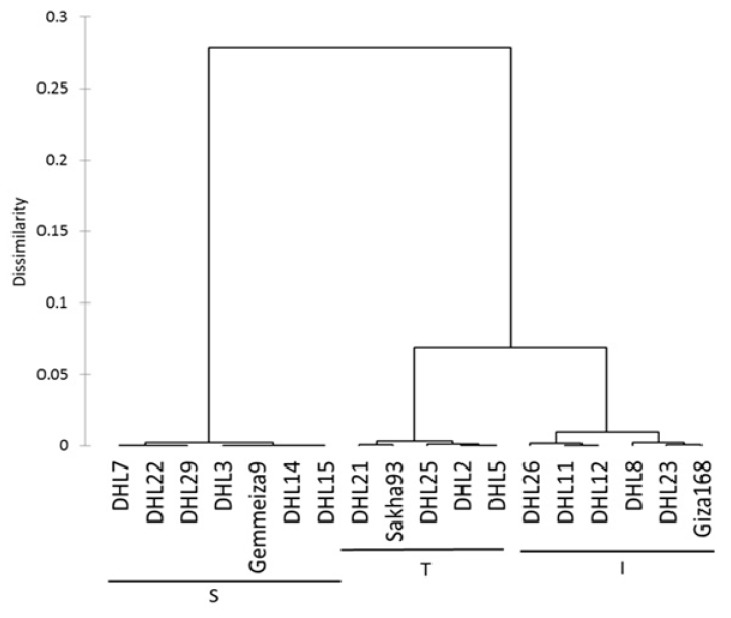
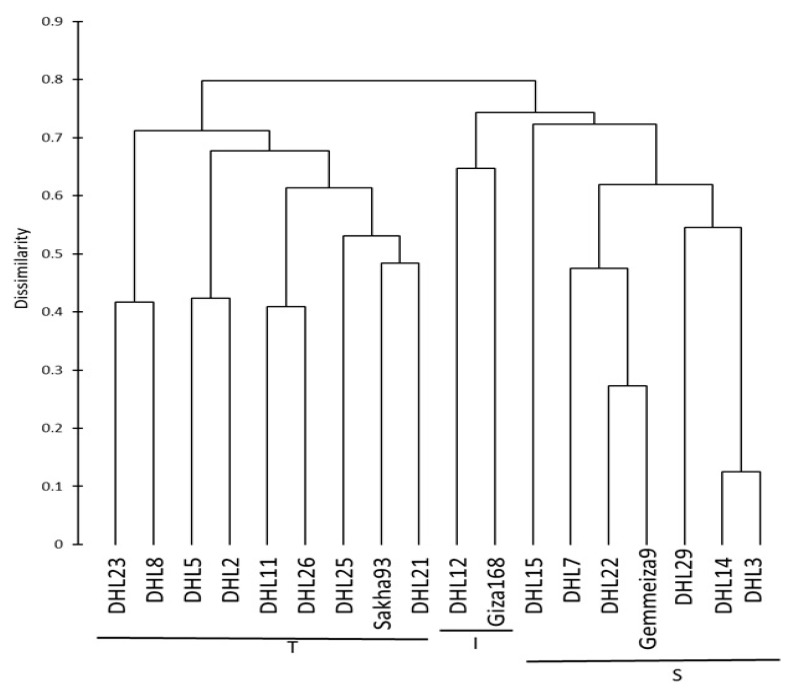
Salinity is a major obstacle to wheat production worldwide. Salt-affected soils could be used by improving salt-tolerant genotypes depending upon the genetic variation and salt stress response of adapted and donor wheat germplasm. We used a comprehensive set of morpho-physiological and biochemical parameters and simple sequence repeat (SSR) marker technique with multivariate analysis to accurately demonstrate the phenotypic and genetic variation of 18 wheat genotypes under salinity stress. All genotypes were evaluated without NaCl as a control and with 150 mM NaCl, until the onset of symptoms of death in the sensitive plant (after 43 days of salinity treatment). The results showed that the relative change of the genetic variation was high for all parameters, heritability (> 60%), and genetic gain (> 20%). Stepwise regression analysis, noting the importance of the root dry matter, relative turgidity, and their respective contributions to the shoot dry matter, indicated their relevance in improving and evaluating the salt-tolerant genotypes of breeding programs. The relative change of the genotypes in terms of the relative turgidity and shoot dry matter during salt stress was verified using clustering methods. For cluster analysis, the genotypes were classified into three groups: tolerant, intermediate, and sensitive, representing five, six, and seven genotypes, respectively. The morphological and genetic distances were significantly correlated based on the Mantel test. Of the 23 SSR markers that showed polymorphism, 17 were associated with almost all examined parameters. Therefore, based on the observed molecular marker-phenotypic trait association, the markers were highly useful in detecting tolerant and sensitive genotypes. Thus, it considers a helpful tool for salt tolerance through marker-assisted selection.
盐度是全球小麦生产的主要障碍。通过根据适应性和供体小麦种质的遗传变异及盐胁迫反应改良耐盐基因型,可以利用受盐影响的土壤。我们使用了一套全面的形态生理和生化参数以及简单序列重复(SSR)标记技术,并结合多变量分析,以准确展示18个小麦基因型在盐胁迫下的表型和遗传变异。所有基因型均在无氯化钠作为对照以及150 mM氯化钠的条件下进行评估,直至敏感植株出现死亡症状(盐处理43天后)。结果表明,所有参数的遗传变异相对变化都很高,遗传力(>60%)和遗传增益(>20%)。逐步回归分析指出了根干物质、相对膨压及其对地上部干物质的各自贡献的重要性,表明它们在改良和评估育种计划中的耐盐基因型方面具有相关性。利用聚类方法验证了盐胁迫期间基因型在相对膨压和地上部干物质方面的相对变化。对于聚类分析,基因型被分为三组:耐盐型、中间型和敏感型,分别代表5个、6个和7个基因型。基于Mantel检验,形态距离和遗传距离显著相关。在显示多态性的23个SSR标记中,有17个与几乎所有检测参数相关。因此,基于观察到的分子标记-表型性状关联,这些标记在检测耐盐和敏感基因型方面非常有用。因此,它被认为是通过标记辅助选择实现耐盐性的有用工具。