Department of Plant Pathology, University of California, Davis, CA, USA.
Department of Microbiology and Plant Pathology, University of California, Riverside, CA, USA.
Mol Plant Pathol. 2020 May;21(5):716-731. doi: 10.1111/mpp.12925. Epub 2020 Feb 28.
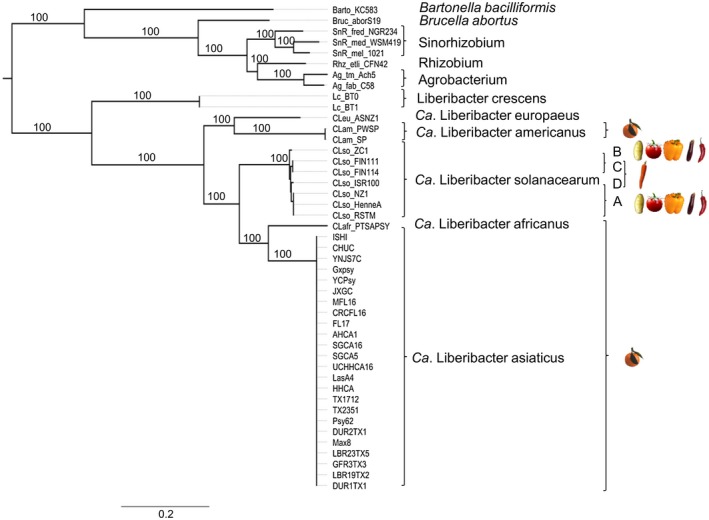
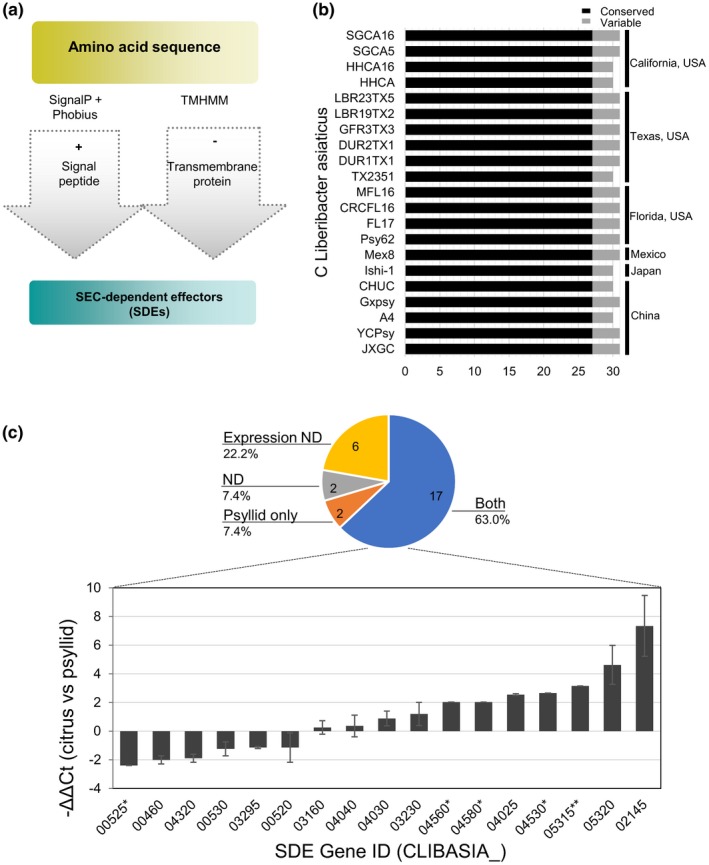
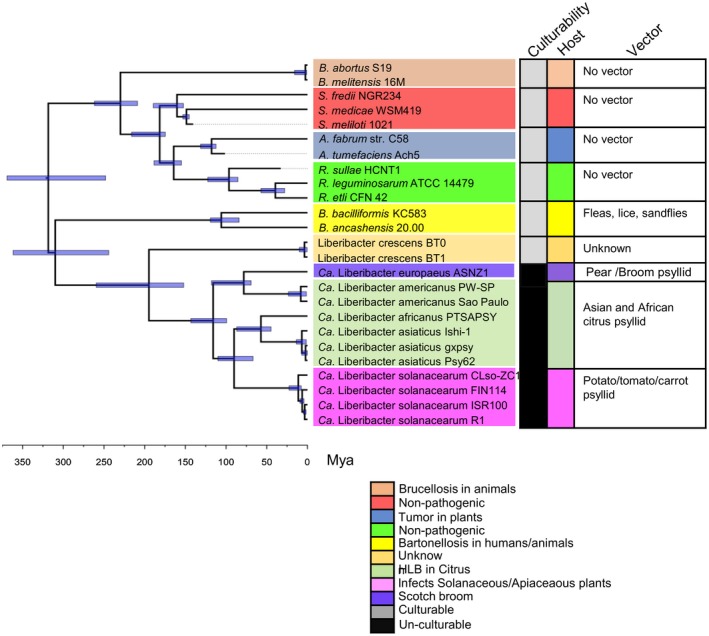
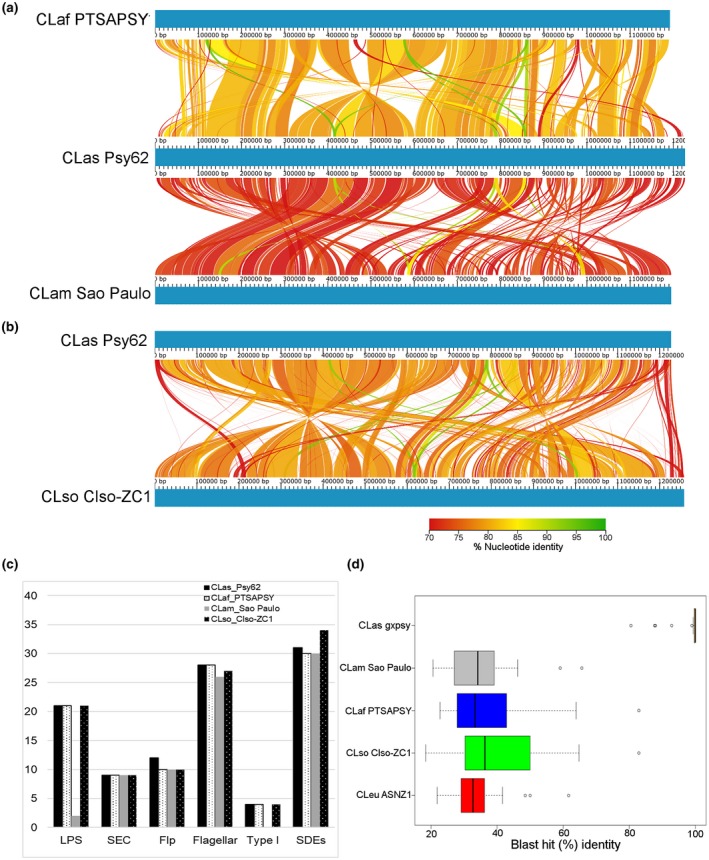
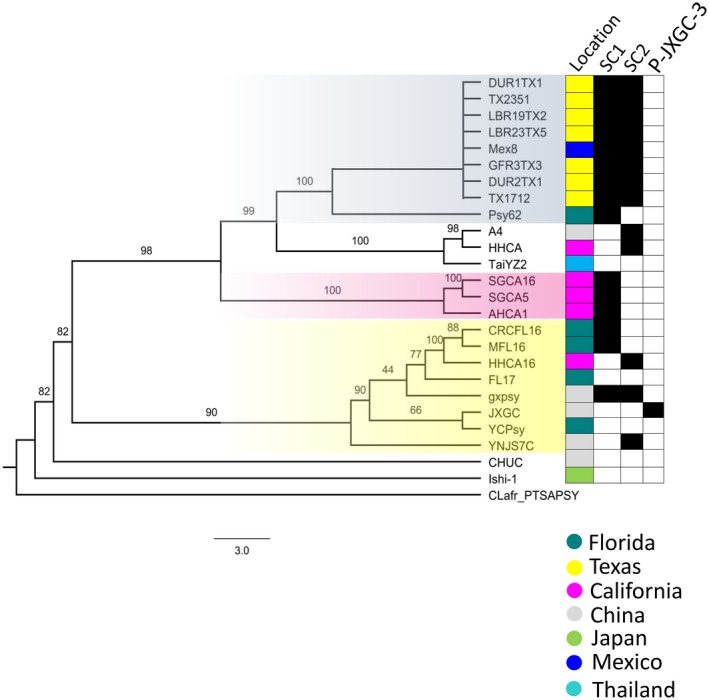
'Candidatus Liberibacter' species are insect-transmitted, phloem-limited α-Proteobacteria in the order of Rhizobiales. The citrus industry is facing significant challenges due to huanglongbing, associated with infection from 'Candidatus Liberibacter asiaticus' (Las). In order to gain greater insight into 'Ca. Liberibacter' biology and genetic diversity, we have performed genome sequencing and comparative analyses of diverse 'Ca. Liberibacter' species, including those that can infect citrus. Our phylogenetic analysis differentiates 'Ca. Liberibacter' species and Rhizobiales in separate clades and suggests stepwise evolution from a common ancestor splitting first into nonpathogenic Liberibacter crescens followed by diversification of pathogenic 'Ca. Liberibacter' species. Further analysis of Las genomes from different geographical locations revealed diversity among isolates from the United States. Our phylogenetic study also indicates multiple Las introduction events in California and spread of the pathogen from Florida to Texas. Texan Las isolates were closely related, while Florida and Asian isolates exhibited the most genetic variation. We have identified conserved Sec translocon (SEC)-dependent effectors likely involved in bacterial survival and virulence of Las and analysed their expression in their plant host (citrus) and insect vector (Diaphorina citri). Individual SEC-dependent effectors exhibited differential expression patterns between host and vector, indicating that Las uses its effector repertoire to differentially modulate diverse organisms. Collectively, this work provides insights into the evolution of 'Ca. Liberibacter' species, the introduction of Las in the United States and identifies promising Las targets for disease management.
‘Candidatus Liberibacter’ 物种是根瘤菌目中通过昆虫传播、局限于韧皮部的 α-变形菌。由于黄龙病,与‘亚洲韧皮杆菌’(Las)感染相关,柑橘产业面临重大挑战。为了更深入地了解‘Ca. Liberibacter’的生物学和遗传多样性,我们对不同的‘Ca. Liberibacter’物种进行了基因组测序和比较分析,包括那些能够感染柑橘的物种。我们的系统发育分析将‘Ca. Liberibacter’物种和根瘤菌目区分在不同的分支中,并表明从共同祖先逐步进化而来,首先分裂成非致病性的 Liberibacter crescens,然后致病性‘Ca. Liberibacter’物种多样化。对来自不同地理位置的 Las 基因组的进一步分析揭示了来自美国的分离株之间的多样性。我们的系统发育研究还表明,Las 在加利福尼亚州有多次引入事件,并从佛罗里达州传播到德克萨斯州。德克萨斯州的 Las 分离株密切相关,而佛罗里达州和亚洲的分离株表现出最大的遗传变异。我们已经鉴定出保守的 Sec 易位体(SEC)依赖性效应物,这些效应物可能参与 Las 的细菌存活和毒力,并分析了它们在植物宿主(柑橘)和昆虫载体(柑橘木虱)中的表达。单个 SEC 依赖性效应物在宿主和载体之间表现出不同的表达模式,表明 Las 使用其效应物库来差异调节不同的生物体。总的来说,这项工作提供了对‘Ca. Liberibacter’物种进化、Las 在 美国的引入以及鉴定 Las 用于疾病管理的有希望的靶标的深入了解。