School of Natural Sciences, Bangor University, Bangor, Gwynedd, United Kingdom.
Department of Genetics, University of North Carolina at Chapel Hill, Chapel Hill, NC.
Mol Biol Evol. 2020 Jul 1;37(7):1893-1906. doi: 10.1093/molbev/msaa050.
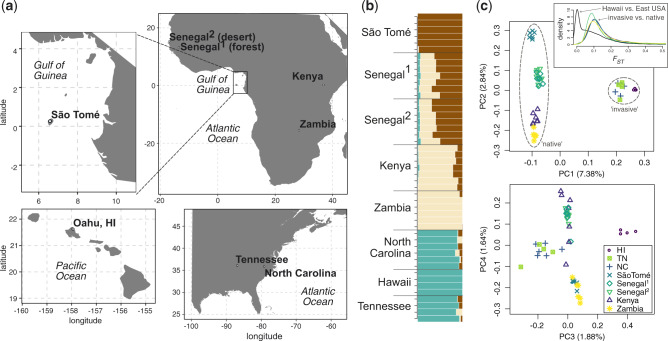
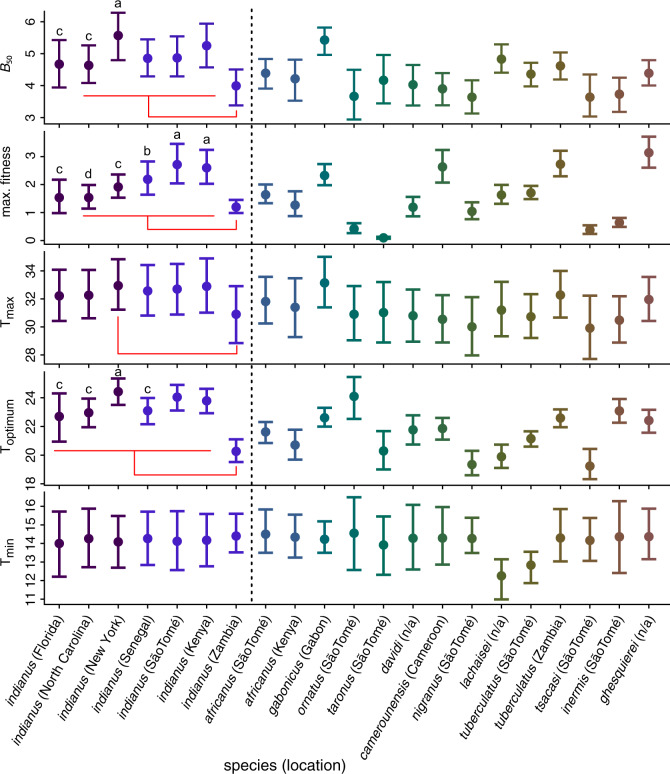
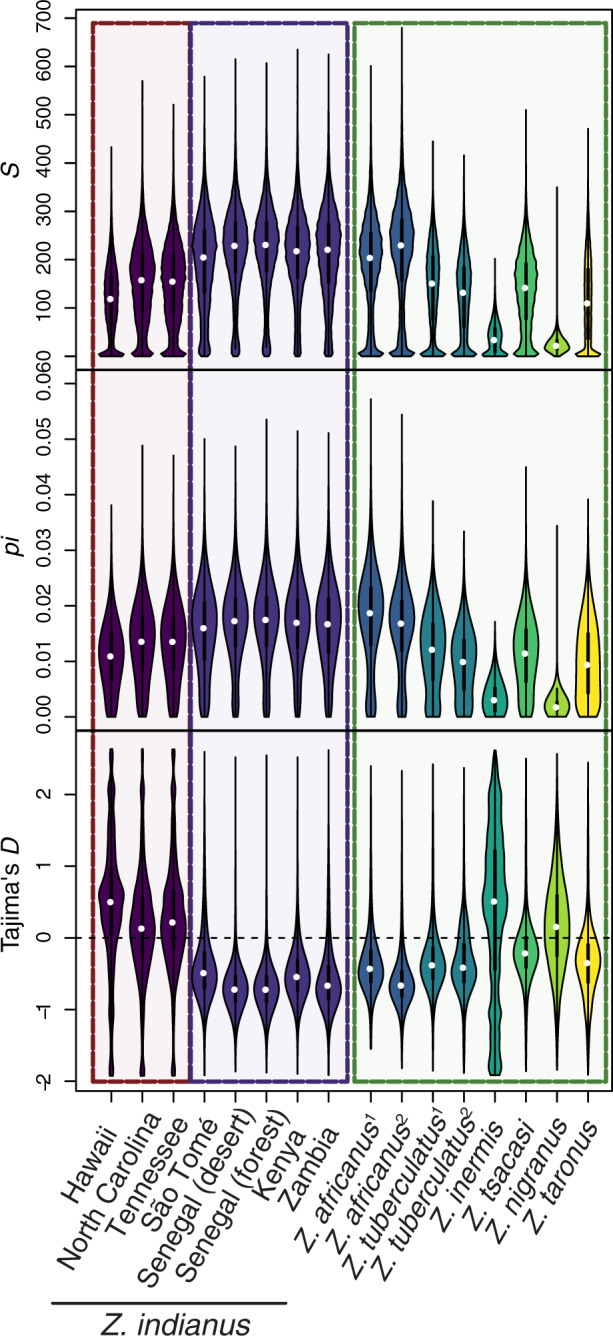
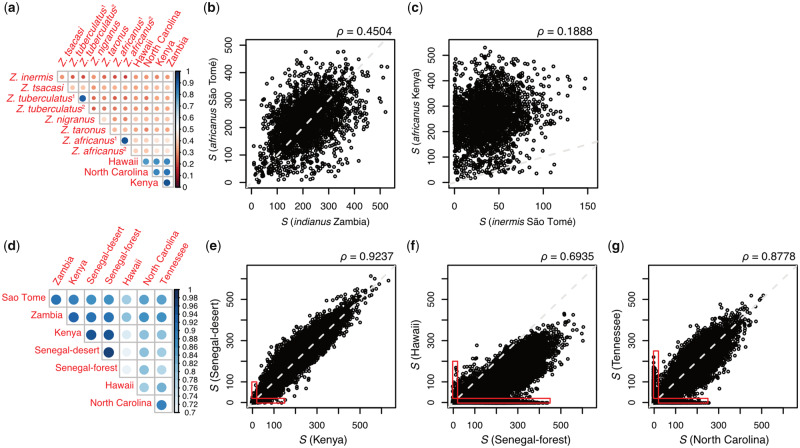
During biological invasions, invasive populations can suffer losses of genetic diversity that are predicted to negatively impact their fitness/performance. Despite examples of invasive populations harboring lower diversity than conspecific populations in their native range, few studies have linked this lower diversity to a decrease in fitness. Using genome sequences, we show that invasive populations of the African fig fly, Zaprionus indianus, have less genetic diversity than conspecific populations in their native range and that diversity is proportionally lower in regions of the genome experiencing low recombination rates. This result suggests that selection may have played a role in lowering diversity in the invasive populations. We next use interspecific comparisons to show that genetic diversity remains relatively high in invasive populations of Z. indianus when compared with other closely related species. By comparing genetic diversity in orthologous gene regions, we also show that the genome-wide landscape of genetic diversity differs between invasive and native populations of Z. indianus indicating that invasion not only affects amounts of genetic diversity but also how that diversity is distributed across the genome. Finally, we use parameter estimates from thermal performance curves for 13 species of Zaprionus to show that Z. indianus has the broadest thermal niche of measured species, and that performance does not differ between invasive and native populations. These results illustrate how aspects of genetic diversity in invasive species can be decoupled from measures of fitness, and that a broad thermal niche may have helped facilitate Z. indianus's range expansion.
在生物入侵过程中,入侵种群可能会遭受遗传多样性的损失,预计这将对其适应性/表现产生负面影响。尽管有一些入侵种群的遗传多样性低于其原生范围内的同物种种群的例子,但很少有研究将这种较低的多样性与适应性降低联系起来。我们使用基因组序列表明,非洲榕果蝇 Zaprionus indianus 的入侵种群的遗传多样性低于其原生范围内的同物种种群,并且在经历低重组率的基因组区域中,多样性比例更低。这一结果表明,选择可能在降低入侵种群的多样性方面发挥了作用。接下来,我们通过种间比较表明,与其他密切相关的物种相比,Z. indianus 的入侵种群的遗传多样性仍然相对较高。通过比较同源基因区域的遗传多样性,我们还表明,Z. indianus 的入侵和原生种群的基因组遗传多样性景观存在差异,这表明入侵不仅会影响遗传多样性的数量,还会影响多样性在基因组中的分布方式。最后,我们使用 13 种 Zaprionus 物种的热性能曲线的参数估计值表明,Z. indianus 具有测量物种中最广泛的热生态位,并且入侵种群和原生种群的表现没有差异。这些结果说明了入侵物种遗传多样性的某些方面如何与适应性措施脱钩,以及广泛的热生态位可能有助于促进 Z. indianus 的分布范围扩大。