Instituto Fernandes Figueira-Fiocruz, Rio de Janeiro, Brazil.
Universidade de São Paulo- USP, São Paulo, Brazil.
PLoS One. 2020 Feb 28;15(2):e0229434. doi: 10.1371/journal.pone.0229434. eCollection 2020.
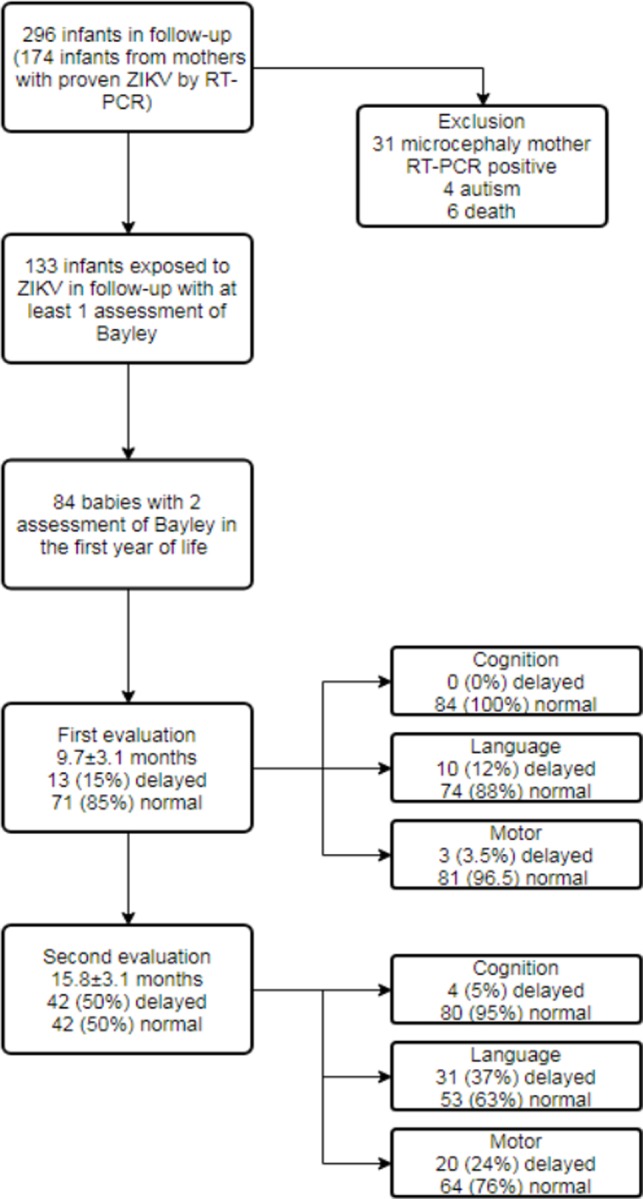
The main goal of this manuscript was to investigate the neurodevelopment of children exposed by Zika virus in the intrauterine period who are asymptomatic at birth. Newborns with documented Zika virus exposure during the intrauterine period who were asymptomatic at birth were followed in the first two years of life for neurodevelopment using Bayley III test. Children were classified as having normal or delayed neurodevelopment for age based on most recent Bayley III evaluation results. Eighty-four infants were included in the study. The first Bayley III evaluation was performed at a mean chronological age of 9.7±3.1 month; 13 children (15%) had a delay in one of the three domains, distributed as follow: 10 (12%) in the language domain and 3 (3.5%) in the motor domain. The most recent Bayley III evaluation was performed at a mean age 15.3±3.1 months; 42 children (50%) had a delay in one of the three domains: 4 (5%) in cognition, 31 (37%) in language, and 20 (24%) in motor performance. There were no statistical differences in Gender, Gestational Age, Birth Weight and Head Circurference at birth between children with normal and delayed neurodevelopment for age. A very high proportion of children exposed ZIKV during pregnancy who were asymptomatic at birth demonstrated a delay in neurodevelopment, mainly in the language domain, the first two years of life.
本手稿的主要目的是研究在宫内期暴露于寨卡病毒但出生时无症状的儿童的神经发育情况。对在宫内期有明确寨卡病毒暴露且出生时无症状的新生儿,在生命的头两年内使用贝利 III 测试进行神经发育随访。根据最近的贝利 III 评估结果,儿童的神经发育被分类为正常或与年龄相关的延迟。共有 84 名婴儿纳入研究。第一次贝利 III 评估在平均年龄为 9.7±3.1 个月时进行;13 名儿童(15%)在三个领域中的一个领域存在延迟,分布如下:10 名(12%)在语言领域,3 名(3.5%)在运动领域。最近的贝利 III 评估在平均年龄为 15.3±3.1 个月时进行;42 名儿童(50%)在三个领域中的一个领域存在延迟:4 名(5%)在认知领域,31 名(37%)在语言领域,20 名(24%)在运动表现领域。在正常和与年龄相关的神经发育延迟的儿童之间,性别、胎龄、出生体重和出生时头围没有统计学差异。在宫内期暴露于寨卡病毒且出生时无症状的儿童中,非常高比例的儿童在生命的头两年内出现神经发育延迟,主要是在语言领域。