Yang Xiawan, Bai Yanliang, Shi Mingyue, Zhang Wanjun, Niu Junwei, Wu Chengye, Zhang Lei, Xu Zhiwei, Liu Xiang, Chen Yuqing, Sun Kai
Department of Hematology, Zhengzhou University People's Hospital and Henan Provincial People's Hospital, Henan, People's Republic of China.
Institute of Hematology, Zhengzhou University People's Hospital and Henan Provincial People's Hospital, Henan, People's Republic of China.
Cancer Manag Res. 2020 Feb 20;12:1293-1301. doi: 10.2147/CMAR.S237467. eCollection 2020.
To validate the clinical efficacy of the recently developed EUTOS long-term survival (ELTS) score in a real-world setting.
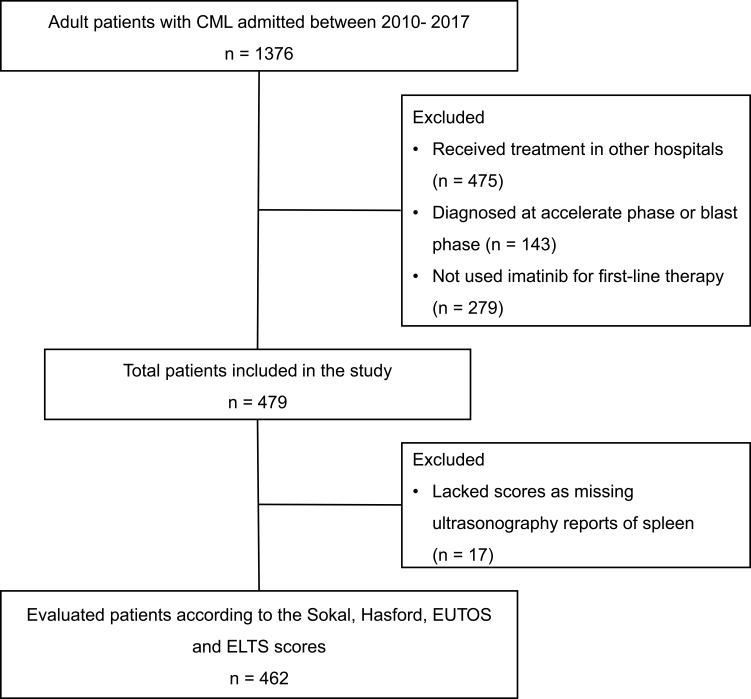
A total of 479 chronic myeloid leukemia (CML) patients treated with frontline imatinib between January 2010 and December 2017 were enrolled in this retrospective study. The ELTS score was evaluated on the end-points including complete cytogenetic response (CCyR), progression-free survival (PFS), overall survival (OS) and CML-related death, and the efficiency of the ELTS score was further compared with the historical Sokal, Hasford, EUTOS scores.
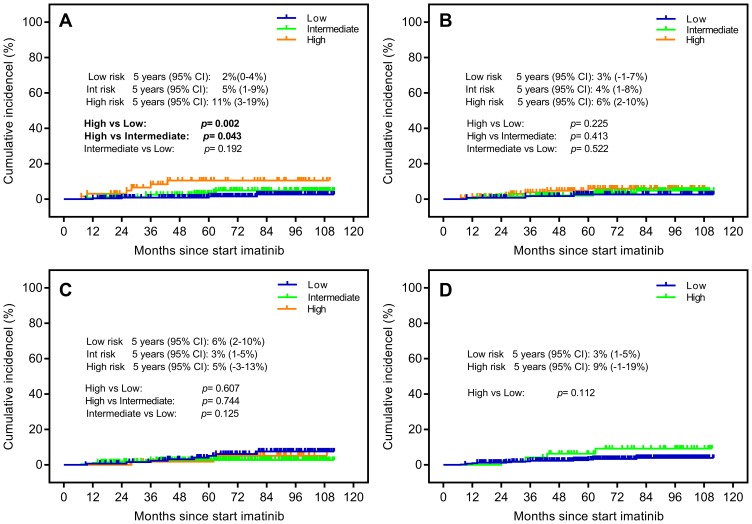
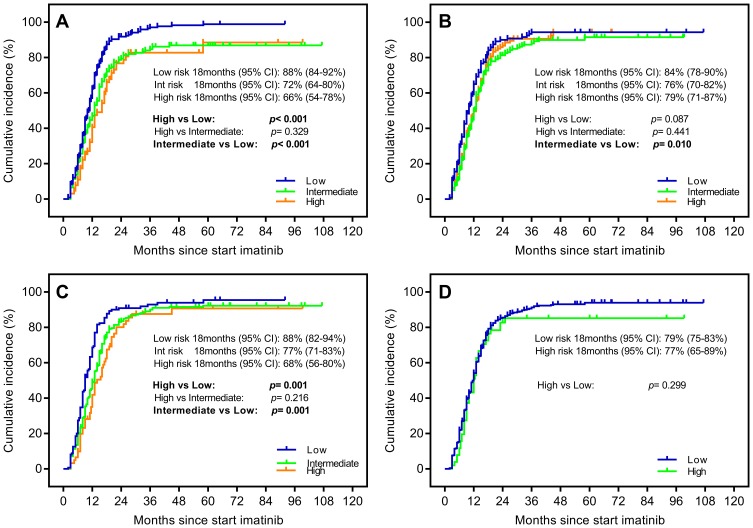
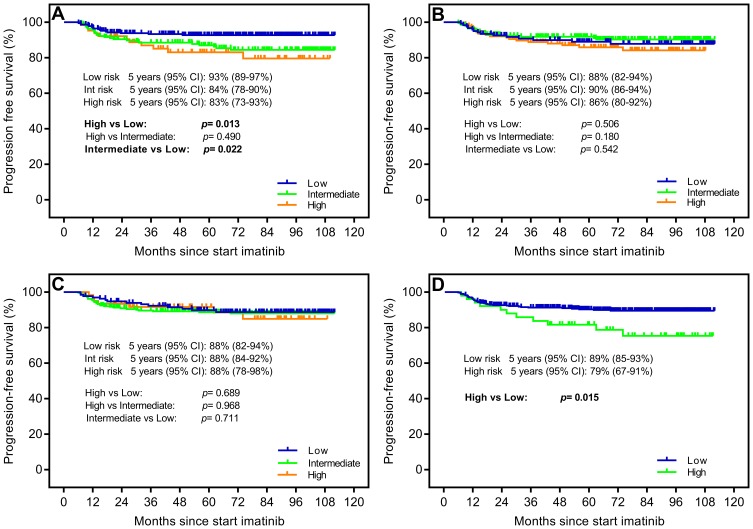
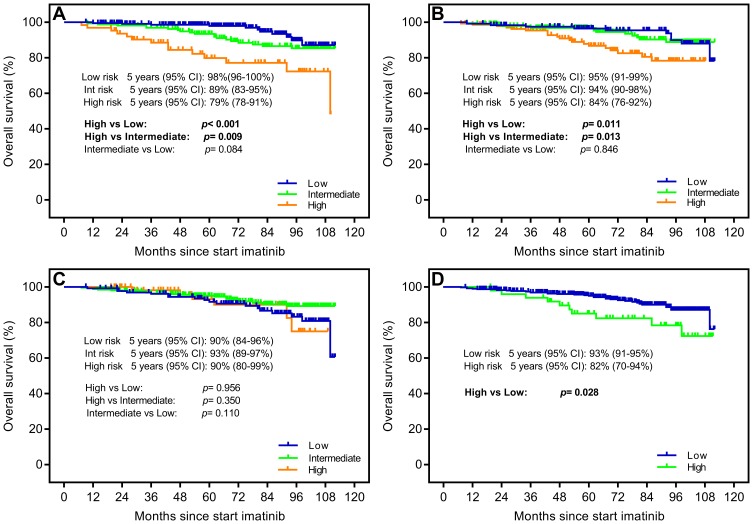
With a median follow-up of 69 months (range, 9-112 months), 462 evaluable patients were stratified into the ELTS low-risk (n = 230), ELTS intermediate-risk (n = 168) and ELTS high-risk (n = 64) groups. For the regular assessment indicators like CCyR, PFS and OS, the ELTS scoring system could effectively identify the corresponding risk groups, similarly with the results provided by previous scoring systems. With respect to the CML-related death, the ELTS score could accurately identify a high-risk group with a significantly higher risk of dying of CML, and the 5-year cumulative incidence occurred in the ELTS high-, intermediate-, and low-risk groups was 11% (95% CI: 3-19%), 5% (95% CI: 1-9%) and 2% (95% CI: 0-4%), respectively. Most notably, the ELTS score outperformed the Sokal, Hasford and EUTOS scores without statistical difference among different risk groups.
The ELTS score could effectively predict the prognosis of imatinib-treated CML patients in real-life settings.
在真实世界环境中验证最近开发的EUTOS长期生存(ELTS)评分的临床疗效。
本回顾性研究纳入了2010年1月至2017年12月期间接受一线伊马替尼治疗的479例慢性髓性白血病(CML)患者。对ELTS评分在包括完全细胞遗传学缓解(CCyR)、无进展生存期(PFS)、总生存期(OS)和CML相关死亡等终点进行评估,并将ELTS评分的有效性与历史上的Sokal、Hasford、EUTOS评分进行进一步比较。
中位随访69个月(范围9 - 112个月),462例可评估患者被分为ELTS低风险组(n = 230)、ELTS中风险组(n = 168)和ELTS高风险组(n = 64)。对于CCyR、PFS和OS等常规评估指标,ELTS评分系统能够有效识别相应的风险组,与先前评分系统提供的结果相似。关于CML相关死亡,ELTS评分能够准确识别出CML死亡风险显著更高的高风险组,ELTS高、中、低风险组的5年累积发生率分别为11%(95%CI:3 - 19%)、5%(95%CI:1 - 9%)和2%(95%CI:0 - 4%)。最值得注意的是,ELTS评分优于Sokal、Hasford和EUTOS评分,不同风险组之间无统计学差异。
ELTS评分能够在现实生活环境中有效预测伊马替尼治疗的CML患者的预后。