Awol Shekur Mohammed, Birhanu Abreham Yeneneh, Mekonnen Zeleke Abebaw, Gashu Kassahun Dessie, Shiferaw Atsede Mazengia, Endehabtu Berhanu Fikadie, Kalayou Mulugeta Haylom, Guadie Habtamu Alganeh, Tilahun Binyam
Department of Health Informatics, Institute of Public Health, College of Medicine and Health Sciences, University of Gondar, Gondar, Ethiopia.
Health Systems Directorate, Ministry of Health, Addis Ababa, Ethiopia.
Adv Med Educ Pract. 2020 Feb 21;11:147-154. doi: 10.2147/AMEP.S233368. eCollection 2020.
Incorporating electronic medical record systems (EMRs) into the healthcare system is not only about modernizing the health system, but is about saving lives by facilitating communication and practicing evidence-based decision. Globally, more than 50% of EMR projects fail before they reach their target. Even though EMRs are an essential tool for health care, their adoption and utilization remains low in developing countries including Ethiopia.
The aim of this study was to determine health professionals' readiness and associated factors toward the implementation of EMRs in four selected primary hospitals in Ethiopia.
An institutionbased cross-sectional study supplemented with a qualitative approach was conducted on 414 health professionals from March 2 to May 5, 2018 in four selected primary hospitals in Ethiopia. A self-administered questionnaire was used to collect the quantitative data and in-depth interviews were employed for the qualitative data. The data were analyzed using SPSS version 20 software. Descriptive statistics, bivariable, and multivariable logistic regression analyses were done. An adjusted odds ratio (AOR) with 95% CI was used to determine the association between the determinants and the outcome variable.
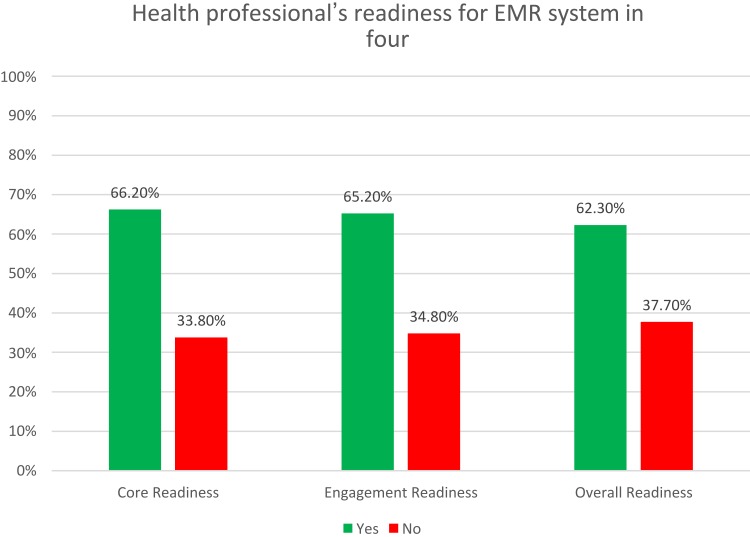
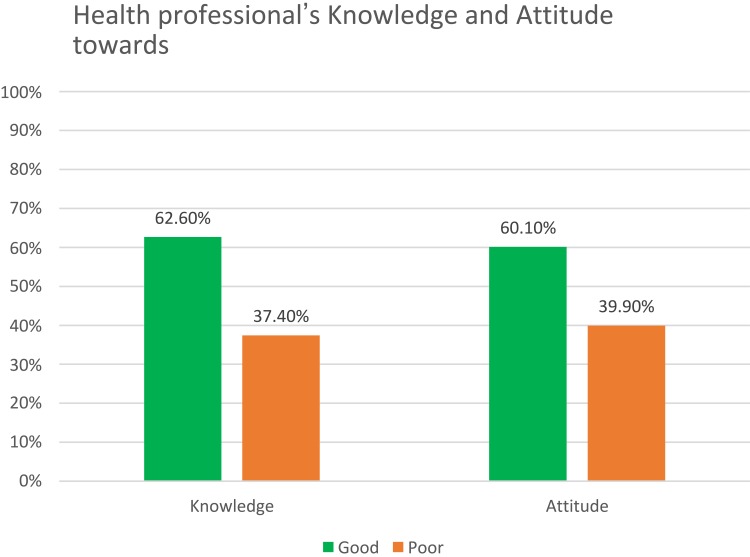
More than half (258; 62.3%) of health professionals were ready to use the electronic medical recording system. EMR knowledge (AOR = 2.64; 95% CI: [1.62, 4.29]), attitude (AOR = 1.63; 95% CI: [1.01, 2.63]), computer literacy (AOR = 3.30; 95% CI: [2.05, 5.31]), and EMR training (AOR = 3.63, ;5% CI: [1.69, 5.80]) were significantly associated with EMR readiness.
In general, the overall readiness of health professionals for EMR implementation was found to be low. Comprehensive packages of capacity-building are crucial to raise the level of knowledge, attitude, and computer skill among health workers.
将电子病历系统(EMR)纳入医疗保健系统不仅关乎卫生系统的现代化,还关乎通过促进沟通和实施循证决策来挽救生命。在全球范围内,超过50%的电子病历项目在实现目标之前就失败了。尽管电子病历是医疗保健的重要工具,但在包括埃塞俄比亚在内的发展中国家,其采用率和利用率仍然很低。
本研究的目的是确定埃塞俄比亚四家选定的基层医院中卫生专业人员对实施电子病历的准备情况及相关因素。
2018年3月2日至5月5日,在埃塞俄比亚四家选定的基层医院对414名卫生专业人员进行了一项基于机构的横断面研究,并辅以定性方法。使用自填式问卷收集定量数据,采用深入访谈收集定性数据。使用SPSS 20版软件对数据进行分析。进行了描述性统计、双变量和多变量逻辑回归分析。采用调整后的比值比(AOR)和95%置信区间来确定决定因素与结果变量之间的关联。
超过一半(258名;62.3%)的卫生专业人员准备好使用电子病历系统。电子病历知识(AOR = 2.64;95%置信区间:[1.62, 4.29])、态度(AOR = 1.63;95%置信区间:[1.01, 2.63])、计算机素养(AOR = 3.30;95%置信区间:[2.05, 5.31])和电子病历培训(AOR = 3.63;95%置信区间:[1.69, 5.80])与电子病历准备情况显著相关。
总体而言,发现卫生专业人员对实施电子病历的总体准备情况较低。全面的能力建设方案对于提高卫生工作者的知识水平、态度和计算机技能至关重要。