Saha Somen, Kotwani Priya, Pandya Apurvakumar, Patel Chintan, Shah Komal, Saxena Deepak, Puwar Tapasvi, Desai Shrey, Patel Dashrath M, Sethuraman A V, Ravi Jayanti S
Indian Institute of Public Health Gandhinagar, NH-147, Palaj Village, Opp. New Air Force Station HQ, Gandhinagar, Gujarat, India.
Department of Health and Family Welfare, Government of Gujarat, Block No. 5, Second Floor, Dr. Jivraj Mehta Bhavan, Old Sachivalay, Sector 10-B, Gandhinagar, Gujarat, India.
J Family Med Prim Care. 2020 Jan 28;9(1):340-346. doi: 10.4103/jfmpc.jfmpc_835_19. eCollection 2020 Jan.
The Health and Family Welfare Department of Gujarat implemented a mHealth Programme called TeCHO+ (Technology for Community Health Operations) in 2018. TeCHO+ is aimed at making progress across all dimensions of the comprehensive primary healthcare services.
The objective of this study is to record the document rollout and early implementation experience of TeCHO+ programme in Gujarat.
The present participatory process documentation exercise was undertaken in Gujarat. The various steps for process documentation were decided after participation in multiple task force meetings and state/district- and taluka-level action seminars and reviewing the TeCHO+ programme data and progress reports. The perceptions of the health officials and field staff were gathered using key informant interviews from five districts of Gujarat: Bharuch, Narmada, Gandhinagar, Mahisagar, and The Dangs. In addition, stakeholders involved with TeCHO+ Programme were interviewed to understand the process of rollout, implementation challenges, and success.
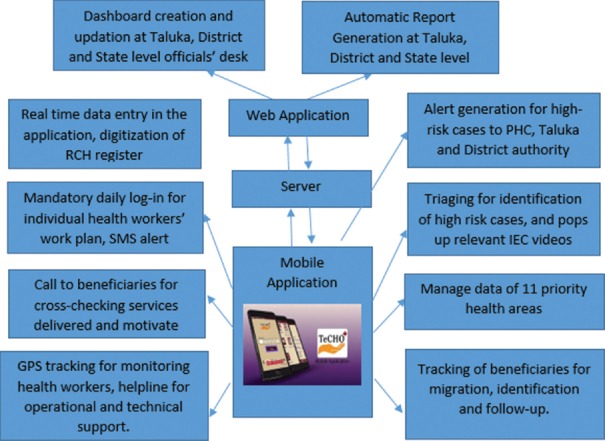
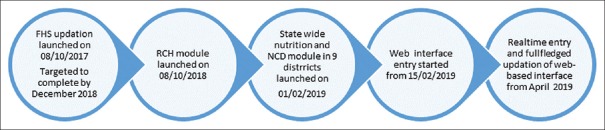
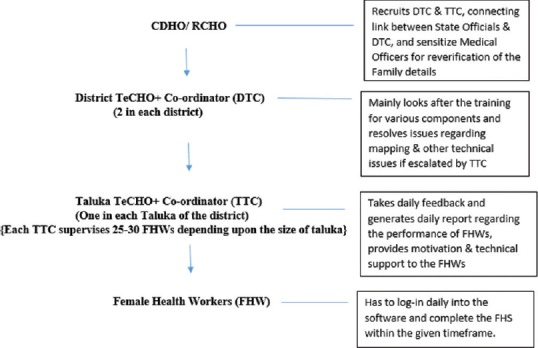
In the initial phase, the TeCHO+ application focussed only on updating the Family Health Survey to improve the quality of data captured in the system. FHWs log-in the mobile application daily to access their daily work plan for which SMS alerts were are also generated. Most FHWs were in their 50s and were first-time smartphone users. Although, they were enthusiastic and open to the new technology, initially they faced certain difficulties in operating the application. The programme had a strong troubleshooting mechanism in terms of the use of WhatsApp group, helpline numbers, and voice calls in addition to supportive supervision.
TeCHO+ showed the potential to enhance the quality of the collected data and also service coverage. However, poor technology literacy of old FHWs, the launch of multiple programme memes at the same time, and target-driven task assignments pose major challenges.
古吉拉特邦卫生与家庭福利部于2018年实施了一项名为TeCHO+(社区卫生行动技术)的移动健康计划。TeCHO+旨在推动全面初级医疗服务各方面取得进展。
本研究的目的是记录TeCHO+计划在古吉拉特邦的文件推广及早期实施经验。
本次参与式过程文件编制工作在古吉拉特邦开展。在参加多个特别工作组会议、州/地区及县一级行动研讨会并审查TeCHO+计划数据和进展报告后,确定了过程文件编制的各个步骤。通过对古吉拉特邦五个地区(巴鲁奇、纳尔默达、甘地讷格尔、马希萨格尔和当斯)的关键信息提供者进行访谈,收集了卫生官员和现场工作人员的看法。此外,还对参与TeCHO+计划的利益相关者进行了访谈,以了解推广过程、实施挑战和成功之处。
在初始阶段,TeCHO+应用程序仅专注于更新家庭健康调查,以提高系统中捕获数据的质量。家庭健康工作者每天登录移动应用程序以获取其每日工作计划,同时还会生成短信提醒。大多数家庭健康工作者年龄在50多岁,是首次使用智能手机的用户。尽管他们对新技术充满热情且持开放态度,但最初在操作应用程序时遇到了一些困难。除了支持性监督外,该计划在利用WhatsApp群组、求助热线号码和语音通话方面有强大的故障排除机制。
TeCHO+显示出提高所收集数据质量以及服务覆盖范围的潜力。然而,老年家庭健康工作者技术素养差、同时推出多个计划主题以及目标驱动的任务分配带来了重大挑战。