Amoakoh Hannah Brown, Klipstein-Grobusch Kerstin, Ansah Evelyn Korkor, Grobbee Diederick E, Yveoo Linda, Agyepong Irene
School of Public Health, University of Ghana, Accra, Ghana.
Julius Global Health, Julius Center for Health Sciences and Primary Care, University Medical Center, Utrecht University, Utrecht, The Netherlands.
BMJ Glob Health. 2019 Mar 8;4(2):e001153. doi: 10.1136/bmjgh-2018-001153. eCollection 2019.
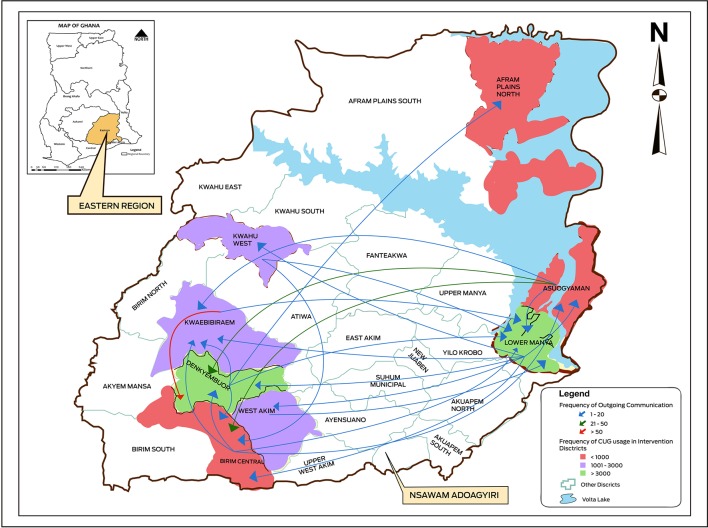
Despite increasing use of mHealth interventions, there remains limited documentation of 'how and why' they are used and therefore the explanatory mechanisms behind observed effects on beneficiary health outcomes. We explored 'how and why' an mHealth intervention to support clinical decision-making by front-line providers of maternal and neonatal healthcare services in a low-resource setting was used. The intervention consisted of phone calls (voice calls), text messaging (short messaging service (SMS)), internet access (data) and access to emergency obstetric and neonatal protocols via an Unstructured Supplementary Service Data (USSD). It was delivered through individual-use and shared facility mobile phones with unique Subscriber Identification Module (SIM) cards networked in a Closed User Group.
A single case study with multiple embedded subunits of analysis within the context of a cluster randomised controlled trial of the impact of the intervention on neonatal health outcomes in the Eastern Region of Ghana was performed. We quantitatively analysed SIM card activity data for patterns of voice calls, SMS, data and USSD. We conducted key informant interviews and focus group discussions with intervention users and manually analysed the data for themes.
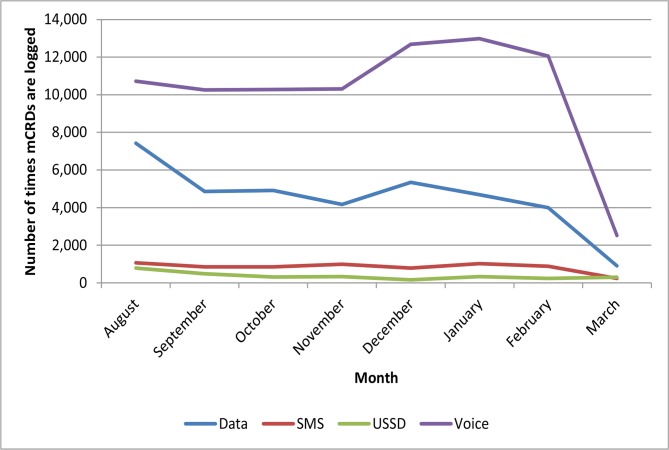
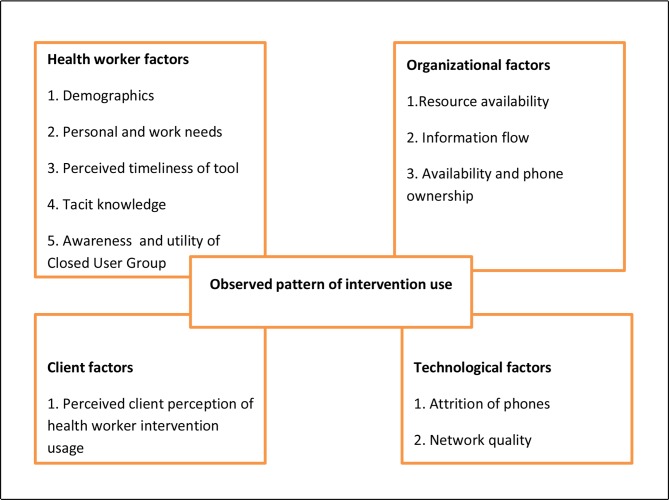
Overall, the phones were predominantly used for voice calls (64%), followed by data (28%), SMS (5%) and USSD (2%), respectively. Over time, use of all intervention components declined. Qualitative analysis showed that individual health worker factors (demographics, personal and work-related needs, perceived timeliness of intervention, tacit knowledge), organisational factors (resource availability, information flow, availability, phone ownership), technological factors (attrition of phones, network quality) and client perception of health worker intervention usage explain the pattern of intervention use observed.
How and why the mHealth intervention was used (or not) went beyond the technology itself and was influenced by individual and context-specific factors. These must be taken into account in designing similar interventions to optimise effectiveness.
尽管移动健康干预措施的使用日益增加,但关于其“如何使用以及为何使用”的记录仍然有限,因此对于观察到的对受益人群健康结果产生影响背后的解释机制也知之甚少。我们探讨了在资源匮乏地区,一种旨在支持孕产妇和新生儿医疗服务一线提供者进行临床决策的移动健康干预措施是“如何使用以及为何使用”的。该干预措施包括电话(语音通话)、短信(短消息服务(SMS))、互联网接入(数据)以及通过非结构化补充服务数据(USSD)获取紧急产科和新生儿诊疗方案。它通过配备有唯一用户识别模块(SIM)卡且在封闭用户组中联网的个人使用和共享设施移动电话来提供。
在加纳东部地区进行的一项关于该干预措施对新生儿健康结果影响的整群随机对照试验背景下,开展了一项包含多个嵌入式分析子单元的单案例研究。我们对SIM卡活动数据进行了定量分析,以了解语音通话、短信、数据和USSD的使用模式。我们与干预措施使用者进行了关键信息人访谈和焦点小组讨论,并对数据进行了手动分析以找出主题。
总体而言,手机主要用于语音通话(64%),其次是数据(28%)、短信(5%)和USSD(2%)。随着时间推移,所有干预组件的使用都有所下降。定性分析表明,个体卫生工作者因素(人口统计学特征、个人和工作相关需求、对干预及时性的认知、隐性知识)、组织因素(资源可用性、信息流、可用性、手机所有权)、技术因素(手机损耗、网络质量)以及客户对卫生工作者干预措施使用情况的认知解释了所观察到的干预措施使用模式。
移动健康干预措施的使用方式及原因(或未使用的原因)超出了技术本身,并且受到个体和特定情境因素的影响。在设计类似干预措施以优化效果时,必须考虑这些因素。