Prathiba P, Niranjjan R, Maurya Dilip Kumar, Lakshminarayanan Subitha
MPH Graduate, JIPMER School of Public Health, Puducherry, India.
Department of Community Medicine, AVMC, Puducherry, India.
J Family Med Prim Care. 2020 Jan 28;9(1):347-353. doi: 10.4103/jfmpc.jfmpc_836_19. eCollection 2020 Jan.
The referral system plays a crucial role in antenatal care and childbearing by providing access to emergency obstetric care. Excess referral from primary care and bypassing secondary levels of care leads to overcrowding of high risk and normal mothers in tertiary centers. Hence, this study aims to assess the gaps in the referral of patients with obstetric emergency from primary care to tertiary care.
In this hospital-based descriptive study, all obstetric patients referred to the Obstetric emergency facility and admitted in postnatal wards during the study period were included. They were interviewed using a pretested questionnaire. Data entry was performed using EpiData version 3.1 and analysis was done using SPSS version 22 software.
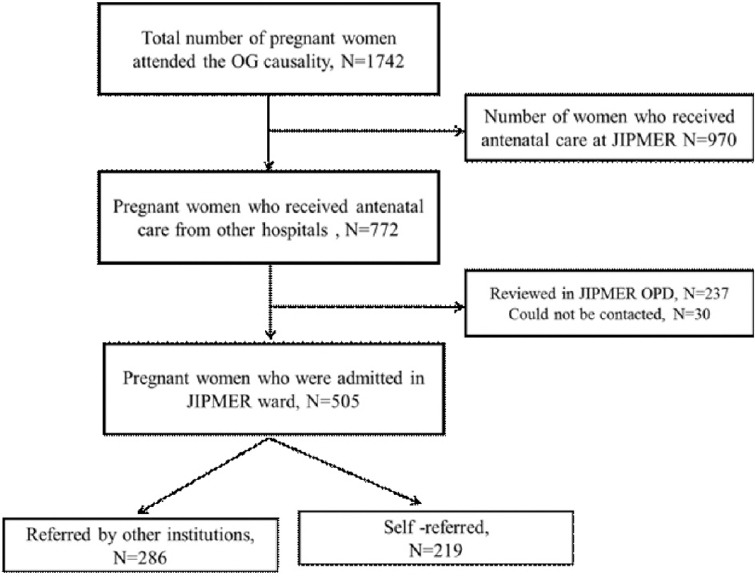
Of the 505 eligible women who attended the facility, 286 (56%) were referred from other institutions, while 44% were self-referred. Among those referred, one-third were from tertiary level facility and 40% from primary care facility. More than half of the referral was through verbal communication to the patient (60%); only one-third had referral slips. Around 40.4% chose bus and private vehicles (37.6%) as their means of transport; only around 10% traveled in 108 ambulances.
Measures to improve the capacity building at primary setting, hierarchy of referral, quality of documentation, and emergency transport mechanism for obstetric patients are vital. The deficits identified in the existing referral system will be useful to give feedback to the health systems of the neighboring regions on emergency obstetrics referrals and to propose referral guidelines.
转诊系统在产前护理和分娩过程中发挥着关键作用,它为产妇提供了获得紧急产科护理的途径。基层医疗过度转诊以及绕过二级护理机构,导致三级医疗中心高危产妇和正常产妇过度拥挤。因此,本研究旨在评估产科急诊患者从基层医疗转诊至三级医疗过程中的差距。
在这项基于医院的描述性研究中,纳入了研究期间转诊至产科急诊设施并入住产后病房的所有产科患者。使用预先测试的问卷对她们进行访谈。使用EpiData 3.1版本进行数据录入,并使用SPSS 22软件进行分析。
在505名到该设施就诊的符合条件的女性中,286名(56%)是由其他机构转诊而来,44%是自行前来。在转诊患者中,三分之一来自三级医疗机构,40%来自基层医疗机构。超过一半的转诊是通过与患者口头沟通进行的(60%);只有三分之一有转诊单。约40.4%选择乘坐公交车,37.6%选择私家车作为交通工具;只有约10%乘坐108辆救护车前来。
提高基层医疗机构的能力建设、完善转诊层级、提升文件记录质量以及建立产科患者紧急转运机制至关重要。现有转诊系统中发现的不足将有助于向邻近地区的卫生系统反馈产科急诊转诊情况,并提出转诊指南。