Nafee Tarek, Gibson C Michael, Travis Ryan, Yee Megan K, Kerneis Mathieu, Chi Gerald, AlKhalfan Fahad, Hernandez Adrian F, Hull Russell D, Cohen Ander T, Harrington Robert A, Goldhaber Samuel Z
The Cardiovascular Division Department of Medicine Beth Israel Deaconess Medical Center Harvard Medical School Boston Massachusetts.
Duke University The Duke Clinical Research Institute Durham North Carolina.
Res Pract Thromb Haemost. 2020 Jan 21;4(2):230-237. doi: 10.1002/rth2.12292. eCollection 2020 Feb.
The identification of acutely ill patients at high risk for venous thromboembolism (VTE) may be determined clinically or by use of integer-based scoring systems. These scores demonstrated modest performance in external data sets.
To evaluate the performance of machine learning models compared to the IMPROVE score.
The APEX trial randomized 7513 acutely medically ill patients to extended duration betrixaban vs. enoxaparin. Including 68 variables, a super learner model (ML) was built to predict VTE by combining estimates from 5 families of candidate models. A "reduced" model (rML) was also developed using 16 variables that were thought, a priori, to be associated with VTE. The IMPROVE score was calculated for each patient. Model performance was assessed by discrimination and calibration to predict a composite VTE end point. The frequency of predicted risks of VTE were plotted and divided into tertiles. VTE risks were compared across tertiles.
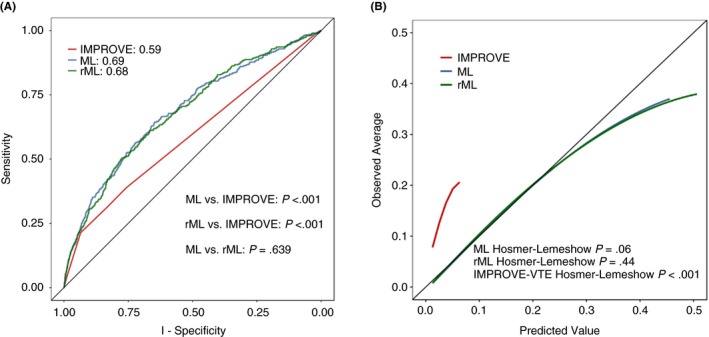
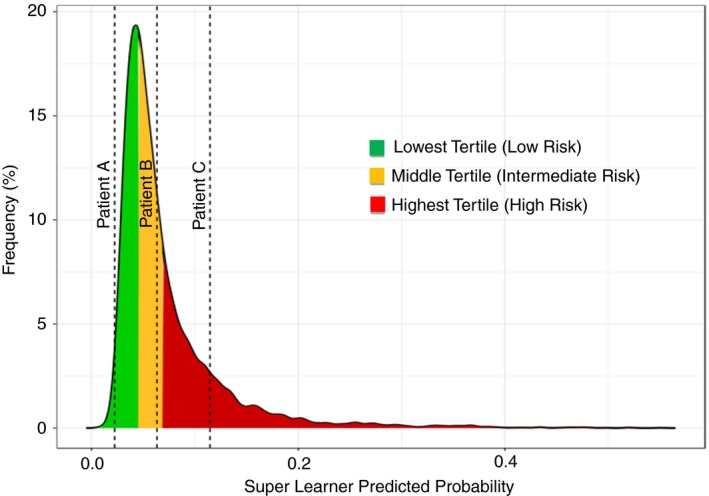
The ML and rML algorithms outperformed the IMPROVE score in predicting VTE (c-statistic: 0.69, 0.68 and 0.59, respectively). The Hosmer-Lemeshow goodness-of-fit -value was 0.06 for ML, 0.44 for rML, and <0.001 for the IMPROVE score. The observed event rate in the lowest tertile was 2.5%, 4.8% in tertile 2, and 11.4% in the highest tertile. Patients in the highest tertile of VTE risk had a 5-fold increase in odds of VTE compared to the lowest tertile.
The super learner algorithms improved discrimination and calibration compared to the IMPROVE score for predicting VTE in acute medically ill patients.
急性病患者静脉血栓栓塞症(VTE)高风险的识别可通过临床判断或使用基于整数的评分系统来确定。这些评分在外部数据集中表现一般。
评估机器学习模型与IMPROVE评分相比的性能。
APEX试验将7513例急性内科疾病患者随机分为延长疗程的贝曲西班组与依诺肝素组。利用68个变量构建了一个超级学习器模型(ML),通过合并来自5个候选模型族的估计值来预测VTE。还使用了16个先验认为与VTE相关的变量开发了一个“简化”模型(rML)。为每位患者计算IMPROVE评分。通过辨别力和校准来评估模型性能,以预测复合VTE终点。绘制预测的VTE风险频率并分为三分位数。比较各三分位数的VTE风险。
在预测VTE方面,ML和rML算法优于IMPROVE评分(c统计量分别为0.69、0.68和0.59)。ML的Hosmer-Lemeshow拟合优度值为0.06,rML为0.44,IMPROVE评分为<0.001。最低三分位数的观察事件发生率为2.5%,第二三分位数为4.8%,最高三分位数为11.4%。VTE风险最高三分位数的患者发生VTE的几率比最低三分位数高5倍。
与IMPROVE评分相比,超级学习器算法在预测急性内科疾病患者的VTE方面改善了辨别力和校准。