New England Biolabs, Ipswich, Massachusetts 01938.
MCBB Graduate Program, Graduate School of Arts and Sciences, Boston University, Boston, Massachusetts 02215.
J Biol Chem. 2020 Apr 3;295(14):4748-4759. doi: 10.1074/jbc.RA119.010951. Epub 2020 Feb 28.
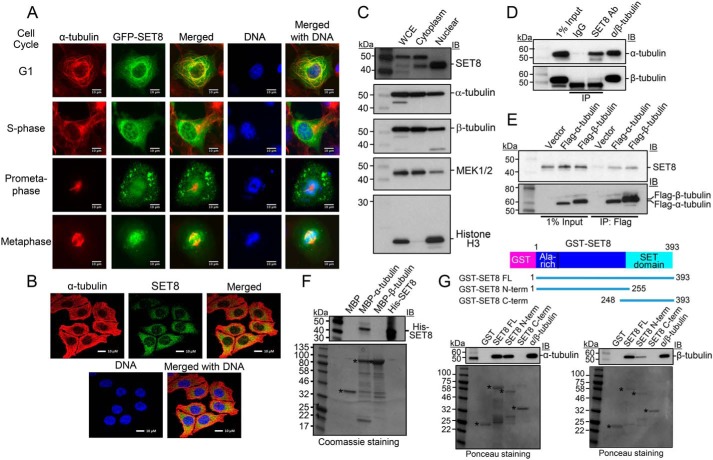
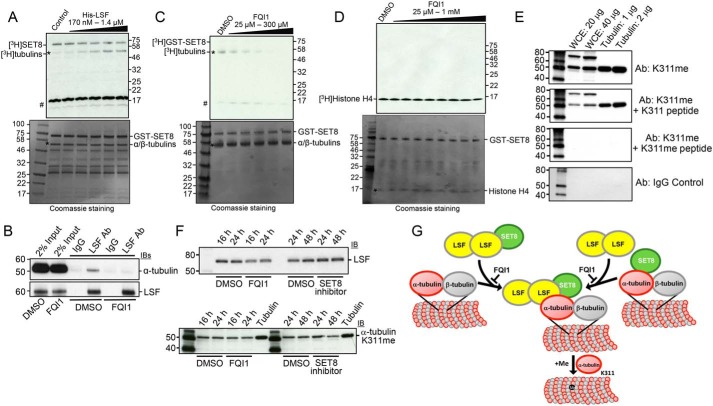
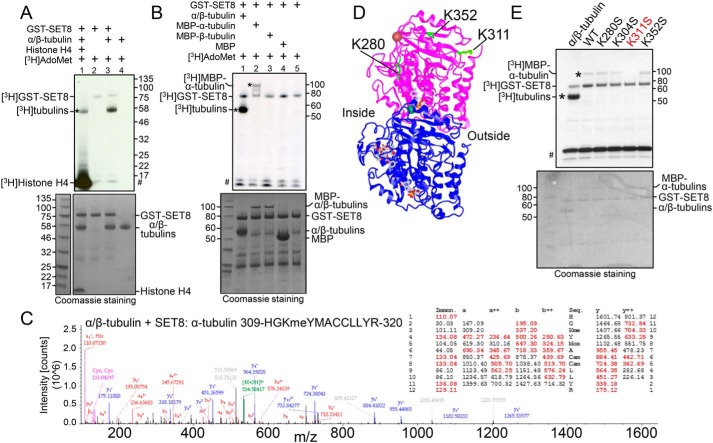
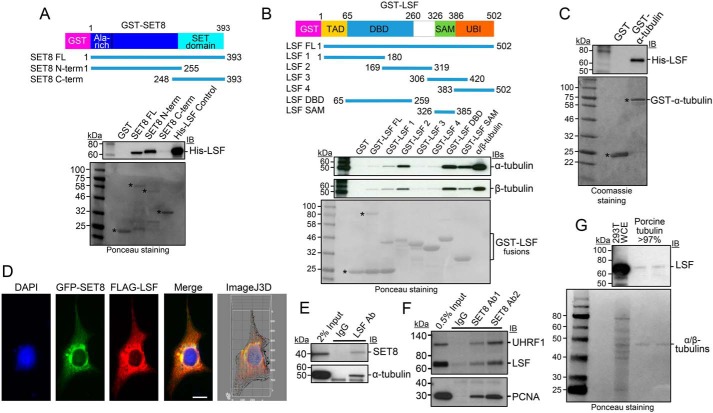
Microtubules are cytoskeletal structures critical for mitosis, cell motility, and protein and organelle transport and are a validated target for anticancer drugs. However, how tubulins are regulated and recruited to support these distinct cellular processes is incompletely understood. Posttranslational modifications of tubulins are proposed to regulate microtubule function and dynamics. Although many of these modifications have been investigated, only one prior study reports tubulin methylation and an enzyme responsible for this methylation. Here we used radiolabeling, MS, and immunoblotting approaches to monitor protein methylation and immunoprecipitation, immunofluorescence, and pulldown approaches to measure protein-protein interactions. We demonstrate that -lysine methyltransferase 5A (KMT5A or SET8/PR-Set7), which methylates lysine 20 in histone H4, bound α-tubulin and methylated it at a specific lysine residue, Lys Furthermore, late SV40 factor (LSF)/CP2, a known transcription factor, bound both α-tubulin and SET8 and enhanced SET8-mediated α-tubulin methylation In addition, we found that the ability of LSF to facilitate this methylation is countered by factor quinolinone inhibitor 1 (FQI1), a specific small-molecule inhibitor of LSF. These findings suggest the general model that microtubule-associated proteins, including transcription factors, recruit or stimulate protein-modifying enzymes to target tubulins. Moreover, our results point to dual functions for SET8 and LSF not only in chromatin regulation but also in cytoskeletal modification.
微管是有丝分裂、细胞运动、蛋白质和细胞器运输所必需的细胞骨架结构,也是抗癌药物的有效靶点。然而,微管蛋白如何被调节和募集来支持这些不同的细胞过程还不完全清楚。微管蛋白的翻译后修饰被认为可以调节微管的功能和动力学。尽管已经研究了许多这些修饰,但只有一项先前的研究报告了微管蛋白甲基化及其负责这种甲基化的酶。在这里,我们使用放射性标记、MS 和免疫印迹方法来监测蛋白质甲基化和免疫沉淀,免疫荧光和下拉方法来测量蛋白质-蛋白质相互作用。我们证明了赖氨酸甲基转移酶 5A(KMT5A 或 SET8/PR-Set7),它可以甲基化组蛋白 H4 的赖氨酸 20,结合α-微管蛋白并将其甲基化在特定的赖氨酸残基上,Lys 此外,晚期 SV40 因子(LSF)/CP2,一种已知的转录因子,结合了α-微管蛋白和 SET8,并增强了 SET8 介导的α-微管蛋白甲基化。此外,我们发现 LSF 促进这种甲基化的能力被喹啉酮抑制剂 1(FQI1)抵消,FQI1 是 LSF 的一种特异性小分子抑制剂。这些发现表明了一个普遍的模型,即微管相关蛋白,包括转录因子,招募或刺激蛋白质修饰酶来靶向微管蛋白。此外,我们的结果表明 SET8 和 LSF 的双重功能不仅在染色质调节中,而且在细胞骨架修饰中。