Vendrik J, Vlastra W, van Mourik M S, Delewi R, Beijk M A, Lemkes J, Wykrzykowska J J, de Winter R J, Henriques J S, Piek J J, Vis M M, Koch K T, Baan J
Heart Centre, Amsterdam University Medical Centres (location AMC), Amsterdam, The Netherlands.
Heart Centre, Amsterdam University Medical Centres (location VUMC), Amsterdam, The Netherlands.
Neth Heart J. 2020 May;28(5):240-248. doi: 10.1007/s12471-020-01374-5.
Immobilisation of patients after transfemoral transcatheter aortic valve implantation (TF-TAVI) is the standard of care, mostly to prevent vascular complications. However, immobilisation may increase post-operative complications such as delirium and infections. In this trial, we determine whether it is feasible and safe to implement early ambulation after TF-TAVI.
We prospectively included TF-TAVI patients from 2016 to 2018. Patients were assessed for eligibility using our strict safety protocol and were allocated (based on the time at which the procedure ended) to the EARLY or REGULAR group.
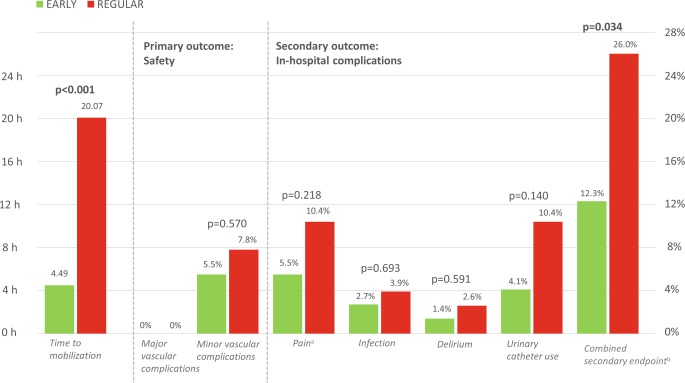
A total of 150 patients (49%) were deemed eligible for early mobilisation, of which 73 were allocated to the EARLY group and 77 to the REGULAR group. The overall population had a mean age of 80 years, 48% were male with a Society of Thoracic Surgeons Predicted Risk of Mortality (STS-PROM) score of 3.8 ± 1.8. Time to mobilisation was 4 h 49 min ± 31 min in the EARLY group versus 20 h 7 min ± 3 h 6 min in the REGULAR group (p < 0.0001). There were no differences regarding the primary endpoint. No major vascular complications occurred and a similar incidence of minor vascular complications was seen in both groups (4/73 [5.5%] vs 6/77 [7.8%], p = 0.570). The incidence of the combined secondary endpoint was lower in the EARLY group (p = 0.034), with a numerically lower incidence for all individual outcomes (delirium, infections, pain and unplanned urinary catheter use).
Early mobilisation (ambulation 4-6 h post-procedure) of TF-TAVI patients is feasible and safe. Early ambulation decreases the combined incidence of delirium, infections, pain and unplanned urinary catheter use, and its adoption into contemporary TAVI practice may therefore be beneficial.
经股动脉经导管主动脉瓣植入术(TF-TAVI)后让患者制动是标准治疗措施,主要是为了预防血管并发症。然而,制动可能会增加术后并发症,如谵妄和感染。在本试验中,我们确定TF-TAVI术后早期活动是否可行且安全。
我们前瞻性纳入了2016年至2018年的TF-TAVI患者。使用我们严格的安全方案评估患者的 eligibility,根据手术结束时间将患者分配到早期组或常规组。
共有150名患者(49%)被认为适合早期活动,其中73名被分配到早期组,77名被分配到常规组。总体人群的平均年龄为80岁,48%为男性,胸外科医师协会预测死亡率(STS-PROM)评分为3.8±1.8。早期组的活动时间为4小时49分钟±31分钟,而常规组为20小时7分钟±3小时6分钟(p<0.0001)。关于主要终点没有差异。两组均未发生重大血管并发症,轻微血管并发症的发生率相似(4/73[5.5%]对6/77[7.8%],p=0.570)。早期组联合次要终点的发生率较低(p=0.034),所有个体结局(谵妄、感染、疼痛和非计划使用导尿管)的发生率在数值上也较低。
TF-TAVI患者早期活动(术后4-6小时活动)是可行且安全的。早期活动可降低谵妄、感染、疼痛和非计划使用导尿管的联合发生率,因此将其纳入当代TAVI实践可能有益。